
Six Questions on the Presidential Election, Judicial Reform Policy Platforms Will Decide the Outcome ~ Press Conference of the Alliance for Monitoring the Implementation of Judicial Reform National Consultative Conference Resolutions
Last edited: 2026-07-27
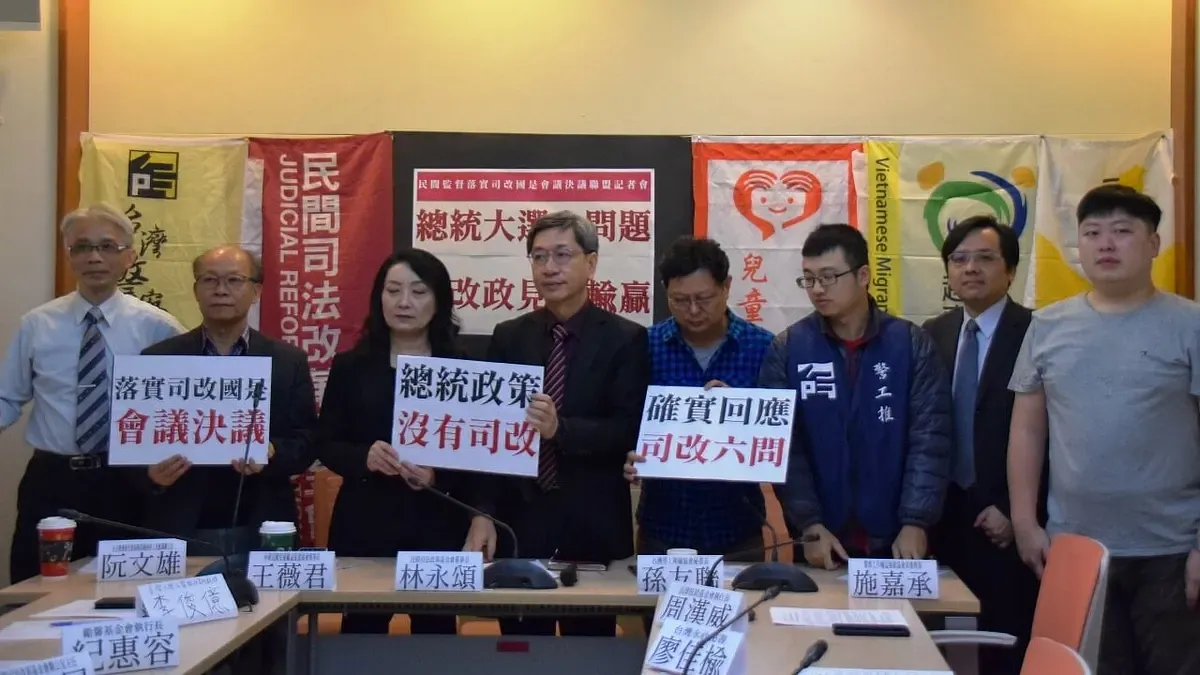
The Alliance for Monitoring the Implementation of Judicial Reform National Consultative Conference Resolutions held a press conference titled "Six Questions on the Presidential Election, Judicial Reform Policy Platforms Will Decide the Outcome" at Room 103, Chung-Hsing Building, Legislative Yuan, at 10:00 a.m. today (Dec. 18). It publicly raised questions to presidential candidates regarding judicial reform policies, calling on presidential and vice-presidential candidates to publicly respond to the Alliance's questions during policy presentation events, debates, or other appropriate occasions, thereby providing the public with a basis to examine their judicial reform platforms.
With less than a month to go before the 2020 presidential election, the presidential candidates of various political parties have rolled out numerous policies as part of their campaigns. However, regarding judicial reform, none of the candidates have put forward concrete and feasible content, causing long-standing public concern over judicial reform issues to be overlooked by the candidates. Ever since the Judicial Reform National Consultative Conference concluded in 2017, many reforms remain unfinished. Judging from the current attitudes of the presidential candidates toward judicial reform, the direction of judicial reform over the next four years still seems uncertain and divided.
In addition to the Central Election Commission announcing the schedules for three presidential candidate policy presentation events and one vice-presidential candidate policy presentation event, Public Television Service has also obtained consent forms from the three presidential candidates to participate in televised debates. Therefore, the Alliance officially released its questions to the presidential candidates today, calling on them to respond to the Alliance's inquiries during the presidential candidate policy presentation on December 18, the vice-presidential candidate policy presentation on December 20, televised debates, or other appropriate occasions. The Alliance's questions are as follows:
- Most of the resolutions from the Judicial Reform National Consultative Conference have yet to be implemented. How do the presidential candidates plan to promote the implementation of these resolutions?
- The Judicial Reform National Consultative Conference invited a majority of non-legal professionals from civil society to participate, yet the implementation of its resolutions has been entirely entrusted to the bureaucratic system, which has been conservative, passive, and ineffective. Do the presidential candidates agree to establish a standing supervisory body with a majority of civil society members and non-legal professionals to participate in the implementation of the Judicial Reform National Consultative Conference resolutions?
- Judicial reform requires the Legislative Yuan to efficiently pass judicial reform bills and the Executive Yuan to actively promote judicial reform policies. How do the presidential candidates plan to coordinate the Legislative Yuan and the Executive Yuan to actively and efficiently implement the resolutions of the Judicial Reform National Consultative Conference?
- The public in our country generally distrusts the judiciary. How do the presidential candidates plan to enhance public trust in the judiciary?
- Our country's judicial caseload is heavy, and judicial quality is somewhat lacking. How do the presidential candidates plan to reduce the judicial caseload and enhance judicial quality?
- Public participation in trials has received high public support, but the debate between lay assessor systems and lay participation systems has yet to be legislated, lagging far behind neighboring Japan and South Korea. How do the presidential candidates plan to accelerate the promotion of a system for public participation in trials?
The Alliance's specific explanations and recommendations regarding the questions are as follows:
-
In addition to convening the Judicial Reform National Consultative Conference, the President should formulate policies to implement its resolutions
Following the adoption of resolutions at the Judicial Reform National Consultative Conference on August 12, 2017, the execution of these resolutions was delegated to various agencies, and the President's role gradually faded. However, most resolutions of the Judicial Reform National Consultative Conference require joint deliberation across judicial and executive agencies, along with preparatory procedures such as inviting experts and scholars for discussion and research. These procedures often take time—several months or even half a year—and when combined with subsequent proposal drafting, legislative steps, and various other factors, the progress of implementing resolutions has been slow. Looking at the implementation of judicial reform resolutions over the past two years, we have witnessed only a massive backlog of resolutions with slow or even stalled progress; many resolutions remain stuck in the stage of holding seminars and conducting research with no follow-up, leaving it unclear when these resolutions will ever be realized.
The Alliance believes that the President still plays an indispensable role in the implementation of the Judicial Reform National Consultative Conference resolutions. The President should establish a complete and reasonable implementation plan, rigorous schedule planning, and ensure its execution so that resolutions can be implemented within the projected timeframe. If the implementation progress of various resolution items remains sluggish or stagnant, policies will easily fail to continue over time due to government personnel changes or elections, making the realization of resolutions indefinitely remote. Therefore, the Alliance calls on the presidential candidates to explain how they will promote the implementation of the Judicial Reform National Consultative Conference resolutions.
-
A standing supervisory body should be established under the Office of the President, with a majority of members coming from civil society and non-legal backgrounds
During the 2017 Judicial Reform National Consultative Conference, most resolutions required joint deliberation across judicial and executive agencies, often consuming significant time in coordination and communication, and sometimes leading to difficulties in implementation due to differing opinions among agencies. Reviewing the implementation of the Judicial Reform National Consultative Conference resolutions over the past two years, we have seen massive progress that is slow or even stagnant, with many resolutions lingering in seminar or research phases without further action. Therefore, a dedicated agency responsible for integrating the various branches and ministries of government and establishing a rigorous schedule for the items mentioned in the resolutions is necessary to genuinely implement the judicial reform resolutions.
Although official and civil communication platforms currently exist, the aforementioned problems still urgently require resolution. Consequently, the Alliance calls for the establishment of a standing body under the Office of the President, which is truly essential for overseeing the implementation of the Judicial Reform National Consultative Conference resolutions. This body would ensure the timelines for various resolutions and handle overall planning, coordination, and supervision; otherwise, the realization of these resolutions will be difficult to sustain. Furthermore, to ensure this standing body meets public expectations, its membership should consist of a majority of civil society members and non-legal professionals to avoid excessive bureaucracy. The Alliance also asks presidential candidates to state whether they agree with the Alliance's proposal.
-
When the Executive Yuan and the Legislative Yuan promote judicial reform policies and bills, presidential coordination is needed to enhance the efficiency of resolution implementation
Under the current approach where the Executive Yuan primarily drives judicial reform policies, momentum for reform is often insufficient because the Executive Yuan itself is the subject of reform. Although various ministries under the Executive Yuan have successively promoted related measures, at the level of the Executive Yuan, judicial reform issues have never truly been the focal point of governance. Consequently, the lack of external forces driving reform has rendered it passive and inefficient. Moreover, when judicial reform issues require legislative amendments, bills struggle to gain cross-party consensus and public support in the Legislative Yuan, severely limiting the number of bills successfully passed.
The Alliance believes that the President should act as the primary helmsman of the Judicial Reform National Consultative Conference. When the implementation of conference resolutions is slow or stagnant, the President should proactively assume the role of coordination and supervision—especially if the President fails to secure a majority of seats in the Legislative Yuan over the next four years, making support from opposition parties a prerequisite for passing bills, thereby rendering the President's role all the more self-evident. Therefore, the Alliance also asks the presidential candidates to explain how they will coordinate the Legislative Yuan and the Executive Yuan to actively and efficiently implement the resolutions of the Judicial Reform National Consultative Conference.
-
The President should strive to enhance public trust in the judiciary
Judicial reform has always been valued by the public. Whether looking at official or civilian polls, public trust in the judiciary remains depressed. The Alliance has found that the judicial reform eagerly anticipated by the public has not received due attention in the policy platforms of the presidential candidates. The Alliance believes that the current progress of judicial reform falls short of expectations, and hopes that regardless of who wins the next presidential election, the incoming administration must value public expectations for judicial reform, promptly adjust policy directions and pacing, continue pursuing judicial reform, and protect vulnerable groups to fulfill the goals of the Judicial Reform National Consultative Conference.
In addition, the Alliance believes that overly dense, incomprehensible, and lengthy judicial judgments, when presented via one-sided media reports that project a negative image of the judiciary, only serve to widen the psychological distance between the public and the judiciary. Therefore, it is hoped that the government will incorporate public voices when implementing resolutions, accelerate the pace of reform, make the judiciary more approachable, and strengthen the dissemination and education of accurate information. This will elevate the visibility of judicial reform, deepen public understanding of its impact, and make judicial reform tangible to the people. Accordingly, the Alliance also asks the presidential candidates about concrete measures to enhance judicial trust.
-
The President should conduct more comprehensive planning and adjustments to enhance judicial quality by alleviating the burdens on judicial personnel
With the volume of judicial cases increasing day by day, the burdens borne by judicial police officers, prosecutors, judges, and other personnel within the judicial system have grown increasingly heavy. The Alliance believes that demanding higher judicial quality while judicial personnel are overburdened is tantamount to climbing a tree in search of fish.
The Alliance contends that alleviating the burden on judicial personnel is not merely a matter of increasing manpower and funding, but requires institutional reforms. For example, the principle of single-copy indictment mentioned in the resolutions of the Judicial Reform National Consultative Conference can substantially lessen the burden on judges, enabling them to focus on the evidence and adversarial arguments presented in court, thereby improving the quality of adjudication. As President, one should possess a broader vision than judicial personnel to undertake more comprehensive planning and adjustments. The Alliance also requests the presidential candidates to answer questions regarding how to reduce the judicial caseload and enhance judicial quality.
-
Public participation in trials is the most tangible judicial reform issue, and the President should adopt a higher perspective to transcend the debate between lay assessor and lay participation systems
Public participation in trials has always been a consensus shared by both the ruling/opposition parties and civil society, as well as the judicial issue of greatest concern to the public. However, from past drafts of the lay observation system to current drafts of the citizen judge system, none have been able to gain widespread support. The Alliance believes that even though there is a high degree of consensus on public participation in trials, the lack of sufficient coordination and communication prior to abruptly adopting a specific system is the main reason behind the strong backlash that prevents the system from being implemented.
Therefore, the Alliance sincerely calls on the President, while advancing the direction of public participation in trials, to adopt a higher perspective, seek common ground while preserving differences amidst the debate over lay assessor and lay participation systems, forge the broadest possible consensus, and propose concrete coordination and communication strategies to accelerate the advancement of the public participation in trials system. Presidential candidates truly owe an answer on the issue of public participation in trials, which is the most tangible judicial reform issue for the public.
Overall, while the Alliance affirms some of the Judicial Reform National Consultative Conference resolutions that have already been implemented, it still considers the pace of reform to be overly sluggish. The Alliance hopes that at this critical juncture of the presidential election, judicial reform issues should not be discarded. The Alliance sincerely calls on all presidential candidates to put forward judicial reform platforms and respond to the Alliance's inquiries to fulfill the goals of judicial reform, while also hoping that regardless of who is elected as the next president, judicial reform will continue steadily forward.
Attending Representatives
Wang Wei-chun / Chairperson, Republic of China Association for Rights of Children
Lin Yung-sung / Chairperson, Judicial Reform Foundation
Juyen Van Hung / Hsinchu Catholic Diocese Vietnam Migrant Workers and Immigrants Office
Li Chun-yi / Professor, Graduate Institute of Forensic Medicine, National Taiwan University
Chou Han-wei / Executive Director, Legal Aid Foundation
Shih Chia-cheng / Standing Director, Police Working Rights Advocacy Association
Chi Hui-jung / Executive Director, The Garden of Hope Foundation
Sun Yu-lien / Secretary-General, Taiwan Labour Front
Lo Shih-hsiang / Executive Director, Taiwan Association for Innocence
Liao Chia-yu / Secretary, Taiwan Association for Human Rights (Association for Universal Promotion of Human Rights)
Hsiao I-min / Office Director, Judicial Reform Foundation
Press Contact
Judicial Reform Foundation / Director Hsiao I-min
This article is an AI-generated translation of the original Chinese text. In the event of any discrepancy, the Chinese version shall prevail.