
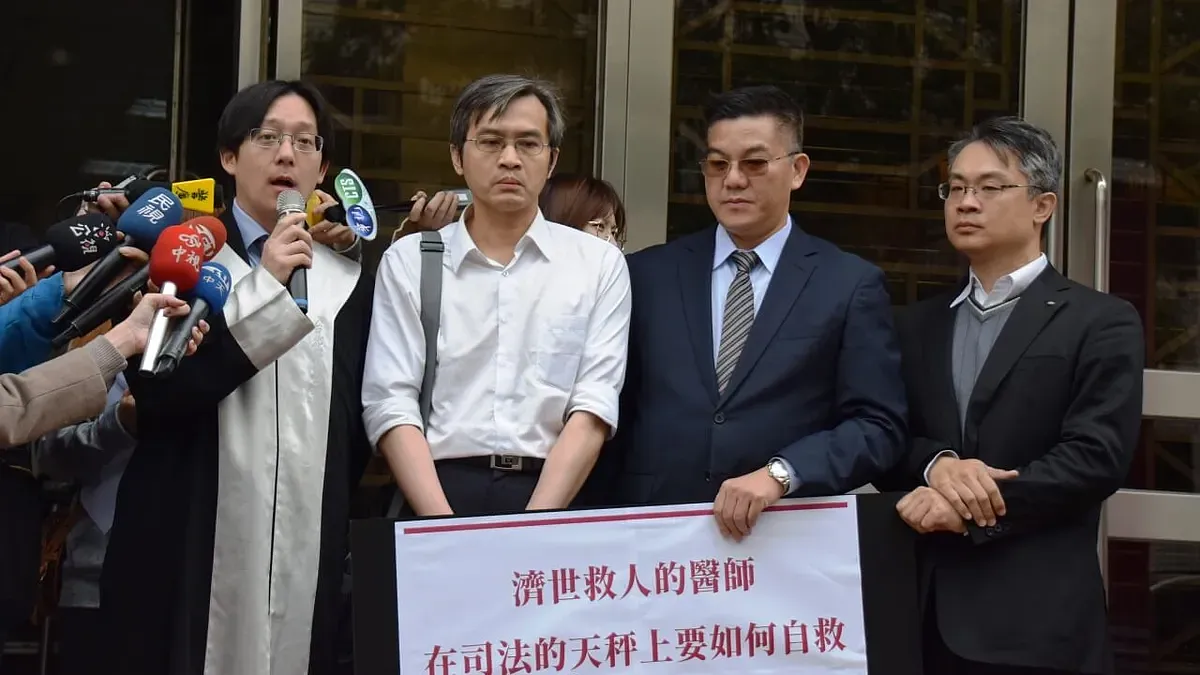
How a Physician Saving Lives Can Save Themselves on the Scales of Justice: Press Conference on the Retrial Verdict of Dr. Huang Hui-fu's Case of Professional Negligence Resulting in Severe Injury
Last edited: 2026-11-03
Today (Dec 19), the Criminal Division of the Taiwan High Court delivered its retrial verdict in the medical dispute case concerning Dr. Huang Hui-fu. Dr. Huang is an attending physician in the Department of Surgery at National Taiwan University Hospital, specializing in trauma, burn care, and microsurgery, and performed emergency surgeries for over 20 patients during the Formosa Fun Coast dust explosion incident.
In 2008, Dr. Huang performed a fasciotomy on an emergency patient who suffered severe swelling in the right lower leg due to a traffic accident, resulting in compartment syndrome. On the fifth day post-surgery, the patient voluntarily transferred to another hospital, and later suffered an amputation due to a right knee dislocation that compressed the popliteal artery. Consequently, the patient's family filed a lawsuit against Dr. Huang. The prosecutor indicted him for professional negligence resulting in severe injury. While the court of first instance found Dr. Huang not guilty, determining there was no medical negligence, the court of second instance inferred that the dislocation had occurred prior to the transfer. It convicted him of professional negligence resulting in severe injury, sentencing him to four months' imprisonment, on the grounds that Dr. Huang only visited the ward the day after the surgery and that postoperative care records failed to reflect peripheral blood circulation status, which violated medical practice standards.
Due to the restrictions under Article 376 of the Code of Criminal Procedure at the time, petty offenses carrying a maximum principal punishment of three years' imprisonment or less could not be appealed to the third-instance court, causing the verdict to become final. Although Judicial Yuan Interpretation No. 752 subsequently declared that restricting appeals to the third instance in cases where the first instance is an acquittal and the second instance is a conviction is unconstitutional and should immediately cease to be effective, and the Legislative Yuan amended the law accordingly, only cases arising after the amendment could be appealed to the third instance. Cases finalized before the amendment, such as Dr. Huang's, remained without a remedy.
Later, through the efforts of the pro bono defense counsel team, three medical evaluations from National Taiwan University Hospital, Tri-Service General Hospital, and Taipei Veterans General Hospital were submitted as new evidence, finally leading to the opening of a retrial in 2018. During oral arguments, the defense team meticulously organized the chronology of events and re-examined the evaluation opinions of the Review Committee of Medical Deliberation cited in the original judgment, further affirming two key points:
-
The fasciotomy itself was successful: Compartment syndrome is common in traffic accidents. The surgery requires cutting an incision of about 20 centimeters in the affected area to allow blood and fluid to drain. Without early treatment, the mortality rate is as high as 40%. Dr. Huang's surgery successfully saved the patient's life.
-
The patient received good care post-surgery: According to the postoperative nursing records—"peripheral blood circulation acceptable" and "wounds slightly oozing pinkish fluid"—as well as the observations after the patient's transfer—"skin temperature warm, skin color pink, wound skin integrity"—it was clearly demonstrated that during the postoperative period, the patient's blood circulation was favorable and Dr. Huang committed no professional negligence.
Regarding the verdict, the defense team expressed affirmation and thanked the judges for their dedicated review, re-examining the aspects of the incident, referring to the professional opinions of the medical evaluations, clarifying the course of events, and restoring Dr. Huang's innocence. Although the retrial court used its judgment to deliver belated justice to Dr. Huang, what cannot be returned are the lost opportunities and time. How much extra mental effort does a surgeon have to spend enduring litigation during the golden decade of their career, racking their brains and exhausting every effort to prove their innocence, and how many opportunities for international medical exchange have they lost due to a criminal record that should never have been theirs? These invisible grievances cannot be undone by a verdict. We hope that in the future, courts handling similar medical disputes will more carefully weigh evidentiary evaluations and medical facts. After all, saving lives is a physician's vocational calling; no physician is willing to harm their patients. The hospital is where physicians should strive to excel, not the courtroom.
Attendees
Wrongful Conviction Defendant
Dr. Huang Hui-fu
Pro Bono Defense Team
Attorney Huang Ming-chan
Attorney Chan I-hao
Attorney Cheng Kai-hung
Press Contact
Judicial Reform Foundation / Specialist Tsai Shang-yu
This article is an AI-generated translation of the original Chinese text. In the event of any discrepancy, the Chinese version shall prevail.