
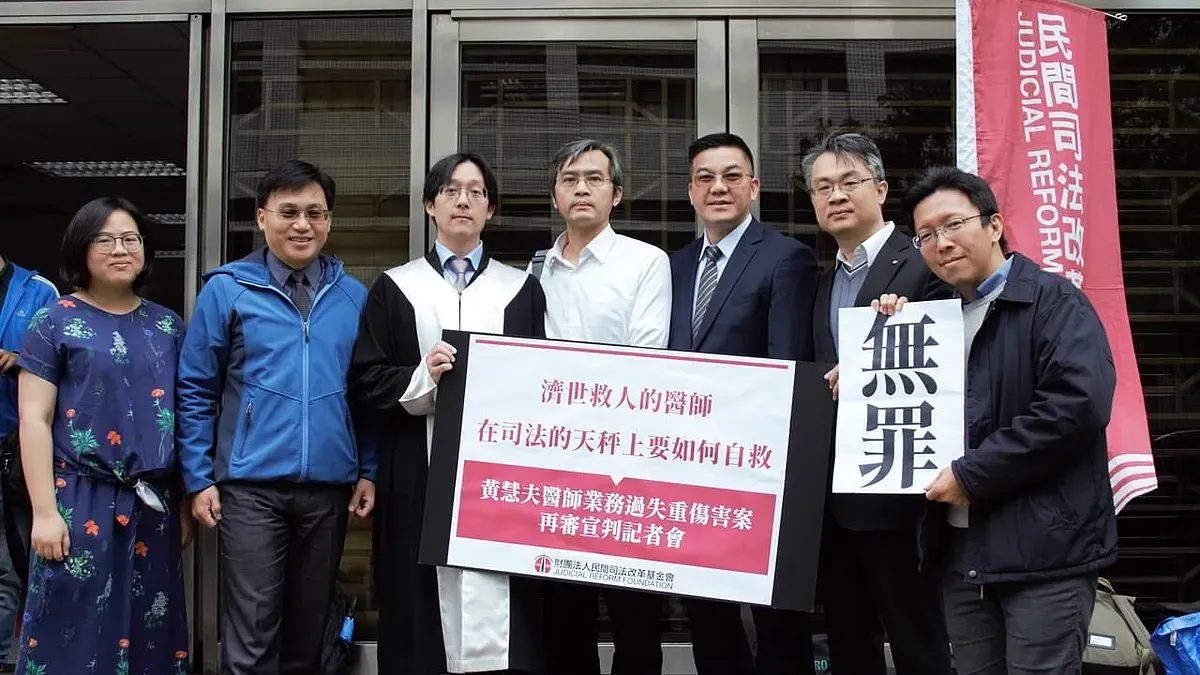
Huang Hui-fu: Cleansing the Judicial Stain on the Physician's White Coat
Last edited: 2026-07-27
Yesterday morning, the Taiwan High Court delivered its retrial verdict, dismissing the original first-instance prosecutor's appeal and ruling me not guilty with finality. This is the first case in a medical lawsuit where a retrial was initiated and a physician was acquitted (107th-Year Zai-Tzu No. 7). I am grateful to Judges Pan Ts'u-hsueh, Lin Keng-tung, and Ch'en Yü-t'ing for their fair trial, as well as to Attorneys Huang Ming-chan, Cheng K'ai-hung, Chan I-hao, and the Judicial Reform Foundation for their persistent rescue efforts. I sincerely hope that my case will awaken the judiciary to reflect on whether its current mindset for adjudicating medical lawsuits should be reconstructed.
Medicine is a highly specialized science. Confronted with the complex human anatomy, one must carefully observe any signs to fathom the mysteries of the human body. All medical diagnosis and treatment protocols must be supported by sufficient evidence and cannot be based on mere speculation. A physician's job is to save lives, heal the wounded, and help patients recover their health. When adjudicating medical lawsuits, judges should not presume that a physician intentionally harmed a patient or committed medical negligence unless there is evidence proving the physician's malicious intent or gross negligence.
The Crucial Attitude of Judges in Adjudicating Cases
After three years of thorough deliberation at the New Taipei District Court, the first-instance judge ruled me not guilty. After the prosecutor appealed to the Taiwan High Court, the second-instance court failed to investigate any new evidence; after a perfunctory hearing held merely twice, it altered the judgment and sentenced me to four months of imprisonment on the grounds that I had "negligently failed to observe whether the peripheral blood circulation of the patient's affected limb was good after fasciotomy...", causing me to suffer wrongful accusations as an innocent person.
It was not until the retrial collegial panel investigated newly issued appraisal reports from three medical centers, and carefully reviewed photographs of the wound taken during successive dressing changes after surgery as well as before and after the hospital transfer, that it concluded: "The blood circulation in the patient's right lower limb remained good after surgery, and no necrosis of the right lower limb muscle tissue occurred during hospitalization at this hospital. It is difficult to deem that the defendant had failed to fulfill his duty of care in diagnosis and treatment." This returned my innocence. In truth, there has only ever been one truth; the crux lies in whether judges can genuinely deliberate cases and discern the finest details.
Cultivating a plastic surgeon is exceptionally difficult. It requires seven years of medical school training, six years of plastic surgery specialization training, and, for males, mandatory military service. One can only stand independently in the operating room at the age of 33 to 35. Furthermore, the peak career of a plastic surgeon performing surgeries is only about 10 years. Between the ages of 45 and 48, as eyesight and physical stamina decline, they gradually find themselves struggling with the delicate suturing of nerves and small blood vessels under a microscope, eventually either stepping back to take on partial roles within the surgical team or exiting the operating room entirely. This illustrates how scarce and precious human resources in surgical medicine are.
This medical lawsuit occurred when I was 34 years old. This year, I am already 46. The 12 years of entangled litigation have occupied the vast majority of my career as a plastic surgeon. Even though the judiciary has now acquitted me, it cannot undo the damage inflicted upon my medical career, and patients who could have otherwise received treatment lost their medical opportunities as a result, vainly wasting precious surgical human resources.
Leading to an Increase in Defensive Medicine
When the judiciary inappropriately imposes criminal punishment on physicians who save lives, it also leads to defensive medicine—that is, medical practices where a physician's diagnosis or treatment is driven not by the patient's best interests, but by the desire to avoid being blamed or even sued by the patient. In recent years, the public health costs wasted on defensive medicine have continuously escalated. There is no greater harm than that caused by judicial miscarriages of justice.
"Superior doctors treat the nation; intermediate doctors treat people; inferior doctors treat illnesses." Judicial judgments serve as the standard and compass for society and the country, and a judge's impartiality is akin to the character of a superior doctor. When facing medical miscarriages of justice, does the judiciary possess the courage to review and improve? Does the judiciary have the ability and patience to rectify erroneous appraisal reports and witness testimonies? Only when the judiciary reflects deeply and implements reforms can it reverse the current lose-lose-lose dilemma caused by defensive medicine for medical staff, patients, and society.
Constructing a Mindset for Adjudicating Medical Cases
I am very fortunate to be the first physician whose injustice was vindicated through a retrial. However, in the past, I surely was not the only physician to suffer from judicial miscarriages of justice, and at present, many physicians remain deeply mired in unjust medical lawsuits. These physicians still need everyone's continuous concern. I sincerely urge the legal community to listen to the voices of the medical community, reconstruct the mindset for adjudicating medical lawsuits, and thoroughly cleanse the judicial stain inappropriately smeared onto the physician's white coat.
※ This article was published in the Apple Daily on Dec. 20, 2019
This article is an AI-generated translation of the original Chinese text. In the event of any discrepancy, the Chinese version shall prevail.