
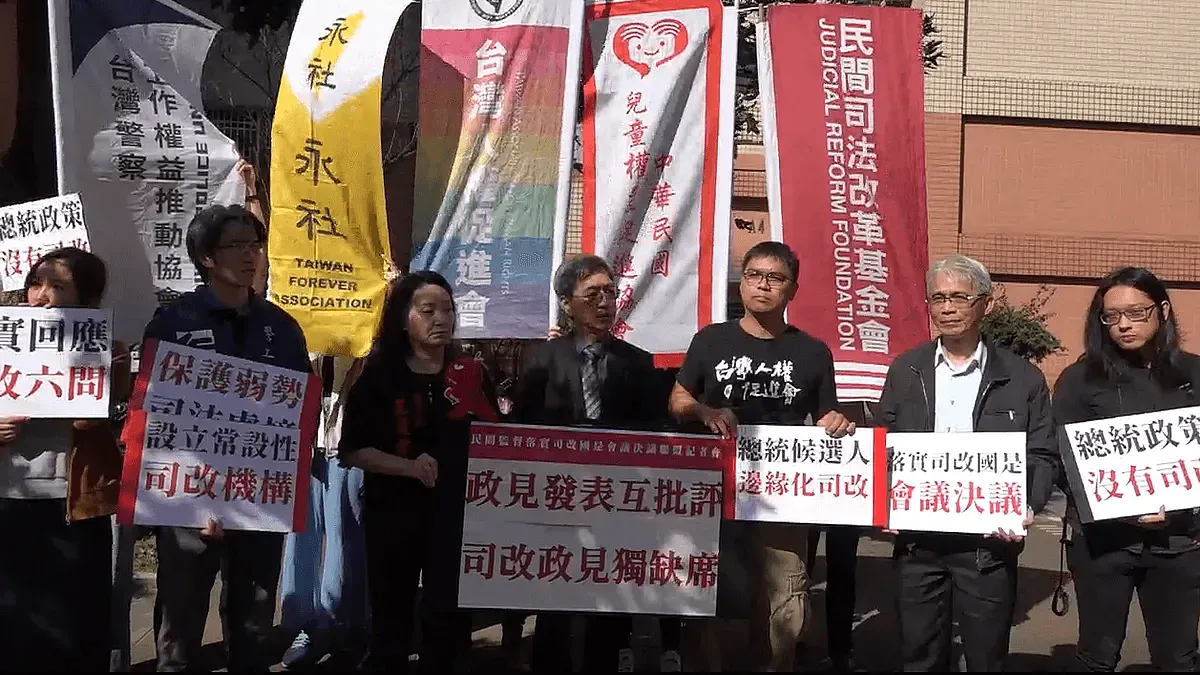
Mutual Criticism in Policy Presentations, Complete Absence of Judicial Reform Policies—Press Conference by the Alliance for Civil Supervision of the Implementation of Judicial Reform National Sun-Conference Resolutions
Last edited: 2026-07-27
This afternoon (December 25) at 12:30 PM, the Alliance for Civil Supervision of the Implementation of Judicial Reform National Sun-Conference Resolutions held a press conference titled "Mutual Criticism in Policy Presentations, Complete Absence of Judicial Reform Policies" outside the China Television Company. While President Tsai Ing-wen responded to the judicial reform issues raised by the Alliance yesterday afternoon, the Alliance calls upon Mayor Han Kuo-yu and Chairman James Soong to also respond to the Alliance's questions. Furthermore, the Alliance urges all three presidential candidates to clearly present judicial reform policies subject to public scrutiny during this afternoon's policy presentation at 2:00 PM, the one on December 27, and the debate on December 29.
On December 18 at 10:00 AM, the Alliance held a press conference titled "Six Questions for the Presidential Election, Judicial Reform Policies Determine Victory or Defeat," publicly posing six questions on judicial reform policy to the presidential candidates. The Alliance called upon the presidential and vice-presidential candidates to publicly respond to these questions during policy presentations, debates, or other appropriate occasions to provide the public with a means to evaluate their judicial reform platforms. However, a week has passed, and the Alliance has only received a response from President Tsai Ing-wen yesterday afternoon, with no word from the other two presidential candidates. Therefore, the Alliance is holding a press conference today right outside the main entrance of China Television, where the second presidential candidate policy presentation is about to be held, in the hope that all candidates will squarely face the Alliance's demands.
Reviewing the first presidential candidate policy presentation on December 18, it consisted largely of mutual criticisms among candidates rather than making full use of the time to present comprehensive and concrete policies. Whether it was the opposition party criticizing the ruling party for poor governance or the ruling party striking back by emphasizing its governing achievements, neither side made judicial reform issues the focus of discussion. Moreover, when candidates elaborated on their policies within the limited time, their topics spanned the economy and people's livelihood, national defense and diplomacy, internal affairs and education, and health and environment—yet judicial reform was conspicuously missing. Even when judicial reform was mentioned, it was narrowed down to preventing corruption rather than receiving comprehensive planning. On December 20, the vice-presidential candidates did not utter a single word about judicial reform policies. Clearly, judicial reform has been marginalized in this election.
Judicial reform is an issue of long-standing public concern. However, in the two policy presentations, it was evidently not valued by the presidential candidates. Since the National Sun-Conference on Judicial Reform concluded in 2017, numerous reforms remain unfulfilled. The future direction of judicial reform over the next four years still seems vague and disputed.
Therefore, the Alliance reiterates its six questions today, calling upon the presidential candidates to acknowledge the public's need for and emphasis on judicial reform, and to officially answer the judicial reform questions raised by the Alliance. The six questions are as follows:
- Most of the resolutions from the National Sun-Conference on Judicial Reform have yet to be implemented. How do the presidential candidates intend to promote the implementation of these resolutions?
- The National Sun-Conference on Judicial Reform invited a majority of non-legal professionals from civil society to participate, yet the implementation of its resolutions has been entirely entrusted to the bureaucratic system, whose conservative and passive approach has yielded poor results. Do the presidential candidates agree to establish a permanent supervisory body consisting of a majority of civil society members and non-legal professionals to participate in the implementation of the National Sun-Conference resolutions?
- Judicial reform requires the Legislative Yuan to efficiently pass judicial reform bills and the Executive Yuan to actively promote judicial reform policies. How do the presidential candidates plan to coordinate the Legislative Yuan and the Executive Yuan to efficiently and effectively implement the resolutions of the National Sun-Conference on Judicial Reform?
- The public in our country generally distrusts the judiciary. How do the presidential candidates plan to enhance public trust in the judiciary?
- Our judicial system carries a heavy caseload, and judicial quality is subpar in certain respects. How do the presidential candidates intend to reduce the judicial caseload and enhance judicial quality?
- Public participation in trials enjoys high public support, but the debate between lay assessor systems and jury systems has yet to be legislated, lagging far behind neighboring Japan and South Korea. How do the presidential candidates plan to accelerate the promotion of a system for public participation in trials?
For President Tsai Ing-wen's response to these six questions, please refer to the appendix. The Alliance's remarks on President Tsai Ing-wen's response are as follows:
-
Affirming President Tsai's campaign platform to continue promoting judicial reform, and expecting President Tsai to fulfill her commitments
President Tsai mentioned in her response: "Reviewing and evaluating the reasons for uncompleted resolution items." "(Judicial reform) continuous promotion and implementation allows quantitative change to generate qualitative change, aiming to give the judiciary a complete overhaul and win public trust." The Alliance affirms President Tsai's willingness to review, continue promoting, and implement the uncompleted items from the National Sun-Conference on Judicial Reform.
The Alliance emphasizes that the president still plays an indispensable role in the implementation of the National Sun-Conference resolutions. Particularly over the two-plus years since the resolutions were made, the reasons for the slow progress—which have prevented the enhancement of public trust in the judiciary—truly require review and joint discussion with civil society organizations to identify the core problems and solutions. The Alliance believes that the president should have a complete and reasonable implementation plan, rigorous schedule planning, and ensure its execution so that resolutions can be implemented within the projected timeframe. We expect that if President Tsai successfully wins re-election, she will faithfully fulfill her current commitments.
-
Recommending that President Tsai actively coordinate relevant agencies to strengthen the efficiency of promoting judicial reform policies
President Tsai mentioned in her response: "In the future, aside from the existing cross-agency judicial reform coordination mechanism, I will instruct the Executive Yuan to communicate more actively with the Legislative Yuan regarding the progress of bills, and will actively utilize various communication platforms to urge and coordinate various agencies to jointly promote judicial reform." The Alliance expresses regret that President Tsai could not commit to establishing a permanent supervisory body under the Office of the President, but would welcome it if the president can more actively conduct inter-agency coordination.
The Alliance finds that the current practice of having the Executive Yuan take the lead in promoting judicial reform policies often lacks reform momentum precisely because the Executive Yuan itself is the subject of reform. Although various ministries under the Executive Yuan have successively promoted related measures, at the level of the Executive Yuan, judicial reform issues have never truly been the focus of governmental attention. Consequently, the lack of external pressure results in reform appearing passive and inefficient. Furthermore, when judicial reform issues require legislative amendments, bills struggle to gain cross-party consensus in the Legislative Yuan and public support, severely limiting the number of laws successfully passed.
The Alliance believes that the president should act as the primary helmsman of judicial reform, taking the initiative to play a coordinating and supervisory role. Especially if the president's political party fails to secure a majority of seats in the Legislative Yuan over the next four years—meaning bills must gain the support of opposition parties to pass—the importance of the role played by the president becomes self-evident.
-
Calling upon President Tsai to strengthen dialogue with civil society and listen to the public's calls for judicial reform
President Tsai mentioned in her response: "Strengthening communication and dialogue mechanisms with civil society." "How to be more grounded and make the public feel the impact inevitably requires investing more reform energy and social communication." The Alliance affirms the strengthening of communication and dialogue mechanisms with civil society, and further hopes that beyond dialogue, the administration will truly listen to the public's aspirations for judicial reform.
The Alliance points out that judicial reform has always been valued by the public, but both official and private polls show that public trust in the judiciary remains low. The Alliance believes that at the current stage, the progress of judicial reform falls short of expectations. Regardless of who wins the next presidency, the administration must value public expectations for judicial reform, listen to the public's calls for judicial reform, continue advancing judicial reform, and protect the disadvantaged in order to fulfill the goals of the National Sun-Conference on Judicial Reform.
Overall, while the Alliance affirms some of the already implemented resolutions of the National Sun-Conference on Judicial Reform, it still considers the pace of reform to be too slow. The Alliance hopes that at this critical juncture of the presidential election, judicial reform issues should not be discarded. The Alliance sincerely calls upon all presidential candidates to put forward judicial reform policies and respond to the Alliance's questions in order to fulfill the goals of judicial reform, while also hoping that whoever wins the next presidency, judicial reform will continue uninterrupted.
Appendix
- President Tsai Ing-wen's Response to the Publicly Posed Questions on Judicial Reform Policy by the Alliance for Civil Supervision of the Implementation of Judicial Reform National Sun-Conference Resolutions
- Verbatim transcript of the policy presentation on December 25, where President Tsai Ing-wen publicly responded in the third round to some of the questions raised by the Alliance and clearly explained her judicial reform policies
Attending Representatives
Lin Yung-sung / Chairperson, Judicial Reform Foundation
Wang Wei-chun / Chairperson, ROC Association for Child Rights Promotion
Li Chun-yi / Professor, Graduate Institute of Forensic Medicine, National Taiwan University
Shih Yi-hsiang / Deputy Secretary-General, Taiwan Association for Human Rights
Peng Chih-cheng / Secretary, Taiwan Association for Human Rights (Yung-She)
Kuo Li-hsuan / Standing Supervisor, Police Labor Rights Promotion Association
Hsiao Yi-min / Office Director, Judicial Reform Foundation
Press Contact
Judicial Reform Foundation / Director Hsiao Yi-min (02)2523-1178#25
This article is an AI-generated translation of the original Chinese text. In the event of any discrepancy, the Chinese version shall prevail.