
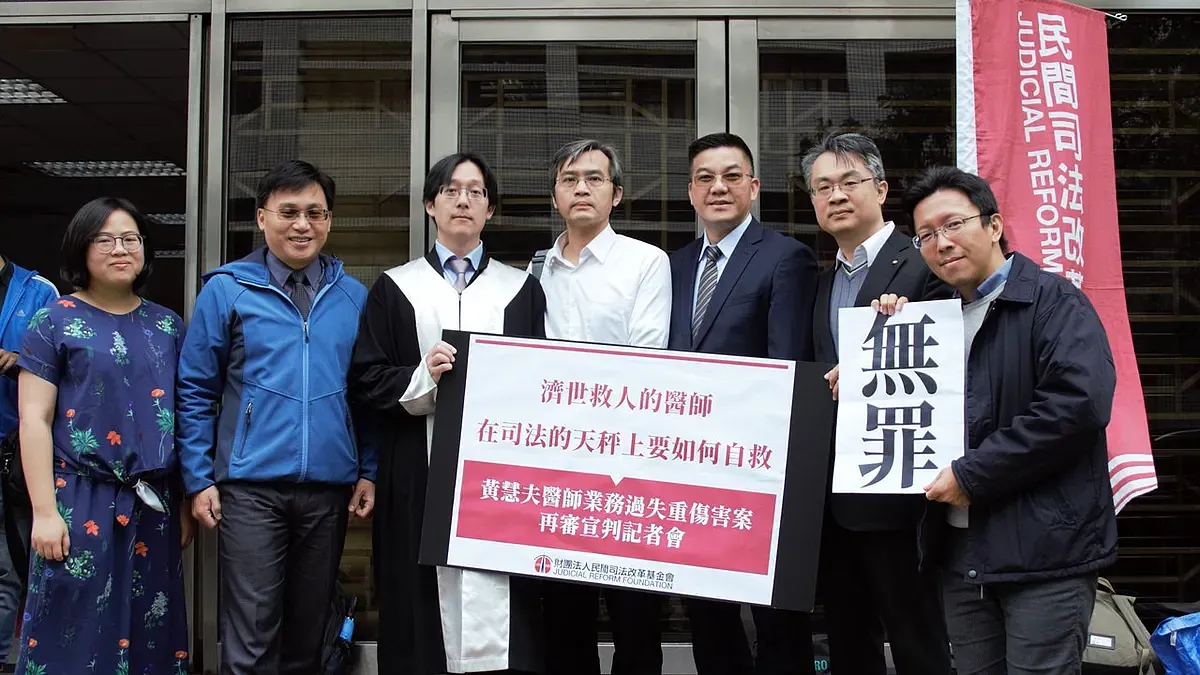
Expert Witness Cross-Examination: Never Another Huang Hui-fu
Last edited: 2026-07-27
The year 2014 was unforgettable for Dr. Huang Hui-fu. After a four-year trial, the district court finally acquitted him in his medical dispute case. However, in that same year, the high court spent seven months overturning the district court's judgment, finding Dr. Huang guilty. Because the case could not be appealed to the Supreme Court, the conviction became final that year.
During that year, which shifted from acquittal to conviction, no new evidence actually appeared. In other words, based on the exact same set of evidence, the district court found Dr. Huang Hui-fu innocent, while the high court found him guilty.
Dr. Huang Hui-fu's case involved highly specialized medical disputes. Because the vast majority of judges, prosecutors, and attorneys lack a professional medical background, cases of this nature rely heavily on other medical experts to provide necessary professional information to the judges, prosecutors, and defense counsel in court, equipping them with the conditions and capability to make determinations. In Dr. Huang's case, expert evaluation reports issued by other medical professionals indeed existed.
However, an evaluation report is ultimately a transmission of specialized information—often involving cross-disciplinary information translation. Therefore, achieving full mutual understanding and awareness between the information receiver and the information provider is quite challenging.
Taking Dr. Huang Hui-fu's case as an example, the language used in the medical evaluation report came from medical experts, whose terminology and phrasing differ from those of legal professionals; their meanings cannot be easily grasped merely by reading the text. Therefore, to truly understand the contents of the evaluation report, relying solely on written text is insufficient. More importantly, through direct dialogue with experts and thorough communication, both sides can genuinely understand each other's true intent, ensuring that the experts truly grasp what the judges, prosecutors, and defense want to know, and that the judges, prosecutors, and defense understand what the experts are saying. Such courtroom dialogue is precisely cross-examination.
During the district court proceedings of Dr. Huang Hui-fu's case, considerable time was spent engaging in dialogue with multiple medical experts, naturally accumulating a wealth of materials. Unfortunately, by the second instance, although the high court held doubts regarding the district court's findings, it appeared to rely solely on its own interpretation of the text to reach a drastically different conclusion, failing to consider that making determinations on highly specialized medical practices based solely on legal expertise or trial experience is extremely dangerous for fact-finding.
Everyone's lived experience is limited. Applying limited lived experience to all matters to make decisions or judgments very easily leads to errors. Although the judicial system is designed to require judges to adjudicate all cases using their limited lived experience, it also provides procedural weapons and tools—such as summoning witnesses, expert evaluations, and cross-examination—to overcome the inherent obstacles of everyone's limited lived experience. Without a genuine recognition of one's limitations, an open-minded approach to carefully considering the diverse life journeys of others and the lived experience they have accumulated, and a self-righteous attitude in judging everything, Dr. Huang Hui-fu's unfortunate experience could easily repeat itself.
※ This article was published in 2019.12.31 ETtoday
This article is an AI-generated translation of the original Chinese text. In the event of any discrepancy, the Chinese version shall prevail.