
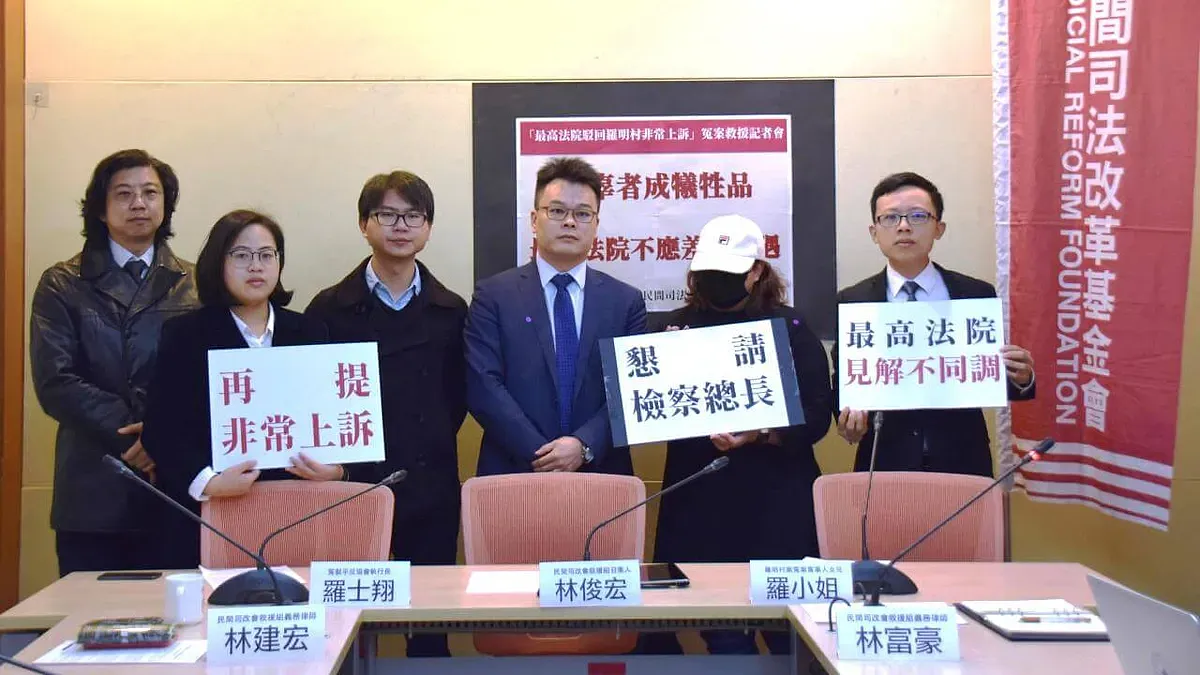
Innocent Persons Become Victims, the Supreme Court Must Not Apply Double Standards! Press Conference on the Wrongful Conviction Rescue of Lo Ming-ts'un
Last edited: 2026-07-27
Preceding Hsinchuang Precinct Criminal Investigation Division Head Lo Ming-ts'un was accused of accepting bribes in violation of his official duties around 1997. Although initially convicted by the court, after the Supreme Court revoked the judgment and remanded the case, the Taiwan High Court's first retrial division changed Lo Ming-ts'un's verdict to "not guilty" in 2002. Just as Lo Ming-ts'un believed the judiciary had finally vindicated him, the prosecutor filed an "appeal past the statutory deadline." Failing to recognize this, the Supreme Court revoked the not-guilty verdict and remanded the case once again, ultimately leading to Lo Ming-ts'un being unjustly sentenced by the court to 13 years in prison.
Procedural Errors Are One of the Straws That Break the Camel's Back in Wrongful Convictions
This case involves issues such as improper interrogation and flawed polygraph reports, and Lo Ming-ts'un also had an alibi for the time of the alleged bribe-taking established by the court. Regarding these flaws in the judgment, Lo Ming-ts'un repeatedly proclaimed his innocence to the court and the Supreme Prosecutors Office, yet the case was consequently kicked back and forth between the two remedial avenues of retrial and extraordinary appeal. In August 2018, the Taiwan High Court explicitly stated in Ruling No. 496 of the 105th Year of the Republic (2016) Tai-Sheng-Tzu that the prosecutor's appeal during the first retrial back then had long since missed the deadline, meaning Lo Ming-ts'un's case had already been finalized as not guilty, and the only legal way to rectify this error was for the Prosecutor-General to initiate an extraordinary appeal. Therefore, in September 2018, Lo Ming-ts'un made his 50th request for the Prosecutor-General to file an extraordinary appeal. Finally, in December 2018, the Prosecutor-General did indeed initiate an extraordinary appeal for this case.
We originally thought that the dawn of vindication was about to shine into this case. After all, the bailiff from back then had appeared in court during the retrial proceedings to give sworn testimony, proving that the not-guilty judgment had been delivered to the bailiff's office on "February 4" of the 91st Year of the Republic (2002) and placed on the prosecutor's desk by the bailiff on the same day. The reason the service certificate was postdated to "February 18" was due to an administrative bad habit at the Taiwan High Prosecutors Office at the time, where the date of stamping the receipt was pushed forward by two weeks to help prosecutors evade the statutory appeal period. With such clear testimony, coupled with the resolution of a symposium held by the High Prosecutors Office back then as corroboration, it was evidently sufficient to determine that the date the High Prosecutors Office received the judgment was "February 4," which conflicted with the "February 18" recorded on the service certificate. And the prosecutor did not appeal until "February 25," which was already overdue.
Unexpectedly, on January 31, 2020, bad news arrived: the Supreme Court dismissed Lo Ming-ts'un's extraordinary appeal.
Double Standards Between Officials and Citizens; No One Can Tell Lo Ming-ts'un Why
Last Friday, Lo Ming-ts'un and his legal team finally received the Supreme Court's grounds for judgment. The Supreme Court held that even though the witness bailiff indeed placed the original judgment text on the prosecutor's desk on February 4, 2002, in accordance with the customary practice of bailiff service, it still did not produce the legal effect of service. In other words, lawful service was not achieved until February 18, when the prosecutor signed for the receipt; therefore, the prosecutor's appeal was not overdue.
The Supreme Court's determination clearly contradicted past jurisprudence. For example, in the 2006 case involving Prosecutor Liu Ch'eng-wu's overdue appeal, the Supreme Court ruled that while Article 58 of the Code of Criminal Procedure stipulates that service upon a prosecutor shall be made to the prosecutor, in practice, situations where a prosecutor is temporarily absent from their office due to court hearings or other reasons are very common; thus, objectively, as long as the judgment is in a state ready to be received at any time, it constitutes lawful service. That is to say, practice did not require the prosecutor to personally sign for it to count. Consequently, when Prosecutor Liu Ch'eng-wu argued that "personal receipt by the prosecutor" should be the standard for lawful service, the court at the time still ruled that his appeal was overdue, upholding the not-guilty verdicts of high-ranking officials such as former Minister of Education Yang Ch'ao-hsiang, former Central Trust of China Chairman Chang Yu-hui, and former Legislator Lai Wan-chung. Yet in this case, Lo Ming-ts'un did not encounter such "judicial persistence"; instead, his appeal was dismissed based on a completely contradictory interpretation. Both being defendants, the situations between officials and ordinary citizens were diametrically opposed, yet no one could tell Lo Ming-ts'un why.
Calling on the Prosecutor-General, the Supreme Court, and the President to See Lo Ming-ts'un's Injustice
The legal team for the Lo Ming-ts'un case and Lo Ming-ts'un's family held a press conference today specifically to publicly oppose the Supreme Court's interpretation—which diverged between officials and citizens—made for the purpose of validating the prosecutor's service. The errors caused by the administrative bad habits of the judiciary back then were not only violations of the people's right to litigation and procedural rights, but also directly resulted in Lo Ming-ts'un continuing to bear an injustice to this day. Therefore, we have the following demands:
- We call upon the Prosecutor-General to once again initiate an extraordinary appeal for Lo Ming-ts'un, giving the Supreme Court an opportunity to face and rectify the judicial system's errors once more!
- When the judiciary is unwilling to face such errors, we earnestly petition the President to pardon Lo Ming-ts'un and prevent him from becoming a victim of judicial bad habits!
- The systematic, disguised extension of prosecutor service dates by the High Prosecutors Office back then likely harmed more than just Lo Ming-ts'un's case. We also call upon the Control Yuan to systematically investigate the errors under those past judicial bad habits; no one should be a victim of judicial bad habits.
- Finally, the Code of Criminal Procedure should be amended to uniformly adopt postal service for prosecutors as well, fundamentally changing the service method that applies double standards between officials and citizens.
Appendix
Attendees
Ms. Lo / Daughter of Wrongful Conviction Party Lo Ming-ts'un
Attorneys Lin Chun-hung / Convener of the Rescue Division, Judicial Reform Foundation
Attorney Lin Chien-hung / Pro Bono Attorney of the Rescue Division, Judicial Reform Foundation
Attorney Lin Fu-hao / Pro Bono Attorney of the Rescue Division, Judicial Reform Foundation
Attorney Lo Shih-hsiang / Executive Director, Taiwan Association for Innocence
Press Contact
Attorney Li Ming-ju, Staff Attorney of the Judicial Reform Foundation
This article is an AI-generated translation of the original Chinese text. In the event of any discrepancy, the Chinese version shall prevail.