
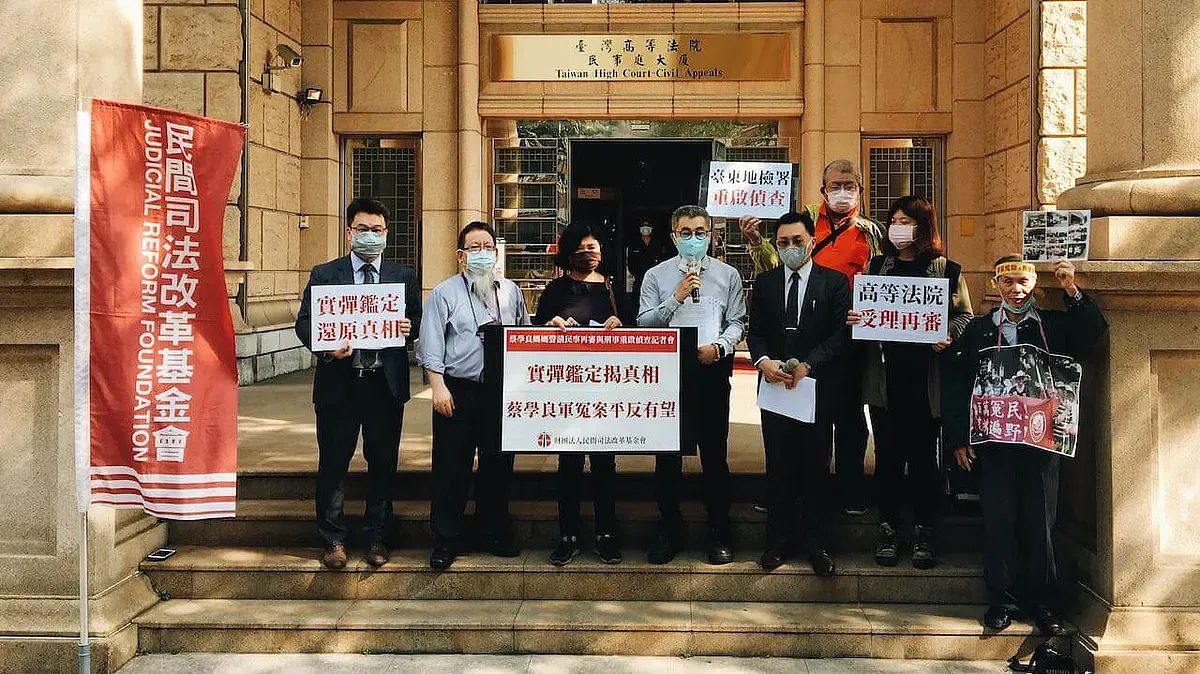
Live-Ammo Ballistic Analysis Reveals the Truth, Bringing Hope for Vindication in the Tsai Hsueh-liang Military Injustice Case: Press Conference on Filing for Civil Retrial and Criminal Reinvestigation
Last edited: 2026-07-27
On May 9, 2008, Air Force Sergeant Tsai Hsueh-liang was found shot to death at the Taiping Firing Range in Taitung County. Although 15 people were at the firing range practicing shooting at the time, all denied witnessing the shooting. Military forensic doctors and military prosecutors examined the body and concluded that Tsai Hsueh-liang had picked up a T65K2 rifle, put the muzzle in his mouth, and committed suicide. The Eastern Military District Prosecutors Office of the Ministry of National Defense closed the case on this basis. Unable to accept that her beloved son had committed suicide, Ms. Yu Jui-min, Tsai's mother, has spent a long time traveling and petitioning for redress.
On April 15, 2015, with the assistance of pro bono lawyers and the Judicial Reform Foundation, the Taiwan High Court issued Civil Judgment No. 12 (2013) (102年上國字第12號), holding that Tsai Hsueh-liang did not die by suicide, but rather suffered an accidental death caused by a T65K2 rifle discharging at close range. The court ordered the Air Force Command of the Ministry of National Defense to pay NT$1,480,731 in national compensation. However, the case still harbored numerous doubts, and Mother Yu continued her advocacy in search of the truth.
Live-Ammo Ballistic Analysis: Gunshot Wound Excluded from Being Caused by Rifle Bullet
Subsequently, the Ministry of National Defense commissioned Professor Li Chun-yi from the Graduate Institute of Forensic Medicine at National Taiwan University—who had previously assisted in the vindication of several major miscarriage of justice cases such as the Cheng Hsing-tse case and the Ch'en Lung-ch'i case—to conduct an examination. In July 2019, the forensic team led by Professor Li conducted a live-ammo ballistic analysis on "The Gunshot Wound Characteristics of Entry Wounds from T65K2 Rifles" at the 205th Factory of the Armaments Bureau Manufacturing Center, Ministry of National Defense, finally uncovering the truth about Tsai Hsueh-liang's death:
"According to domestic and foreign forensic medicine textbooks and case reports concerning gunshot wound characteristics of rifle entry wounds, as well as the research report commissioned by the Ministry of National Defense on the gunshot wound patterns of entry wounds from domestically produced T65K2 rifles, both indicate that the flame and high-temperature gas generated by shooting a rifle equipped with a flash suppressor will produce petal-shaped flame burn marks on the skin surrounding the entry wound or on the hand holding the flash suppressor during close-range shooting. However, neither the gunshot entry wound on Tsai Hsueh-liang's face nor his hands showed any petal-shaped flame burn marks. Therefore, the gunshot wound suffered by Tsai Hsueh-liang can be excluded from having been caused by a domestically produced T65K2 rifle and bullet." (See Appendix 1 for the evaluation report)
The evaluation report points out that Tsai Hsueh-liang did not die from a bullet fired by a T65K2 rifle, overturning the conclusions of "death by suicide" by the military and the Taitung District Prosecutors Office, as well as "accidental death" by the Taiwan High Court. During the investigation back then, prosecutors found that aside from the T65K2 rifle at the Taiping Firing Range, only the company commander was equipped with a .45 caliber pistol; however, none of the 20 rounds in the pistol magazine had been fired, thereby ruling out the possibility of the pistol's involvement. Now that the truth has emerged that Tsai Hsueh-liang did not die from a rifle bullet, the injustice in this case awaits thorough investigation by the judiciary.
Petitioning the Taitung District Prosecutors Office to Reopen Investigation and the Taiwan High Court to Initiate Civil Retrial
The ballistic evaluation report is the key to restoring the truth, and the doors of justice should be opened for the victims of injustice.
The live-ammo ballistic analysis clearly meets the criteria of "discovery of new facts or new evidence" under Article 260, Paragraph 1, Subparagraph 1 of the Code of Criminal Procedure. Pro bono lawyers and the Judicial Reform Foundation will assist Mother Yu in filing a formal petition for a reopened investigation with the Taitung District Prosecutors Office, which has jurisdiction over the crime scene.
On the other hand, the live-ammo ballistic analysis also satisfies the criteria of Article 496, Paragraph 1, Subparagraph 13 of the Code of Civil Procedure regarding "a party discovering unconsidered evidence or evidence that may be used, provided that such consideration would have led to a more favorable judgment." Furthermore, pursuant to Article 500 of the same Code, an action for retrial must be filed within a non-extendable period of 30 days. The Ministry of National Defense served the evaluation report to Mother Yu on February 10. Today is the day before the expiration of the civil retrial period. Pro bono lawyers and the Judicial Reform Foundation, accompanying Mother Yu and her family and friends, submitted the civil retrial petition to the Taiwan High Court, requesting the civil court to further examine the facts of the truth and render a judgment.
Attending Representatives
Ms. Yu Jui-min / Mother of Tsai Hsueh-liang
Chang Ching, Attorney-at-Law / Lawyer for the Tsai Hsueh-liang Case
Wu Yung-mao, Attorney-at-Law / Lawyer for the Tsai Hsueh-liang Case
Lin Chun-hung, Attorney-at-Law / Convener of the Rescue Division, Judicial Reform Foundation
Hsiao I-min, Director / Office Director of the Judicial Reform Foundation
Appendices
Press Contacts
Hsiao I-min, Office Director, Judicial Reform Foundation
This article is an AI-generated translation of the original Chinese text. In the event of any discrepancy, the Chinese version shall prevail.