
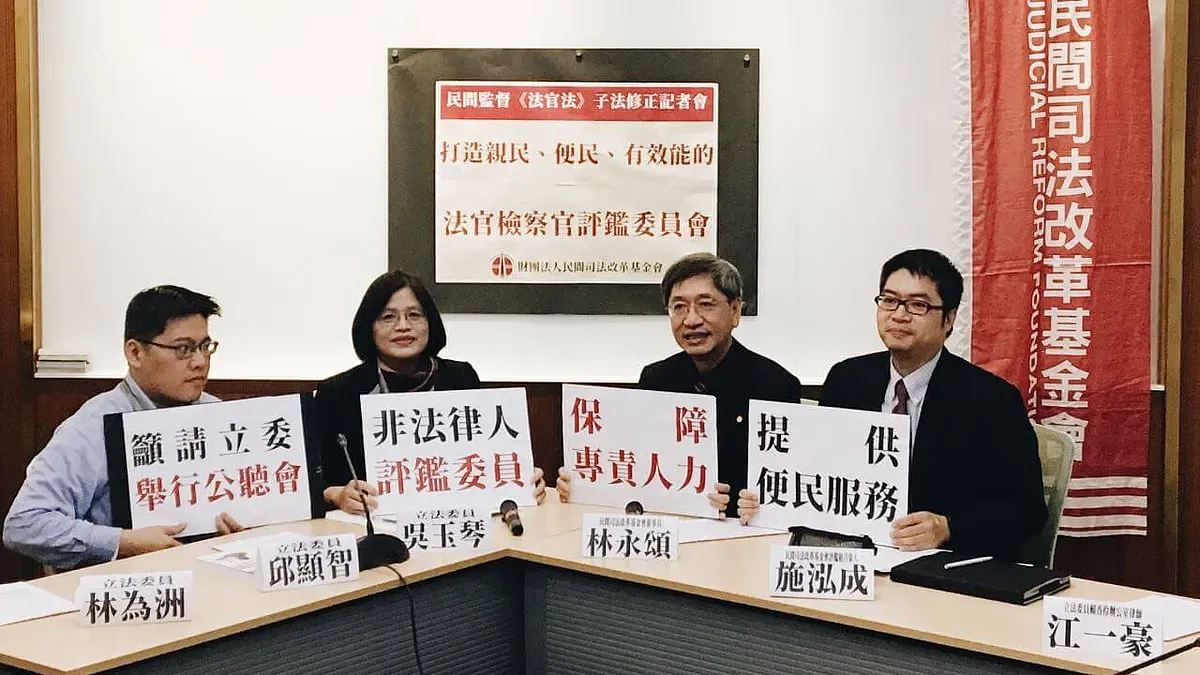
Building a People-Friendly, Accessible, and Efficient Judges and Prosecutors Evaluation Commission - Civil Society Press Conference on Monitoring Amendments to Subsidiary Legislation under the Judges Act
Last edited: 2026-07-27
The new Judges Act system allowing citizens to directly request individual evaluations of judges and prosecutors will take effect on July 17. If the Judges Evaluation Commission and Prosecutors Evaluation Commission are people-friendly, accessible, and efficient, they will surely help elevate public trust in the judiciary, which is currently on precarious ground. Conversely, if they adopt an arrogant attitude toward the people and bureaucratic procedures in investigating cases, they will likely generate even greater public grievance against the judiciary.
To build a Judges Evaluation Commission and a Prosecutors Evaluation Commission that meet public expectations, appropriate complementary subsidiary legislation must be enacted and amended. (See the attached table for related subsidiary legislation.) However, civil society has found that the Judicial Yuan and the Ministry of Justice have been working behind closed doors, and the revised subsidiary regulations run counter to the good intentions and merits of the new Judges Act system.
Guaranteeing Dedicated Personnel to Enhance Service Efficiency
Paragraph 2, Article 41-2 of the newly amended Judges Act explicitly stipulates: "The Judicial Yuan shall, in accordance with the law, employ dedicated personnel to assist in handling the review of evaluation requests, the investigation of evaluation cases, and other matters related to evaluations." Article 89 further stipulates that this shall apply mutatis mutandis to prosecutors. The purpose is to cope with the substantial increase in case volume after opening up individual evaluations directly requested by the people, and to enhance service efficiency by securing dedicated personnel through complementary measures.
The problem is that Article 7 of the "Regulations Governing the Organization of the Judges Evaluation Commission," revised and promulgated by the Judicial Yuan on March 6, stipulates: "The Commission shall have one executive secretary, who shall be concurrently served by a commissioned official within the established personnel quota of the Judicial Yuan to execute matters related to the Commission." Furthermore, Article 6 of the Ministry of Justice's prior "Regulations Governing the Organization of the Prosecutors Evaluation Commission" stipulates: "The Prosecutors Evaluation Commission shall have one executive secretary to superintend commission affairs, who shall be concurrently appointed by the Ministry of Justice from among its staff." Both sets of subsidiary regulations stipulate that the executive secretaries of the evaluation commissions shall be concurrently held by administrative bureaucrats.
The executive secretary is equivalent to the "chief executive officer" of a civil society organization, superintending commission affairs and executing resolutions, and serves as the highest administrative head of the evaluation commission. How can such an important position be concurrently held by an administrative bureaucrat rather than a dedicated professional? How can they be expected to devote themselves wholeheartedly to managing commission affairs? How can they independently resist lobbying by the powerful and influential?
This Foundation calls upon the Legislative Yuan to supervise the Judicial Yuan and the Ministry of Justice in amending the "Organizational Regulations" to comply with the provisions of the Judges Act, ensuring that evaluation commissions—from their highest head, the executive secretary, down to clerks, investigative specialists, and grassroots administrative secretaries—consist entirely of dedicated personnel. Furthermore, the evaluation commissions should be authorized to independently recruit and employ dedicated personnel, and the Judicial Yuan and the Ministry of Justice should be prohibited from recruiting and appointing them on their behalf.
Attuned to People's Needs and Providing Accessible Services
Subparagraph 3, Paragraph 1, Article 35 of the newly amended Judges Act stipulates that for individual evaluations, "written statements and duplicate copies shall be submitted, recording the following items, and relevant materials shall be attached." Before the legal amendments, individual evaluations were handled by professional organizations, and submitting "written statements" posed no difficulty. However, after the legal amendments open up individual evaluations to the general public, submitting a "written statement" becomes a very difficult procedural threshold. While financially well-off citizens can hire lawyers to draft statements on their behalf, for citizens who cannot afford lawyer fees, the Judges Evaluation Commission and Prosecutors Evaluation Commission must provide or design appropriate accessible measures to help people transform their grievances and dissatisfaction into written expressions.
Currently, the Judges Evaluation Commission has an independent office located on the 9th floor of the Judicial Yuan's Second Office Building, but the space is insufficient to accommodate citizens coming in person to request evaluations. The Prosecutors Evaluation Commission is cramped inside the Ministry of Justice building and even lacks an independent office, which urgently needs to be established. Moreover, courts and prosecutors offices are distributed all over the country, and the evaluation commissions should not be limited to Taipei; they should widely establish offices or branch offices to proactively reach out to the public.
This Foundation calls upon the Legislative Yuan to supervise the Judicial Yuan and the Ministry of Justice in amending the "Organizational Regulations" to authorize evaluation commissions to establish local branches or offices to provide written statement consultation and document-receiving services. They should also be encouraged to actively cooperate with the Legal Aid Foundation and social organizations to provide legal consultation, social worker assistance, or case referrals, thereby lowering the threshold for economically disadvantaged or physically and mentally disabled citizens to request individual evaluations. For those in prisons or detention centers, mobile case-acceptance and in-prison investigations should also be planned to safeguard their right to a fair trial. Overall, evaluation commissions should be attuned to the needs of the people and provide a variety of accessible services.
Stipulating the Ratio of Non-Legal Evaluation Commissioners
Paragraph 1, Article 33 of the newly amended Judges Act stipulates: "The Judges Evaluation Commission shall be composed of three judges, one prosecutor, three attorneys, and six scholars and impartial members of society," which adds two scholars and impartial members of society compared to the old law. What is worrying is that the Judicial Yuan and the Ministry of Justice have not yet amended their subsidiary legislation to explicitly stipulate the proportion of non-legal representatives among the scholars and impartial members of society. This fails to ensure an open and diverse background for evaluation commissioners and prevents perspectives outside of legal thinking from being reflected.
Those most easily overlooked and harmed in judicial procedures are often the most marginalized people in society with no resources. In the first eight years of the implementation of the Judges Act, citizens could only indirectly request individual evaluations through agencies and organizations, and the vast majority of public petitions were accepted by civil society groups, including this Foundation. Through the experience of these eight years, we have come to understand that citizens harmed by the judiciary urgently need warm and empathetic treatment—yet this is precisely the training that individuals with legal backgrounds lack the most.
This Foundation calls upon the Legislative Yuan to supervise the Judicial Yuan and the Ministry of Justice in amending relevant subsidiary legislation to stipulate the proportion of non-legal persons among the six scholars and impartial members of society. This will ensure that evaluation commissions are no longer exclusively composed of individuals with legal backgrounds, and through the participation of non-legal professionals, guarantee that citizens receive responses imbued with human warmth and empathy when requesting individual evaluations.
Call to Hold Public Hearings on Complementary Amendments to Subsidiary Legislation under the Judges Act
Prior to the implementation of the new Judges Act system, the Judicial Yuan and the Ministry of Justice must complete the amendments to related subsidiary legislation. This Foundation calls upon legislators to hold public hearings on complementary subsidiary legislation related to the Judges Act, inviting civil society organizations, scholars and experts, the Judicial Yuan, the Ministry of Justice, and members of the Judges and Prosecutors Evaluation Commissions to attend, discuss countermeasures together, and build a people-friendly, accessible, and efficient Judges Evaluation Commission and Prosecutors Evaluation Commission.
Appendix
| Name of Subsidiary Regulation under the Judges Act | Competent Authority | Legal Hierarchy | Amendment Status |
| Regulations Governing the Organization of the Judges Evaluation Commission | Department of Judicial Administration, Judicial Yuan | Regulations | Revised and Promulgated |
| Implementation Measures for Evaluations by the Judges Evaluation Commission | Department of Personnel, Judicial Yuan | Regulations | No Amendment Information Available |
| Measures for the Election by Balloting of Judge Representatives to the Judges Evaluation Commission | Department of Personnel, Judicial Yuan | Regulations | No Amendment Information Available |
| Main Points for Implementing Case Allocation in the Judges Evaluation Commission | Department of Personnel, Judicial Yuan | Administrative Rules | No Amendment Information Available |
| Measures for the Election by Balloting of Judge Representatives to the Judges Evaluation Commission | Department of Personnel, Judicial Yuan | Regulations | Revised and Promulgated |
| Regulations Governing the Organization of the Prosecutors Evaluation Commission | Department of Prosecutorial Affairs, Ministry of Justice | Regulations | No Amendment Information Available |
| Implementation Measures for Prosecutor Evaluations | Department of Prosecutorial Affairs, Ministry of Justice | Regulations | No Amendment Information Available |
| Measures for the Election by Balloting of Prosecutor Representatives to the Judges Evaluation Commission | Department of Prosecutorial Affairs, Ministry of Justice | Regulations | Revised and Promulgated |
| Measures for the Election by Balloting of Prosecutor Representatives to the Prosecutors Evaluation Commission | Department of Prosecutorial Affairs, Ministry of Justice | Regulations | Revised and Promulgated |
| Election Measures for Attorney Representatives to the Judge Selection Committee, Judges Evaluation Commission, and Prosecutors Evaluation Commission of the Taiwan Bar Association | Taiwan Bar Association | Administrative Rules | No Amendment Information Available |
Attendees
Wu Yu-ch'in / Legislator
Ch'iu Hsien-chih / Legislator
Wang Shuo / Attorney, Office of Legislator Lai Hsiang-ling
Lin Yung-sung / Chairperson, Judicial Reform Foundation
Shih Hung-ch'eng / Convener of the Evaluation Division, Judicial Reform Foundation
Hsiao I-min / Office Director, Judicial Reform Foundation
Press Contacts
Director Hsiao I-min, Judicial Reform Foundation
This article is an AI-generated translation of the original Chinese text. In the event of any discrepancy, the Chinese version shall prevail.