
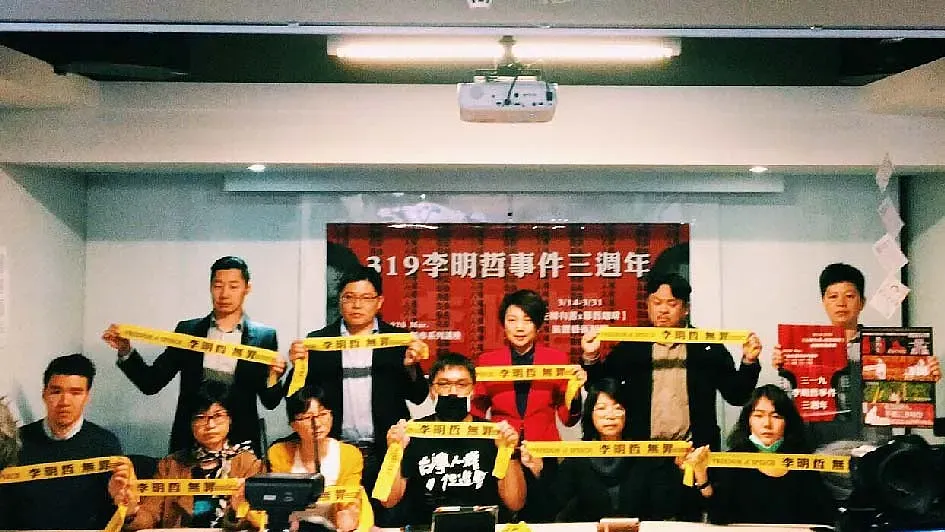
We Have Not Forgotten Li Ming-che: Freedom of Speech Is Not a Crime — Press Conference on the Third Anniversary of Li Ming-che's Arrest
Last edited: 2026-07-27
Today, March 19, marks the third anniversary of the detention of Taiwanese NGO worker Li Ming-che. Three years ago, due to comments shared and issues discussed with Chinese netizens online, Li Ming-che was subjected to enforced disappearance by the Chinese government on March 19, 2017. To this day, Li Ming-che remains incarcerated in China's Chishan Prison without being released. Democratic Progressive Party (DPP) legislator-at-large Hung Sun-han stated: 'Li Ming-che has been imprisoned for three years now, and I believe he must deeply miss his family and his democratic, free homeland of Taiwan. What he promoted was nothing other than democratic values and party rotation—things that Taiwanese people have long taken for granted, yet China criminalized him for them.' In fact, even within prison, Li Ming-che remains mindful of justice. The executive director of the Covenants Watch stated: 'Although Li Ming-che is suffering in prison, his thoughts are constantly occupied with improving the plight of his fellow inmates. Therefore, on behalf of Li Ming-che, we call on the international community to continue paying attention to the long working hours without rest, forced labor, and extremely poor living conditions inside Chinese prisons.'
The Li Ming-che Rescue Team continues its efforts to rescue Li Ming-che and urges the public not to forget that our compatriot remains unjustly imprisoned by the Chinese government. In addition to holding this third-anniversary press conference, we are hosting the '365 Letters to Li Ming-che' exhibition at 'Apostrophe Books x Murky Cafe,' calling on everyone to continue expressing concern through letters and demanding that the Chinese government release Li Ming-che as soon as possible. Wu Ting-chen, representative of Art Action for Freedom (AAfF), who curated the '365 Letters to Li Ming-che' exhibition, stated: 'We hope to awaken public concern for human rights and freedom through art actions and a series of lectures. Li Ming-che is precisely a symbol of the deprivation of human rights and freedom. We urge the public to place greater importance on human rights issues, knowing there could always be a next Li Ming-che.'
As Li Ming-che's work partner, Cheng Hsiu-chuan, principal of Taipei Wenshan Community College, stated that human rights work is a long road. Li Ming-che came to the community college to develop human rights education and was arrested as a political prisoner by China precisely because of his human rights work. Last year, community colleges in several counties and cities across Taiwan were also asked by local politicians to have their education bureaus conduct speech inspections due to the Hong Kong Anti-Extradition Law Amendment Bill movement or fake news lectures, which fully demonstrates that human rights education in Taiwan still needs to be popularized.
Is It Hard to Report Safety? Li Ching-yu Demands Family Phone Contact with Ming-che
Due to the impact of the novel coronavirus (COVID-19), the monthly family visits that Li Ming-che's relatives were originally entitled to have also been interrupted. Coupled with the fact that Li Ming-che is still unable to communicate externally or make phone calls, he has once again fallen into a state of complete silence. Li Ching-yu already held a press conference yesterday (3/18) to call on the Chinese government to allow Li Ming-che to make a family phone call back to Taiwan to report that he is safe. Non-partisan legislator Freddy Lim (Lin Chia-lung) stated: 'At a time when the COVID-19 outbreak in China is exploding, the prison hygiene and prison human rights in China are even more worrying. According to Li Ching-yu's statement yesterday, the Chinese side has suspended all prisoner visits since January in response to COVID-19. The Chinese government should immediately allow the two to communicate to ensure Li Ming-che's health and personal safety.'
Chiu I-ling, Secretary General of Amnesty International Taiwan, stated that on the third anniversary of Li Ming-che's arrest, he is still unable to communicate externally or make family phone calls. These are all basic rights granted to inmates by China's Prison Law. The restriction of Li Ming-che's external communication by Chinese prisons violates Article 47 of China's Prison Law regarding the protection of the right to communicate, and also violates Rule 58 of the United Nations Standard Minimum Rules for the Treatment of Prisoners (the Nelson Mandela Rules) concerning the basic rule of 'contact with the outside world.'
Li Ming-che's Health and Safety Cause Concern
Secretary General Chiu I-ling further stated that the spread of the novel coronavirus continues without an end in sight, and we are deeply worried about Li Ming-che's health and public health conditions in Hunan's Chishan Prison. She once again called on the Chinese government to ensure that the right to health of all personnel in prisons, including prisoners, is fully protected. DPP legislator-at-large Fan Yun similarly expressed concern: Whether Hunan's Chishan Prison has suffered infections is worrisome; as COVID-19 spread from Hubei into domestic prisons, cluster infections have been successively reported in prisons in Hubei, Shandong, and Zhejiang. Whether Li Ming-che, imprisoned in Hunan's Chishan Prison, has been affected by the ongoing epidemic cannot be verified.
Is Li Ming-che the Only Person Convicted of Crimes Such as 'State Security' and 'Subversion of State Power'?
Li Ming-che is not an isolated case. In 2019, two more Taiwanese individuals were incriminated, disappeared, or arrested under charges of 'state security' and 'subversion of state power.' DPP legislator-at-large Fan Yun stated that from 2012 up until the two individuals last year, Taiwanese people have continuously been incriminated, arrested, and disappeared by China under preposterous charges of 'state security' and 'subversion of state power,' and there may be even more dark figures. Every year, over five million Taiwanese people travel to China for tourism, studying, or business, and they should all be free from the fear of arbitrary arrest.
Liu Lu-na, representative of the Citizen Congress Watch and Taiwan Thinktank (New Bloom / Taiwan Foundation for Democracy partners, representing New Bloom/Citizen Platform/etc.), stated: 'This was verified during the investigation and workshops of the 'Understanding China Project' conducted by the Citizen Platform last year (2019). We asked interviewees with experience in China to share whether their personal speech was censored and their experiences regarding personal safety while in China. We conducted in-depth interviews with more than 30 friends who have previously or are currently studying or working in China, and held nine regional workshops. The preliminary conclusion is that Taiwanese people lack sufficient concepts regarding how to protect themselves and the risks of going to China. Self-protection at most means limiting one's own speech expression and bypassing the Great Firewall, or feeling complete freedom only at the very moment of returning to Taiwan.'
In response to this, Shih Yi-hsiang, Secretary General of the Taiwan Association for Human Rights (TAHR), called on all Taiwanese and foreigners who have the opportunity or are certain to travel, do business, study, visit family, or engage in exchanges in China to make prior risk assessments and contingency preparations, especially regarding personal information security and privacy protection. Doing so not only protects oneself but also protects the person communicating with you. Based on information from the Taiwan Foundation for Democracy, TAHR has launched a 'Safety Guide Lazy Package for Taiwanese Going to China' and urges friends traveling to China to make good use of it.
Chang Chih, regional advocacy officer of the Judicial Reform Foundation, stated that the Li Ming-che incident has awakened Taiwanese people's understanding of China's 'administration according to law,' while simultaneously continuing to highlight that cross-strait judicial mutual legal assistance has plummeted to a freezing point. The *Cross-Strait Joint Crime-Fighting and Judicial Mutual Assistance Agreement* stipulates that both sides must establish a communication mechanism and promptly notify the other party's designated competent authorities. However, from the very beginning of the Li Ming-che incident, the Chinese government responded passively and even refused to proactively notify. Over the past three years, families have repeatedly requested to visit Li Ming-che, and even when relatives requested to let Li Ming-che return to Taiwan to attend a funeral, the Chinese government refused under various excuses without administering according to law, and to this day continues to suppress Li Ming-che's right to external communication, openly violating the laws it enacted itself.
China repeatedly emphasizes 'the rule of law,' and both sides of the strait have signed the binding *Cross-Strait Judicial Mutual Assistance Agreement*. However, facts have proven that 'the rule of law' is merely a slogan, and the *Cross-Strait Judicial Mutual Assistance Agreement* is no different from a dead letter. According to the Straits Exchange Foundation (SEF) in September of last year, there were a total of 149 cases of Taiwanese losing contact in China, of which 82 cases have been found through channels, but 67 cases still have no news to this day. As the Chinese government continues to disregard the *Cross-Strait Judicial Mutual Assistance Agreement*, the Taiwanese government remains unable to grasp the situations of Taiwanese people 'being disappeared,' 'being arbitrarily arrested,' and even 'being arbitrarily detained' in China. Therefore, we still call on the Chinese government to genuinely administer according to law. At the same time, we call on the Taiwanese government to continue reflecting on how we can effectively prevent the emergence of the next Li Ming-che when cross-strait judicial mutual assistance has reached its lowest point.
Li Ming-che Is an International Human Rights Incident
Huang Yi-bi, executive director of the Covenants Watch, stated that if speaking the truth can subvert a state power, it must be because that state power is built upon lies. What makes an epidemic spiral out of control is not the virus, but the authoritarian mindset and totalitarian system that forbid people from expressing speech. On the 1096th day of Li Ming-che's arrest, Taiwanese people should unite to jointly condemn China for treating human lives as grass and international norms as nothing. At the same time, four international human rights organizations—FORUM-ASIA (Asian Forum for Human Rights and Development), FIDH (International Federation for Human Rights), along with the Taiwan Association for Human Rights and the Covenants Watch, which have long assisted in Li Ming-che's international rescue—also issued a joint statement demanding that China immediately release Li Ming-che and end the use of 'enforced disappearance' and 'arbitrary arrest' to retaliate against human rights defenders and rights advocates.
Appendix
- 'Third Anniversary of Li Ming-che's Arrest: Release Li Ming-che' Video
- Li Ming-che Case Lazy Package
- Timeline of NGO Rescue Efforts in the Li Ming-che Case
- A Five-Minute Video to Understand the Li Ming-che Case
- Li Ching-yu's Application Requesting the Chinese Government to Open Family Phone Calls for Li Ming-che
- Safety Guide Lazy Package for Taiwanese Going to China
This article is an AI-generated translation of the original Chinese text. In the event of any discrepancy, the Chinese version shall prevail.