
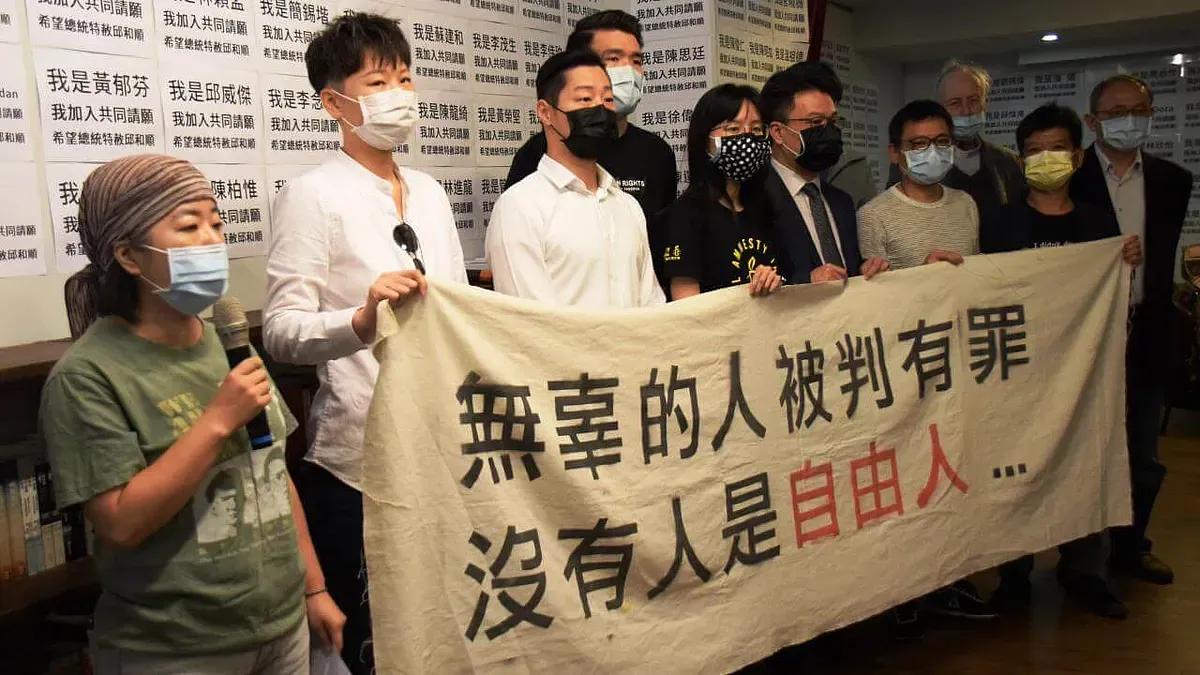
Sixty Years of Ho-Shun and Counting: Press Conference Demanding an Immediate Pardon for Ch'iu Ho-Shun
Last edited: 2026-07-27
Starting March 9 this year, the 'Ch'iu Ho-Shun Case Support Group' invited individuals from legal, political, academic, arts, cultural, religious, and other domestic and international sectors to jointly petition the President to pardon Ch'iu Ho-Shun. In less than a month, by the submission date of the petition on April 7, they successfully invited nearly 400 figures from various fields to sign the 'Petition for Pardon,' along with 61 domestic and international civil society groups from 29 countries. In addition, online petitions calling for the pardon, initiated separately by the support group and Amnesty International, have gathered over 30,000 signatures spanning 40 countries and regions worldwide, with signatures still growing.
On April 7, Ch'iu Ho-Shun's 60th birthday, the 'Ch'iu Ho-Shun Case Support Group' officially delivered the 'Petition for Pardon' and the list of online petition signatories to the Office of the President (video click here). Alongside civil society groups, scholars, and lawyers who have long supported the exoneration of Ch'iu Ho-Shun's miscarriage of justice, the co-petitioners include international reviewers of the Two Covenants, members of the Presidential Human Rights Advisory Committee, current legislators and councilors, Golden Horse and Golden Bell Award-winning directors, religious leaders, and prominent figures from the arts, cultural, and sports sectors who have expressed support for the petition to pardon Ch'iu Ho-Shun.
Taiwanese society is currently focused on disease prevention, and many issues have been overlooked. On April 7, Ch'iu Ho-Shun's birthday, representatives from the 'Ch'iu Ho-Shun Case Support Group' visited him at the detention center and deeply felt his longing for freedom and innocence—having now been deprived of his freedom for 11,696 days (Ch'iu was arrested on his birthday in 1988). Therefore, we still decided to hold this press conference, hoping to use the power of the media to let more people know his story and plight.
The press conference was hosted by Lin Hsin-yi, Executive Director of the Taiwan Association to End the Death Penalty. She noted that many people in Taiwan have recently experienced quarantine or lockdown measures during the pandemic. Imagine how agonizing it is to be unable to go outside for 14 days; multiply that by tens of millions, and that is what Ch'iu Ho-Shun has experienced for 32 years. This is why the 'Ch'iu Ho-Shun Case Support Group' had to step forward and hold this press conference.
Legislator Freddy Lim (Lin Chia-lung) spoke first at the press conference. Having previously served as the president of Amnesty International Taiwan, Lin understands the details of the Ch'iu Ho-Shun case. Thus, from the past to the present, he has continuously supported the case and will continue to do so until the day Ah-Shun is free. Lin stated that recent incidents involving police kicking a student's head have sparked social discussion; during the martial law era in the past, there were many instances of torture, and Ch'iu Ho-Shun was sentenced to death under such circumstances. In the past, the Control Yuan launched investigations twice that found the case to be a miscarriage of justice, and domestic and international experts have continuously voiced support for Ch'iu Ho-Shun. Even though Taiwan's judicial system includes the crime of 'perversion of the law by a judge,' the door to judicial relief remains firmly shut. We know that exonerating miscarriages of justice is extremely difficult, such as the Su Ping-k'un case, which only found relief last year. Today, we appeal here to President Tsai Ing-wen to pardon Ch'iu Ho-Shun. This is not only a miscarriage of justice but also a humanitarian issue. We hope that through years of appeals and the solidarity of various groups, Ch'iu Ho-Shun can obtain the freedom he deserves.
Annie Huang (Ch'iu Yi-ling), Secretary General of Amnesty International Taiwan, spoke next, stating that Amnesty International has included Ch'iu Ho-Shun as a target for solidarity and launched urgent actions since 2011. Over the years, the French, Norwegian, and German sections have continuously monitored this case and initiated solidarity campaigns in their countries, persistently writing postcards to him. Representatives from the international secretariat or various national sections also visit him at the Taipei Detention Center whenever they visit Taiwan. This year, Amnesty International Taiwan also invited other sections to record a 'Happy Birthday' song for Ch'iu Ho-Shun, calling on everyone to join the petition and take further advocacy action. Annie Huang expressed deep regret that on his 60th birthday, Ch'iu Ho-Shun remains unreleased. Based on the clear facts that this case involved torture and an unfair trial, Amnesty International believes that Ch'iu Ho-Shun should be released immediately, and calls on President Tsai Ing-wen to immediately pardon and release him.
Last year, the International Federation for Human Rights (FIDH) held its first Asian international congress in Taiwan, gathering over 400 human rights defenders from around the world and putting Taiwan in the global spotlight. Pan Yi, Director of the FIDH East Asia Program, stated that FIDH is a founding member and Executive Committee member of the World Coalition Against the Death Penalty (WCADP). FIDH opposes all forms of the death penalty and believes that the right to life is the most fundamental right among universal human rights. During the FIDH congress, FIDH representatives visited Mr. Ch'iu Ho-Shun at the Taipei Detention Center. At the opening ceremony of the congress, Mr. Hsu Tzi-chiang explained Ch'iu Ho-Shun's current situation in front of President Tsai Ing-wen, and during the congress, 192 member organizations from various countries unanimously passed an emergency motion demanding that the Taiwan government comprehensively review the human rights violations Ch'iu Ho-Shun may have suffered and calling on President Tsai to pardon him. In light of the novel coronavirus pandemic, FIDH launched the #ForFreedom global action on April 8 to remind governments of their obligation and responsibility to ensure the safety and health of all detainees, calling for the release of all detained human rights defenders. This action naturally includes all death row inmates of wrongful convictions. State authorities have deprived Ch'iu Ho-Shun of his freedom by improper means for 32 years, and his physical health is deeply concerning. In times of crisis, governments have an obligation to protect the most vulnerable, and we hope President Tsai Ing-wen can pardon Ch'iu Ho-Shun as soon as possible so that an innocent man may regain his freedom at an early date.
Three individuals wrongfully convicted and later exonerated on death row—Hsu Tzi-chiang, Su Chien-ho, and Cheng Hsing-tse—attended the press conference today. Although Liu Bing-lang and Chuang Lin-xun were unable to attend, they also expressed their support. Hsu Tzi-chiang stated that he is 49 years old this year, while Ch'iu Ho-Shun is already 60; when Hsu was sent to the detention center in 1996 due to a wrongful conviction, Ch'iu had already been inside for 9 years. While Hsu wore leg irons for 10 years, Ch'iu has worn them for 18. Today, Hsu has been released for 7 years, yet Ch'iu is still in the Taipei Detention Center, yearning for the freedom lost 32 years ago. 'When an innocent person is convicted, no one is free.' Hsu called on everyone living in a democratic and free country not to tacitly condone the continuation of such injustices as Ch'iu Ho-Shun's case in Taiwan. Hsu believes and hopes that the President will exercise her moral stature and possess the resolve to end the injustice against Ch'iu Ho-Shun. 'Therefore, on behalf of the wrongfully convicted exonerated persons present, I jointly petition and call upon the President to grant Ch'iu Ho-Shun a pardon that completely forgives his crime and sentence.'
Professor Huang Sung-li, Convener of the Covenants Watch, also stated that he has served as a member of the Presidential Human Rights Advisory Committee since May 2016. The committee holds meetings every three months, chaired by the Vice President. As the name suggests, the committee is advisory in nature and does not form part of administrative policymaking. He proposed a discussion on 'petitioning the President to consider pardoning Mr. Ch'iu Ho-Shun' at the 38th committee meeting on February 21 this year, reporting on the numerous doubts raised by Ch'iu Ho-Shun's lawyers and simulating a judgment by the Asian Court on Human Rights on the Ch'iu case, pointing out that the government of the Republic of China violated the two basic human rights obligations prohibiting torture and ensuring a fair trial. Among the 13 citizen representatives on the Presidential Human Rights Advisory Committee, speakers in the discussion agreed that the Ch'iu Ho-Shun case involved torture and raised concerns about the lack of review procedures in the Amnesty Act, ultimately recommending that the President convene a review panel to understand the case. The post-meeting resolution stated that 'the valuable opinions provided by members will be submitted to the President for reference after the meeting.' Professor Huang Sung-li hopes the President will agree to pardon Ch'iu Ho-Shun, signaling the government's abandonment of the authoritarian mindset of torture-induced confessions and establishing Taiwan as a constitutional state that protects human rights.
Ch'iu Ho-Shun is a Catholic and is currently detained; he has expressed that religion has given him a great deal of encouragement. Father Wu Wei-li has also visited Ch'iu Ho-Shun at the detention center and thus attended today to represent the Catholic community in solidarity with Ch'iu Ho-Shun. Father Wu explained that our Jesus Christ was also wrongfully accused and sentenced to death nailed to the cross; therefore, we oppose the death penalty.
Yu Po-hsiang, Convener of the Ch'iu Ho-Shun Defense Counsel, stated that the Ch'iu Ho-Shun case stemmed from torture, happening precisely at the tail end of the authoritarian rule. Although society both domestically and internationally generally views this case as our country's most urgently needed miscarriage of justice to be rescued, the courts have consistently been unable to completely draw a clear line in this case between torture—the most serious form of unlawful state violence—and have lacked the courage to correct their own mistakes. This has made the case a massive stain on Taiwan's judicial system and human rights record internationally, and a symbol that Taiwan has not completely cast off torture nor fully bid farewell to the era of authoritarian rule.
In terms of rectifying the grievances suffered by Ch'iu Ho-Shun, the judicial system is powerless—or more precisely, it has firmly bolted the doors of justice. As long as Ch'iu Ho-Shun's wrongful imprisonment does not end for a single day, the massive violation of his human rights does not cease for a single day, and the state continuously crushes and tortures Ch'iu Ho-Shun's life without pause. If this cruel process of ceaselessly producing injustice is not interrupted, it will ultimately end with Ch'iu Ho-Shun's life withering away in a dark and sunless cell.
Today, only the power of pardon bestowed upon the President by the Constitution can terminate the injustice in the Ch'iu Ho-Shun case. When we can no longer expect the judiciary to vindicate Ch'iu Ho-Shun's grievances, and Ch'iu Ho-Shun's health no longer permits him to continue waiting for rescue in a prison cell, the defense counsel formally appeals to the President: grant Ch'iu Ho-Shun a pardon that completely forgives his crime and sentence. This is not only to immediately end the massive harm caused to Ch'iu Ho-Shun by 32 years of wrongful imprisonment, but also symbolizes Taiwan's determination to pursue transitional justice.
The Judicial Reform Foundation has long invested in the rescue efforts for Ch'iu Ho-Shun, mobilizing hundreds of volunteers in the past to visit Ch'iu Ho-Shun and give him sustenance in the detention center. Chang Chih, Regional Advocacy Specialist at the Judicial Reform Foundation, stated that the list of co-petitioners demanding the President pardon Ch'iu Ho-Shun includes prominent figures from various domestic and international fields, attracting widespread attention. Next, the 'Ch'iu Ho-Shun Case Support Group' will hold a 'Free Chiou' event at the Huashan Grassland on May 2, once again conveying through action the message of numerous citizens supporting Ch'iu Ho-Shun. In addition, the support group will continue a series of online advocacy actions, inviting all participating signatories to continue speaking out online and calling on the President to pardon Ch'iu Ho-Shun.
Co-organizing Groups
Ch'iu Ho-Shun Defense Counsel
Judicial Reform Foundation
Taiwan Association to End the Death Penalty
Taiwan Association for Human Rights
Covenants Watch
Taiwan Association for Innocence
Amnesty International Taiwan
International Federation for Human Rights (FIDH)
Press Contacts
Chang Chih / Judicial Reform Foundation
Lin Hsin-yi / Taiwan Association to End the Death Penalty
This article is an AI-generated translation of the original Chinese text. In the event of any discrepancy, the Chinese version shall prevail.