
JRF Newsletter
Written Before the Verdict: Reflections on the Defendants in the #323 Executive Yuan Occupation Case
Last edited: 2026-07-27
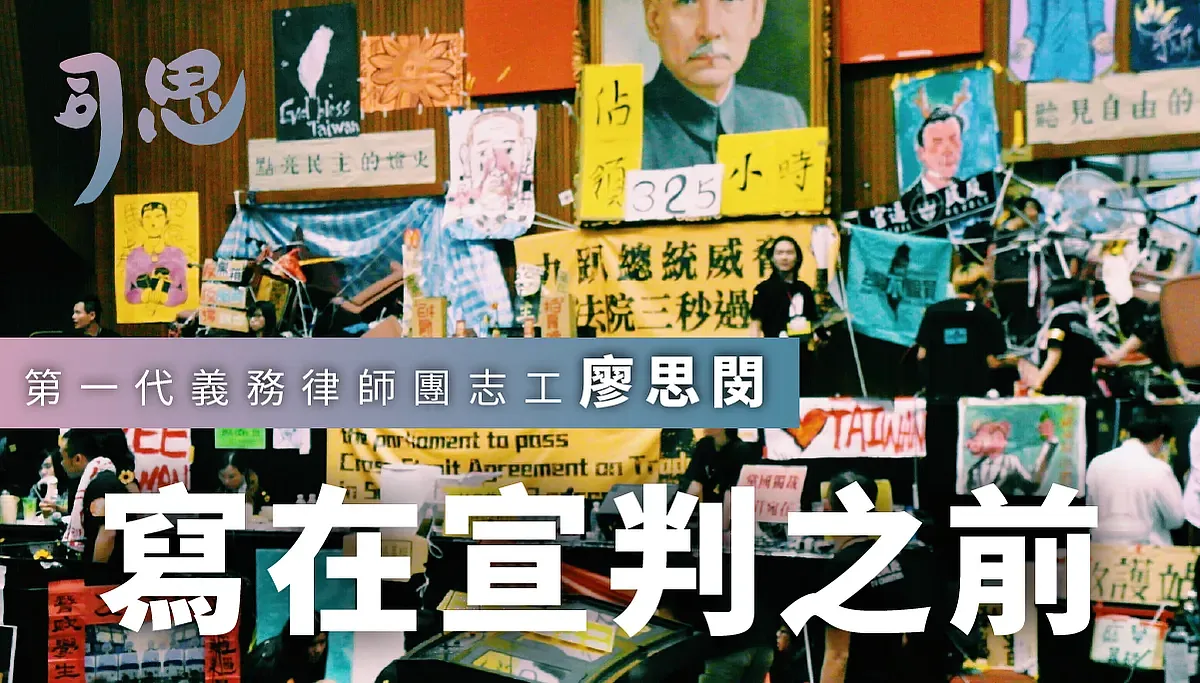
Editor's Note: Liao Szu-min, affectionately known as "Little Szu," started young and entered the field early, serving as a first-generation volunteer for the March 18 Anti-CSSTA Black Box Lawyers' Group. On the night of March 24, she was at the scene inside the Executive Yuan, but evacuated the premises along with the media, thus escaping that subsequent night of bloodshed. A sophomore in college at the time, she resolutely threw herself into the Judicial Reform Foundation's volunteer program, helping with massive amounts of image organization, defendant outreach, and lawyer coordination. Back then, lawyer group meetings regularly drew fifty or sixty participants; without the help of these volunteers, the pro bono lawyer platform could not have made it through the first wave of litigation preparation. As six years have passed since 324, Szu-min has gone from a volunteer to a full-time staff member, and has now also left the JRF. With the April 28 ruling on the 323 defense case fast approaching, we asked Szu-min if she had anything she wanted to say...
I hardly know where to begin, considering it has already been six years, and I left my job as an assistant to the lawyers' group nearly four years ago.
Every time I see news related to March 18, March 23, April 28, and other such cases, my heart stirs inevitably. Beyond that emotion, there is perhaps a lingering guilt—a guilt for failing to fulfill my initial promise to walk alongside the defendants all the way through. I also wonder sometimes if it was because I didn't do well enough or do enough back then that this trial drags on without end, unable to reach a proper, conclusive close. Such thoughts are of little use; in a way, I am also a "giant in thought, a dwarf in action." After leaving, the most I can do is flick my fingers to share information, or act as a former assistant who can provide historical context when the JRF needs to dig into the archives, or like now, write a short essay, hoping that at certain moments, I might recall a few memories and spark a tiny ember.
I still remember the day the prosecutors filed the indictment. We learned about it from the news, but no one had received the indictment document yet. We finally managed to get the version intended for reporters, and then we started cross-referencing it one by one against the name list the JRF had collected at the time. That list contained hundreds of names, and after cross-referencing, we found that some indicted individuals were still not on our list. We tried every possible method, asking various groups, but some names still couldn't be pieced together, and naturally, we had no contact information for them. Driven by the sentiment of not letting a single person fall through the cracks, the JRF adopted a brute-force approach, looking up the hearing dates for the preparation proceedings by case number and division, and having the lawyers' group assistants take turns observing court sessions in the hope that the defendants who received subpoenas would arrive on schedule, so we could then ask them for their information and whether they needed legal assistance.
No one has to take responsibility for state violence, yet the state still keeps its tight grip on the people
Actually, those preparation proceeding sessions are the court observations that left the deepest impression on me. I remember meeting one of the defendants we had been searching everywhere for during one of those sessions. He was very young and came to court by himself without finding a lawyer. He was so flustered and terrified during the hearing, saying he was just passing by and got pushed inside, and then saw everyone getting emotional, with some people throwing things at the police and others shouting about beatings. The whole scene was chaotic; he had no idea what was happening, nor did he understand why he was being prosecuted. That was the first time I felt how important this job truly is. If we had found him sooner, he wouldn't have had to face the massive judicial system all by himself, and perhaps he wouldn't have been so flustered and scared.
Not long ago, a colleague currently in charge of the lawyers' group called to dig into the archives, asking if I remembered a certain defendant? I had an impression of the name, remembering that we had been in touch at one point but later lost contact, leaving us unable to provide subsequent assistance. After looking into it for a while, my colleague said that person was indeed marked as lost-contact on the spreadsheet, but he had been found guilty in the first instance, and because we couldn't get in touch with him, he didn't appeal the second-instance ruling and may have already begun serving his sentence. This news left me both shocked and saddened. Actually, I neither remember his face nor the circumstances of our contact precisely, but precisely because of that, I feel all the more distressed. I wondered if there was something I had failed to do back then. I thought that if he had been a defendant who caught even a sliver of the spotlight or one who participated alongside a group of peers, he wouldn't have lost contact, nor would he have had his sentence executed so easily. I was reminded of the documentary Wild Strawberries: A Formosa Generation that I watched recently: those who get left behind are always the ones who lose their names in the movement.
Six years have passed, the litigation is still ongoing, and still no one has to take responsibility for state violence, yet the state still keeps its tight grip on the people. This small group of people can only linger in the courtroom, as if time froze in that movement from six years ago. It is hard to imagine what the scene will be like when the verdict is handed down in a few days. I suppose that even with an acquittal, it will hardly be a scene of cheers and jubilation; it will likely just be a sigh of relief that it is finally over.
I dare not harbor too many expectations. Regardless of whether the result is good or bad, it must be firmly remembered in our hearts. I will always remember it firmly.
📣Second-Instance Verdict of the 323 Defense Case: April 28, 10:00 AM @ Courtroom No. 4, Taiwan High Court
This article is an AI-generated translation of the original Chinese text. In the event of any discrepancy, the Chinese version shall prevail.