
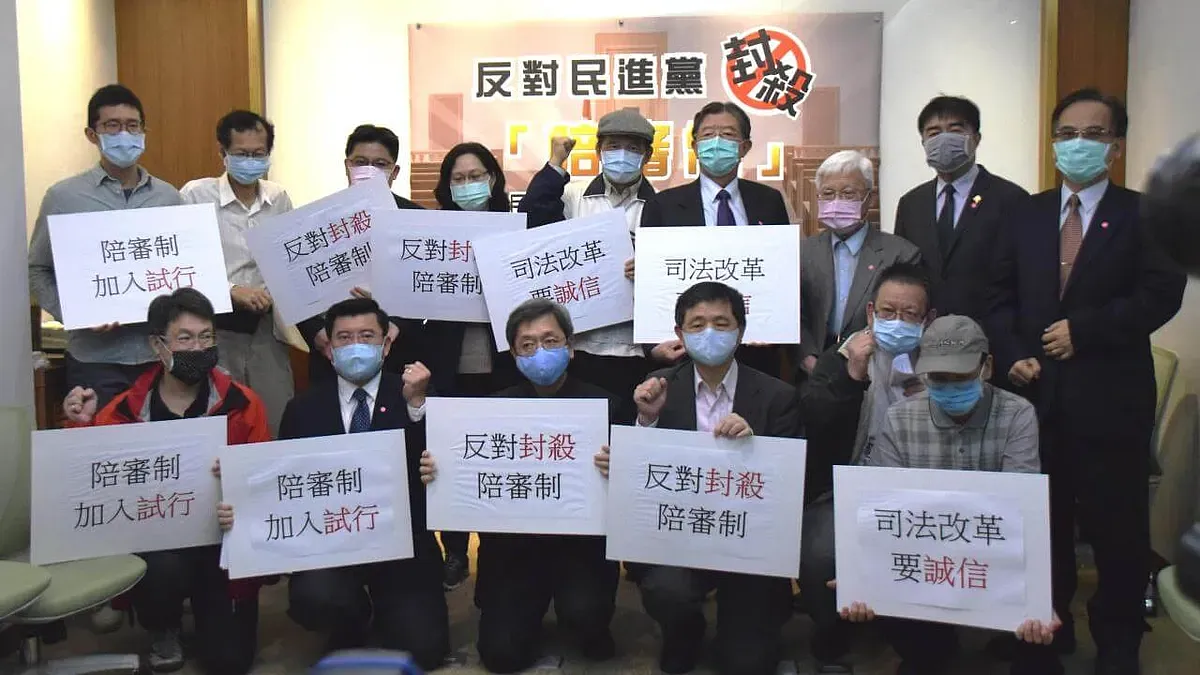
Joint Press Conference by Civil Society Organizations Opposing the Democratic Progressive Party's Suppression of the Jury System
Last edited: 2026-07-27
During the review of the draft Act on Criminal Trials with Citizen Participation in the Judiciary and Organic Laws and Statutes Committee of the Legislative Yuan this session, the Democratic Progressive Party completely suppressed the "jury system" to shield the Judicial Yuan. As the Legislative Yuan will continue reviewing the draft bill for three consecutive days this Monday, Wednesday, and Thursday, all civil society organizations concerned with judicial reform have jointly issued the following statement:
-
Good Faith is the Foundation of Advancing Judicial Reform
Beginning early last year, the Judicial Yuan engaged in intensive consultations with civil society organizations regarding the draft Act on Criminal Trials with Citizen Participation, reaching a consensus to conduct a six-year pilot program implementing both the jury system and the lay participation system concurrently, and specifically drafted a bill featuring both systems running in parallel. However, this year, without any communication with civil society, the Judicial Yuan submitted only the draft Act on Criminal Trials with Citizen Participation featuring a sole pilot of the lay participation system to the Legislative Yuan for deliberation. The Judicial Yuan's breach of promise, marked by a lack of good faith, has once again severely undermined public trust in the judiciary.
Even more disappointing is the political credibility of the Democratic Progressive Party (DPP). Article 28 of the DPP Party Charter explicitly advocates for the establishment of a jury system and the formation of juries. On September 27, 2012, Legislator K'o Chien-ming, convener of the DPP Legislative Caucus, stated in the Judiciary and Organic Laws and Statutes Committee: "Today, on behalf of the DPP Caucus, this legislator has proposed the jury system, and Legislator Yu Mei-yu is also a co-sponsor." Speeches by DPP legislators supporting the jury system can be found everywhere online. (Watchout, [8th Legislative Yuan Speech Statistics] Who Favors Public Participation in Trials?) Today, suppressing the "jury system" is tantamount to shaking the foundational legitimacy of the DPP's push for judicial reform.
-
Public Opinion is the Basis for Institutional Selection
Facing skepticism from civil society, the Judicial Yuan presented ten reasons for not adopting the jury system, emphasizing that adopting only the lay participation system as a single pilot in the draft Act on Criminal Trials with Citizen Participation is a choice planned and evaluated based on the nation's conditions and legal system. However, these ten reasons put forward by the Judicial Yuan are manifestly erroneous and clearly designed to deliberately mislead the Legislative Yuan and the general public. (See the appendix for a detailed compilation of the errors.)
Civil society believes that both the jury system and the lay participation system have their respective advantages and disadvantages, and no one can truly say for certain which system is more suitable for our country. Taiwan is currently at a crossroads of institutional selection. Civil society advocates for piloting both systems concurrently precisely to accurately assess public opinion before designing a system suited to our national conditions. The Judicial Yuan's self-righteousness in choosing the lay participation system on behalf of the people, along with legal elites' arrogance in looking down upon public opinion, is laid bare.
The Judicial Yuan's Ten Reasons for Rejecting the Jury System Are Entirely Wrong! Judicial Yuan's Reason for Rejecting the Jury System Flaws in the Judicial Yuan's Reasoning 1 The division of labor between the jury and judges prevents mutual communication and exchange. The division of labor between the jury and judges exists precisely to prevent professional judges from contaminating jurors' mental impressions. 2 Juries easily result in a hung jury. A hung jury refers to a jury's inability to reach a unanimous verdict. Some countries do not adopt unanimity; our country can design voting standards suited to our national conditions. 3 Jury verdicts do not provide reasons, making post-trial verification impossible. Jury verdicts in some countries include reasons, but whether reasons are provided or not does not affect the right of appeal. 4 Juries generally do not participate in sentencing, failing to reflect the public's views on sentencing. Juries in some countries can participate in sentencing, but all must abide by sentencing guidelines. 5 Juries involve a larger number of participants, incurring higher judicial trial costs. The jury system requires only 1 judge, whereas the lay participation system requires 3 judges. It is hard to say whether the judicial costs of jury trials or lay participation are higher or lower. 6 The jury system monopolizes the authority of fact-finding through lay citizens rather than professional judges, which may be unconstitutional. Article 80 of the Constitution stipulates that judges shall try cases in accordance with the law, but it does not restrict judges to exclusively being professional judges or lay judges. 7 Juries originated from the purpose of resisting ruling classes, which differs from the purpose of the system introduced by our country. The jury system is a universally applied trial system and has nothing to do with whether the ruling class fails to judge in accordance with the law. 8 Compared to judges, juries incur high costs and low efficiency in resolving disputes. Compared to judges alone, the lay participation system faces the exact same issues. It is hard to say whether the costs and efficiency of jury trials versus lay participation are higher or lower. 9 The jury system has declined amidst the global trend of public participation in the judiciary. More countries in the world use the jury system than the lay participation system; the jury system is more prevalent internationally. 10 Polls show that the majority of the public tends to support the lay judge system featuring joint deliberation and joint adjudication. Without an actual pilot allowing the public to understand the differences, advantages, and disadvantages between the jury system and the lay participation system, any poll lacks an empirical basis. -
Civil Society Participation in Promoting the Joint Pilot of Jury and Lay Participation Systems
On March 27, when President Tsai Ing-wen received the "Alliance for Civil Supervision of Judicial Reform National Consultative Conference Resolutions," she stated that thanks to civil society participation, judicial reform issues could continue to engage in societal dialogue and gradually achieve the goals of reform. The government will also strengthen communication platforms with civil society, implementing communication and dialogue mechanisms at both the ministry and court levels to continuously carry out the model and spirit of the National Consultative Conference on Judicial Reform.
On the core judicial reform issue of "public participation in trials," the Judicial Yuan and the DPP should especially implement the spirit of "communication and dialogue" from the National Consultative Conference on Judicial Reform, listen to the people's voices, and strive for civil society participation. Accordingly, civil society organizations call for:- The Judicial Yuan should submit the revised draft—which features the concurrent piloting of both jury and lay participation systems negotiated with civil society last year—as a reference for review by the Judiciary and Organic Laws and Statutes Committee of the Legislative Yuan.
- The DPP should not restrict its legislative members from supporting the jury system or the joint pilot of both jury and lay participation systems.
- The Judiciary and Organic Laws and Statutes Committee of the Legislative Yuan should jointly review the proposals for the "jury system" and the "concurrent implementation of both systems" alongside the Judicial Yuan's draft Act on Criminal Trials with Citizen Participation, ensuring that all versions of the bills emerge from the committee for cross-caucus consultation.
Attendees
Representatives of Civil Society Organizations
Attorneys Ch'in Yung-sung / Chairperson, Judicial Reform Foundation
Attorney Cheng Wen-lung / Founding Chairperson, Taiwan Association for Citizens' Jury
Attorney Ch'en Chuan-yueh / Founding Chairperson, Taiwan Forever Association
CEO Chang Hung-lin / CEO, Citizens' Watchdog Parliamentary Coalition
Chairperson Tsai Ming-hsien / Chairperson, Taiwan United Nations Alliance
Attorney Su Huan-chih / Former Magistrate of Tainan County
President Chang Yeh-sen / President, Taiwan Society
President Li Ch'uan-hsin / President, Peishih Society
Convener Hsu Hui-ying / Convener, Taiwan Language Normalization Promotion Alliance
Founding President Hu Shih-ho / Founding Chairperson, Taiwan Parliament Transparency Association
Chairperson Li Li-chung / Chairperson, Chinese National Rule of Law Reform Promotion Association
Director Pan Wei-yu / Director, Taiwan Teachers' Union
Attorney Chang Ching / Member, 2017 National Consultative Conference on Judicial Reform
Arts Administrator Huang Pin-hsuan / Arts Administrator, Tsai Jui-yueh Cultural Foundation
Legislators
Legislator Chiu Hsien-chih / New Power Party Legislator
Legislator Lai Hsiang-ling / Taiwan民眾黨 Legislator
Co-supporting Organizations
Taiwan Constitution Foundation
Taiwan Civil Participation Association
Animal Protection Legislative Alliance Taiwan
Taiwan Association of Criminal Defense Lawyers
Tax and Legal Reform League
Taiwan Forever Association
(Continuously adding)
Press Contacts
Hsiao I-min, Office Director, Judicial Reform Foundation
This article is an AI-generated translation of the original Chinese text. In the event of any discrepancy, the Chinese version shall prevail.