
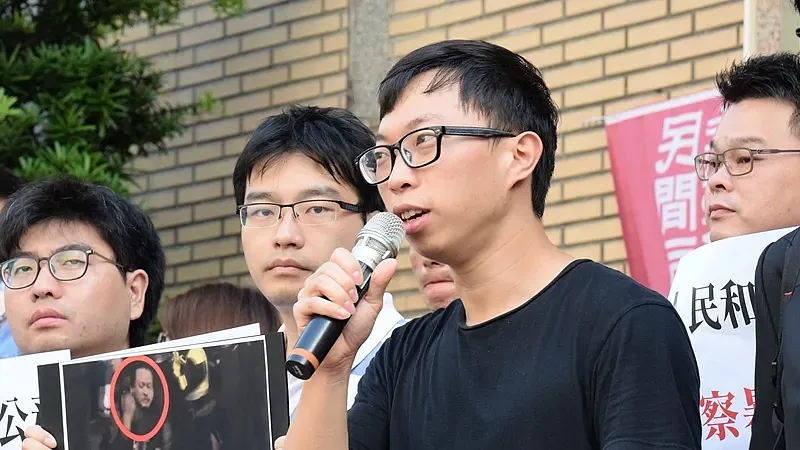
Is 6 years enough to deliver justice to participants in a social movement?
Last edited: 2026-07-27
The clock has passed midnight, and it is now April 28th—the day of the second-instance sentencing for the March 23 Executive Yuan occupation incident 6 years ago.
Spanning one-fifth of my life so far, the last event in my life that lasted this long was probably "attending elementary school"?
6 years is not a short, fleeting period for anyone. Within 6 years, a child can finish elementary school, or go from the first year of junior high to the first year of college. A graduate student can finish four years of a master's program and then take a two-year leave of absence to work on their thesis (not me). 6 years of time is enough to completely change a person.
However, is 6 years enough to deliver justice to participants in a social movement?
Today at 10:00 AM, that answer will be revealed.
---
Rooted in reasons such as "freedom of speech" and "civil disobedience," all defendants in the March 18 occupation of the Legislative Yuan case were acquitted with finality in early 2018. However, the March 23 occupation of the Executive Yuan action, which occurred merely five days later, met a starkly different fate. On April 10, 2017, the first-instance judgment for the March 23 Executive Yuan occupation case was handed down: more than half of the 21 defendants were found guilty, with sentences reaching up to five months of imprisonment. Meanwhile, prosecutors continued to appeal against the activists who were acquitted in the first instance.
Looking back at Taiwan's political dynamics in recent years, "March 18" has been crafted and presented as a symbol of "reform" and "progress," carrying hopes for so-called "new politics." In contrast, March 23 has always remained obscure, like the other side of the moon, fading into the background of mainstream political agendas for years. Every social movement naturally has its light and shadow, and this is nothing particularly unique. There were many other movements and protests concurrent with or preceding and following March 18/323 that jointly supported and constructed that generation, yet they almost never received attention and glory.
However, political significance and values are retroactively added and bestowed; what should not be forgotten or ignored in this process are the marks branded upon the activists, and their diverse faces and stories.
During the final pleading stage of the last court hearing, many defendants finally had the time to speak freely without worrying about being rudely interrupted by the judge. The statements of the crowd were brief and detached, or filled with grievance and anger: the state clearly committed wrongs first, yet people who stood up to correct them were labeled as rioters; those who maintained order at the scene were accused of incitement; covering police officers with blankets was accused of "obstructing official duties"; and after being brutally beaten with batons, they could not find the violent police officers for 6 years, only to be treated like criminals in subsequent court proceedings, constantly facing the judges' unfriendly preconceptions and overtly biased discretionary summons.
From everyone's remarks, it is evident how that movement and this lawsuit have left varying depths of scars on everyone's lives over the past 6 years. Court proceedings are mostly tedious and mundane, but these moments are often the most moving and painful.
For instance, one defendant indignantly remarked that those with high visibility and microphones who participated in March 18 could not only be acquitted but even run for public office, whereas the nameless participants of March 23 who rushed to the front lines had to be found guilty. Their words were filled with the grievances of the past 6 years. As a defendant in both the March 18 and March 23 cases, hearing these words naturally evoked mixed feelings in my heart. Yet, one undeniable point remains: in the March 23 Executive Yuan case, many people not only faced violent and merciless treatment by the state apparatus that very evening, but were subsequently cast into an even longer, crueler, and more tedious judicial litigation process. Aside from the assistance provided by the pro bono lawyer team and certain social movement activists, the resources and social attention they received were meager to say the least.
During past court hearings, defendants frequently failed to appear. Some had even missed multiple sessions, and their lawyers could not contact them. This was because, over the course of 6 years, some people had changed jobs and residential addresses, while others could no longer bear the prolonged litigation process and lacked the capacity to continuously face pressure from their workplaces (needing to take leave for court appearances) and families, choosing instead to passively confront the lawsuit.
The glory and burdens of a movement have never fallen equally on different people's shoulders.
Political logic and reality may be hard to change, but at the very least, we should strive to see and remember these different stories, and fight for a fair judgment for everyone.
---
In the first-instance judgment, almost all activists accused of obstructing official duties were found guilty. Ironically, those "holding microphones" accused of "inciting crimes" were all acquitted. Once again, this highlights the absurdity of this 6-year-long litigation: a civil disobedience action triggered by the government's unjust policies, whose participants who engaged in it out of free will were crudely divided into "those who incited others to commit crimes" and "criminals," yet in the end, the ones found guilty were entirely the so-called "incited"?
This lawsuit has been fought for 6 years, and I have repeatedly explained the same statement in court for 6 years: I—along with other individuals identified as "ringleaders"—did not incite anyone, nor did anyone else commit a crime. The action that took place on the evening of March 23 six years ago was initiated and responded to based on people's own will and judgment, under circumstances where the government disregarded the Constitution and the law to forcefully push through the controversial Cross-Strait Service Trade Agreement.
We did not incite anyone. To understand what happened on the Executive Yuan plaza that evening through Article 153 of the Criminal Code from the authoritarian era—"inciting others to commit crimes"—is nothing short of insulting to all those who entered the Executive Yuan plaza with determination that day. If they were merely incited, why did no one turn around and leave when they saw their companions ahead being dragged behind riot shields and beaten mercilessly in the dark? If they were merely incited, why did no one get up and leave when the on-site commanders knelt and begged the sit-in crowd inside the Executive Yuan to evacuate? If they were merely incited, why did people grip their companions' hands even more firmly when they saw rows of riot police advancing with slogans and water cannons entering the scene?
Similarly, we reject the accusation of "obstructing official duties." Both March 23 and March 18 belong to acts of civil disobedience undertaken by the people when the representative system faced severe threats; they fall within the scope of freedom of speech, and took the form of peaceful sit-ins, thus deserving protection. The "official duties" of the police at the scene should have been to ensure the personal safety of the participants and others under the premise of respecting this collective exercise of freedom of speech, rather than "violently suppressing" citizens exercising their rights.
---
Over the past 6 years, I am grateful to the pro bono lawyer team and the Judicial Reform Foundation for their dedicated assistance to every client. Although Taiwanese society, after experiencing three major elections, may have long forgotten the historical background, context, and process of the March 18 and March 23 actions—leaving behind only slogans like "youth participation in politics" and "new politics," perhaps coupled with decontextualized ridicule such as "awakened youth" and "eggshell chicks"—these respectable individuals still insist on vividly remembering our faces at that time, continuously advocating and speaking up for our ideals and actions back then, preventing us from doubting whether all of this was entirely meaningless. I feel heartfelt gratitude.
I hope that tomorrow, all these unforgotten memories of the past 6 years will resonate, living up to that night we endured together through clenched teeth, blood, and tears.
The sole demand: Complete acquittal for all participants in the March 23 Executive Yuan occupation case.
※ Reprinted with the author's consent
This article is an AI-generated translation of the original Chinese text. In the event of any discrepancy, the Chinese version shall prevail.