
The Road Beneath Our Feet, Where Does It Lead? Commemorating the 10th Anniversary of the Revocation of Attorneys T'ang Chi-t'ien's and Liu Wei's Licenses
Last edited: 2026-07-27
2020 marks the tenth year since attorneys T'ang Chi-t'ien and Liu Wei had their attorney licenses revoked. While many lawyers have written articles to commemorate this milestone and reflect on the present, I am stranded overseas, overwhelmed by my studies, and struggling to learn English. Burdened by these matters and my own indolence, I initially wanted to shirk this responsibility. However, both T'ang Chi-t'ien and Liu Wei are dear friends of mine. Attorney T'ang in particular has been a presence that spanned nearly the entire course of my legal practice. Upon reflection, I realize I still need to write down a few stories—letting the lesser illustrate the greater, and serving as a humble spark to draw forth genuine gems.
Looking back and recounting the fragments of my interactions with Attorney T'ang feels much like reflecting on my entire legal career.
A Fleeting Glimpse
In November 2006, I received my judicial examination scores, successfully passing to acquire qualifications for the legal profession. In 2017 [Note: likely a typo in the original text for 2007], I went to Beijing's JY Law Firm for my traineeship, and by 2008, I obtained my attorney's license and began formal practice. I remember one afternoon when several lawyers at the firm received the same letter, and unexpectedly, I got one too. The content, as I recall, called upon lawyers across Beijing to participate in the direct election of the bar association. It argued that we lawyers should elect our own association and choose association personnel who would serve the numerous attorneys. The names of several signatories have slipped my mind, but I vaguely remember one was Attorney T'ang Chi-t'ien. At the time, I was a trainee lawyer running around for my principal, struggling merely to make ends meet. Although receiving that letter stirred a wave of emotion within me, I truly had no idea what to do. I remember mentioning the letter to a few lawyers after work, and a local Beijing lawyer at our firm—noted for his particularly sharp tongue—let out a scornful, mocking laugh and said, 'Just watch, those few idiots. Once the judicial bureau steps in to deal with them, they'll be completely dumbfounded right away!'
This was the first time I heard Attorney T'ang's name, but it was just a fleeting glimpse; even the subsequent developments I only learned about years later. The reason was that for quite a long period after becoming a lawyer, I was extremely isolated. Aside from my work, I had almost no contact with lawyers from other firms. Although I later saw many dramatic gatherings and activities of lawyers handling various cases online, I was almost entirely cut off from them, and I didn't even know the names of most people. This was also a source of great distress for me.
Later on, after getting to know Attorney T'ang and many other lawyer friends—especially those who had participated in that year's direct election of the bar association—I was finally able to connect the story sparked by that 2008 letter. Back then, all the lawyers who initiated the direct election of the bar association faced persecution. To this day, almost the vast majority have lost their attorney licenses, and some even went to prison and suffered torture. Aside from T'ang Chi-t'ien, there were Chiang T'ien-yung, Hsieh Yen-yi, Wen Hai-po, T'ung Ch'ao-p'ing, Yang Hui-wen, Chang Li-hui, Ch'eng Hai, Li Su-pin, and others. These individuals almost all became my good friends later on, but back then, when I was just starting out in the profession, I was worlds apart from them. The only things remaining in my memory were that single letter and a solitary name: T'ang Chi-t'ien.
Undercurrents Spanning Four Years
In 2008, I completed my traineeship, replacing my blue trainee license with a red one, and officially obtained my attorney's license. In 2009, I transferred firms to practice independently.
The new law firm I joined was one of the largest in China today, with branches spanning almost the entire country. After arriving, I had a new office space that was magnificent and resplendent, and I immediately became ambitious, running myself ragged for cases. As a junior lawyer merely trying to survive, I took on any kind of case: divorce, real estate transactions, traffic accidents, forced evictions, criminal defense—a jack-of-all-trades lawyer handling everything. Because the scope was too broad and lacked specialized expertise, my work was miscellaneous rather than refined, and I frequently stayed up all night studying a case. The survival issue was soon resolved, and I no longer had to worry about food and clothing, but I quickly grew weary of the lawyer's life. At the time, I thought: Is my life from now on going to be nothing more than rushing from one case to another? If it were like this for a lifetime, such an existence would be utterly meaningless.
During this process, Ch'en Kuang-ch'eng was imprisoned in Dongshigu Village, Linyi, then Kuang-ch'eng went to Beijing, and then Kuang-ch'eng went abroad... I kept paying attention to this and even wrote a playful acrostic poem: 'Kuang fears the dark, Kuang provokes the villainous party's slanders; they were never meant to coexist, hence the dungeon's depths.' But I didn't know that many other lawyers were watching from behind the scenes, and I certainly didn't know that many of Kuang-ch'eng's lawyer friends were right there in Beijing.
During this period, there was also the 'strike the black' (anti-gang) campaign waged in Chongqing by Lord Po and Wang, leading to the Li Chuang case. Ch'en Yu-hsi and Kao Tzu-ch'eng represented the first instance, while Ssu Wei-chiang represented the second instance. Among them, the conclusion of Ch'en Yu-hsi's first-instance defense statement—'In the realm of legal defense, wind may enter, rain may enter, but the police may not'—and Attorney Ssu Wei-chiang's conclusion—'Public justice may not be present in the moment, but we can wait for it'—both became the most renowned defense statements of that time. At the time, I cherished and studied them deeply, but looking upon the names of these figures felt like gazing up at the Milky Way. Who would have thought that interactions with them would come later? I remember when state media publicly spread rumors that Li Chuang had solicited prostitutes, I posted a single sentence in the law firm's QQ group: 'Good people join the Party, bad people solicit prostitutes; this is a Cultural Revolution method.' As a result, I was given a thorough scolding by the firm's director... Looking back, I really want to slam the table and curse.
Furthermore, there was the famous Xiaohe Case in Guiyang. Attorney Chou Tse made monumental contributions to the Xiaohe Case. At Chou's invitation, well-known domestic lawyers gathered at the Xiaohe District People's Court in Guiyang to commence a trial lasting more than forty days. At the time, both state media and self-media outlets provided extensive coverage. Aside from Chou Tse, participating lawyers included Yang Chin-chu, Professor Ho Ping, Yang Hsueh-lin, Liu Chih-chiang, Ch'ih Su-sheng, Li Chin-hsing, Li Kuei-sheng, Chang Lei, Wang Hsing, Chu Ming-yung, Ssu Wei-chiang, and others—over a hundred lawyers in all. I was following this case, and at the time, combing through the names of these lawyers still felt like gazing at the Milky Way, cherishing them deeply yet having no opportunity to be acquainted with them.
During this period, Weibo began to catch on in China. I suddenly realized that as a 'passionate youth' of over twenty years, many of my reflections on social issues were shared by many friends online. At the same time, I handled an eviction case involving ethnic Korean residents in Yanbian, Jilin, whose homes and land were seized by the government to build a project. Eviction cases are completely unreasonable; the person governing Jilin at the time was Sun Cheng-tsai, who later filled the vacancy left by Lord Po and Wang and went to Chongqing. Rumors on the street had it that Sun was the crown prince, but this crown prince quickly ended up in the Imperial Clan Court. After taking on the case, I rushed to Jilin to investigate and gather evidence, only to be followed and threatened. When I went to the court, they refused to accept the case. After several rounds of engagement—a scholar facing hooligans, let alone hooligans wielding state power—I naturally returned in defeat. However, I truly could not bear to see a large number of ethnic Koreans rendered destitute and displaced after having their homes and land snatched by the government, so I began exposing the facts of the case online.
One day, I received an unfamiliar phone call: 'Hello, is this Attorney Ch'en? I'm T'ang Chi-t'ien...' My brain raced, flashing rapidly like a fast-rewinding movie until it landed on that letter calling for the direct election of the bar association that I had received back in 2008. I asked, 'You're Attorney T'ang?' 'Yes, it's me.' Then we began to communicate. Attorney T'ang said he had seen the Yanji eviction case I handled, noting that it was a case from his hometown, and hoped we could find some time to meet and chat. I immediately agreed. This was in the winter of 2012, like a hidden thread stretching across thousands of miles; little did I know that the person who sent the letter back then was the very person on the phone today.
Not long after, I received another call, and Attorney T'ang invited me to meet for a meal. I can no longer remember the exact location, but it was likely a very small law firm. Also attending were Li Ho-p'ing and Pao Lung-chün. This was my first contact with human rights lawyers, and I never expected that they would all later become fellow sufferers in adversity.
Converging Like the Sea
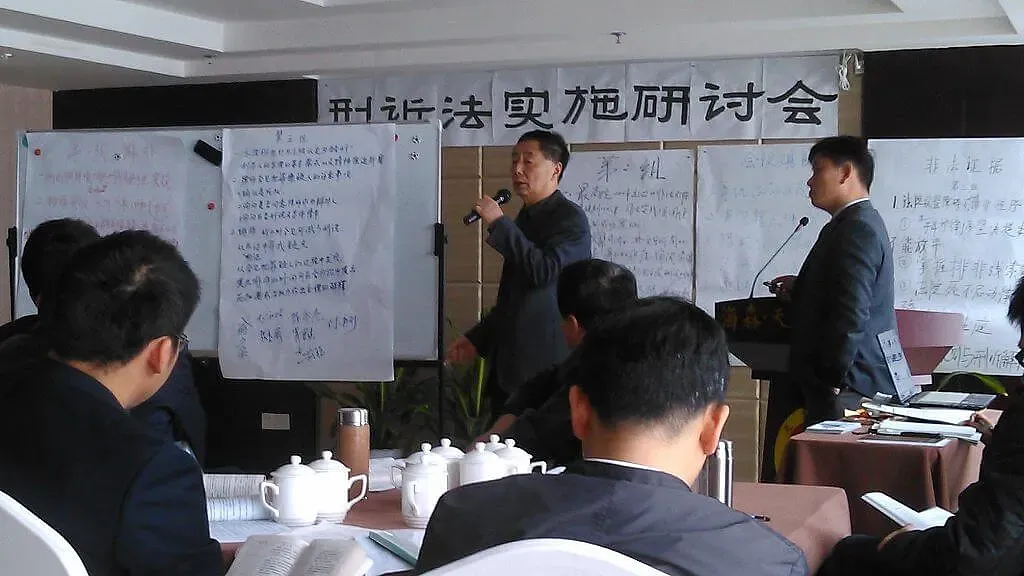
In the spring of 2013, I received another call from Attorney T'ang, inviting me to go to Ch'angsha to attend a conference on criminal procedure law. At the time, I agreed with great reluctance, still feeling deeply inadequate due to my lack of specialized expertise—attending such a high-end conference made me feel quite ashamed of myself. Yet Attorney T'ang cordially urged me to attend. Looking back today, attending this conference became a turning point in my legal career. The lawyers gathered there to study the law together formed an assembly of brilliant stars, though I didn't know any of them. I remember the night before the meeting, Attorney T'ang invited me and a few other lawyers to discuss how to kick off the ice-breaking session the next day and help everyone get acquainted. I offered a suggestion, and to my surprise, it was adopted. I suggested that everyone give a brief self-introduction covering three points: my hobbies, my dream, and... I can no longer remember what the third point was. As it turned out, the ice-breaking was a great success; the next day, many lawyers talked extensively about their dreams when sharing them, but ultimately, they could be summed up in two characters: constitutionalism. At the time, I was very ill-informed; what I said was that I hoped for an independent and fair judiciary—if the judiciary could be fair, I would gladly accept losing a case. But in today's China, the courtroom is truly not a place where reason and law are discussed. A certain Attorney Chao summarized at the end: 'What all of us share regarding our ideal is actually the same thing, and it can be summed up in two characters: constitutionalism.'
Among the many lawyers, I was a newcomer, and apart from T'ang Chi-t'ien, everyone else was completely unfamiliar to me. Seeing these great lawyers I had long looked up to standing right before me filled me with both envy and joy. For instance, Attorney Wang Ch'eng, who had already been suspended from practice at the time, handed me a business card with his photo on it. He looked as handsome as the singer Wang Chieh back in the day, and I vaguely remember the card mentioned that he had initiated the 'Hangzhou Don't Buy Real Estate Movement.' Of course, I learned the subsequent story later: the Hangzhou authorities could not tolerate it, so they suspended his work, suspended his wife's work, cut off his water and electricity, broke his ribs, and finally forced his hand, telling him he had to leave Hangzhou. As a result, he was forced to move to Wuhan.
Because I did not yet specialize in criminal defense at the time, I felt utterly ashamed of myself in front of these criminal defense heavyweights. I remember during a meal, Attorney Li Chin-hsing, dressed in a suit and brimming with imposing dignity, sat shoulder to shoulder with me and asked, 'Attorney Ch'en, what kind of cases do you primarily handle?' I wanted nothing more than to crawl into a hole, and stammered that I handled a bit of everything, but mostly civil and commercial matters, with few criminal cases. Old Li said, 'Focus mainly on criminal cases from now on; we have plenty of cases...' Outside of meetings, we climbed Mount Yuelu and listened to Attorney Liu Wei-guo recount how, before specializing exclusively in criminal defense, there was a period when he refused to take on business in other fields even when he had no cases—difficult at first, but achieving mastery later on.
By this time, Attorney T'ang Chi-t'ien's practice license had already been revoked for two years. As we exchanged business cards during dinner, I remember his card bore the words: 'The Number One Lawyer to Have His License Revoked.'
This had a profound impact on me at the time. After the conference, I returned to Beijing and bought a massive collection of books on criminal defense. I studied while handling cases, quickly phasing out cases in other areas, and became a lawyer dedicated solely to criminal defense. I was born with a rebellious streak and disliked authoritarianism, which meant I had experienced a personal awakening relatively early on. However, for over a decade, I had been an isolated 'single-strung' passionate youth—a lonely chopstick without like-minded friends. That criminal procedure law study conference in Ch'angsha, Hunan, helped me find my friends, and over the next few years, the vast majority of these lawyers became my good friends. Attorney T'ang Chi-t'ien was the initiator who prompted my professional transition and turned me into a human rights lawyer; he was the one who guided me into the great sea.
Later on, when chatting with many lawyers about how they transitioned into human rights lawyers, quite a few told me it was because of T'ang Chi-t'ien. Another lawyer said, 'Old T'ang was both a teacher and a friend to me,' and so on. The instances are too numerous to list, so I won't name them all.
Bidding Farewell at the 'Deathbed'
In the years that followed, our interactions grew even more frequent: the New Citizens' Movement case, the Dalian Falun Gong case (An Guo case), the Chi-hsi case, the Jiansanjiang incident, and so on. The stories are a long string, and I will not recount them one by one here.
On May 3, 2017, while my family and friends were vacationing in Yunnan, I was arrested at gunpoint by dozens of people and detained at a police station. In the early hours of the next morning, domestic security (guobao) agents from the Beijing Municipal Public Security Bureau, the director of the municipal judicial bureau, and multiple police officers rushed to Yunnan. Three of them escorted my wife and children back to Beijing, while two guobao agents and the judicial bureau director escorted me back. During the interrogation and psychological pressure sessions, throughout the journey back to Beijing over several days, and in the subsequent long-term surveillance I was subjected to, the guobao recounted to me how they systematically dealt with human rights lawyers one by one—such as Kao Chih-sheng, Chiang T'ien-yung, T'ang Chi-t'ien, Yü Wen-sheng, and so on. At that time, Chiang T'ien-yung had already been seized, T'ang Chi-t'ien had been in a car accident, and Yü Wen-sheng had not yet been imprisoned. The gist of the guobao's remarks was: The Party will never let you people go; we're taking you down one by one.
On April 1, 2019, I had planned a date to visit the United States as a visiting scholar, but the guobao explicitly told me it was impossible to let me go, that my wife and children should forget about leaving the country, and that this restriction was indefinite. Knowing full well they wouldn't let me go, but with the plane ticket in hand, I still wanted to go and leave a record of the process. I arranged to meet several lawyer friends at the airport—both to see me off and to serve as witnesses. Attorney T'ang was one of them. Naturally, without any doubt, I was intercepted at the airport; 'endangering national security' is the lifelong charge bestowed by the Communist Party.
Not long after, I still managed to leave China and come to the US as a visiting scholar. The CCP authorities immediately cancelled my attorney license, bringing my legal career to an end in 2019.
A Decade of Paving Roads
The 709 Crackdown erupted in 2015, turning over three hundred people into targets of suppression. Dozens were arrested, followed by wave after wave of lawyers having their licenses stripped away. Beyond my worries for these lawyer friends, I felt even greater anxiety for their children—such as those of Hsieh Yen-yi, Wen Tung-hai, Sui Mu-ch'ing, and others. Once the fathers lost their attorney licenses—what the judicial bureau calls 'smashing your rice bowl'—how were we supposed to make a living and feed our infants crying out for milk? With two little rascals of my own at home, seeing them always brings to mind friends whose rice bowls were smashed. Lawyers like T'ang Chi-t'ien, Chiang T'ien-yung, Wang Ch'eng, and others, who had their licenses stripped even earlier, endured even longer and heavier suffering over the past decade.
I briefly combed through the methods used by the CCP to persecute human rights lawyers: threats by the judicial bureau, bar association persecution, harassment by law firms, threats against family members, exit bans, confiscation of licenses, forced eviction and moving, framing and stigmatization, cutting off water and electricity, criminal framing, torture and abuse, and so on. T'ang Chi-t'ien, Chiang T'ien-yung, Wang Ch'eng, and others have tasted almost every single one of these tactics, day after day, year after year. As flesh-and-blood human beings and fathers of children, when would there ever be an end to this kind of life?
I remember during a chat, Attorney T'ang once expressed: 'Don't be eager for instant success; people like us can only be stepping stones...' A decade of paving roads—the road lies beneath our feet. Over a decade ago, T'ang Chi-t'ien, Chiang T'ien-yung, and others initiated the direct election of the bar association, which marked the beginning of their road-paving. Those who came later, like myself, guided by T'ang, Chiang, and others to become human rights lawyers, are by no means few in number. The fact that people continue to awaken and are willing to contribute a portion of their strength to democracy and the rule of law means that these road-pavers and stepping stones are radiating warmth. Yet for themselves, their work is gone, their lives are gone, their health is gone—where does this road lead?
Drafted hastily by Chien-kang
In the morning of April 23, 2020
This article is an AI-generated translation of the original Chinese text. In the event of any discrepancy, the Chinese version shall prevail.