
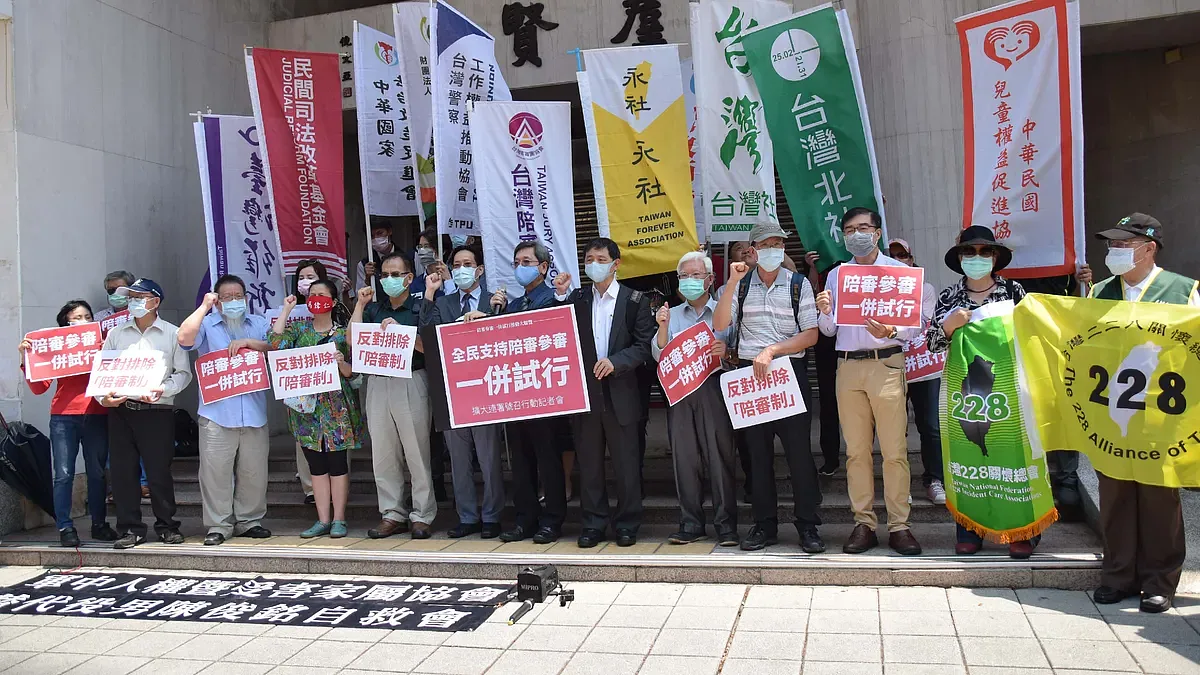
Joint Statement by Civil Society and the Judicial Yuan on Past Consultations Regarding the Draft Act on National Participation in Criminal Trials
Last edited: 2026-07-27
From December 2018 to May 2019, the Judicial Yuan took the initiative to invite the Judicial Reform Foundation and the Taiwan Association for Assessor System (collectively referred to as civil society groups) to hold seven rounds of consultations regarding the Draft Act on National Participation in Criminal Trials. However, in a press release issued on April 27, 2020, the Judicial Yuan stated that "the claim that the Judicial Yuan 'reached a consensus with civil society groups to jointly pilot the jury system and the assessor system for a period of six years, and specifically drafted a dual-system parallel bill' is entirely untrue." This statement is hereby issued to clarify the misunderstandings arising from differing interpretations by both parties regarding "dual-system parallelism" and "consensus":
-
Both parties reached a consensus on distinguishing the final deliberation of whether the defendant is guilty into jury-style deliberation and assessor-style deliberation, which civil society terms "dual-system parallelism" and the Judicial Yuan terms "internal dual-track parallelism." Because the Judicial Yuan interpreted civil society's "dual-system parallelism" as "external dual-system parallelism"—which excludes "internal dual-system parallelism"—it publicly claimed that no consensus was reached.
Civil society holds that the most critical distinction between the jury system and the assessor system lies in whether the guilt of the defendant is determined solely by citizens (jury system) or jointly by citizens and judges (assessor system). Therefore, if a system allows the defendant to choose between these two approaches, it is referred to as "dual-system parallelism," regardless of whether the same trial procedures are shared at other stages (such as the number of judges and citizens, citizen selection procedures, preparatory procedures, evidence investigation, or oral arguments).
The Judicial Yuan refers to the jury system and the assessor system as "dual tracks." If they differ only in the part where the defendant's guilt is determined, it is called "internal dual-track parallelism"; if differences also extend to trial procedures at other stages, it is called "external dual-track parallelism."
During the seven rounds of consultations between the Judicial Yuan and civil society, the Judicial Yuan already presented its planned "internal dual-track parallelism" trial procedure (refer to the consultation draft). On the most critical aspect—distinguishing whether the defendant is guilty through jury-style deliberation or assessor-style deliberation—both parties reached a clear consensus. Consequently, civil society publicly stated that a consensus on "dual-system parallelism" had been reached with the Judicial Yuan.
Interpreting the Judicial Yuan's press release with the utmost goodwill, the reason the Judicial Yuan publicly claimed that no consensus was reached is that, under its own understanding of "dual tracks," it interpreted civil society's "dual-system parallelism" as "external dual-system parallelism." This was because, during the consultation process, civil society initially took the view that if a defendant chose jury-style deliberation, the trial procedures at other stages must differ from those of assessor-style deliberation, including reducing professional judges to one and canceling interim discussions (though a consensus was later reached on this point as well, as detailed in point 2). Meanwhile, the Judicial Yuan only proposed "internal dual-track parallelism" during consultations, leading it to publicly state that no consensus had been reached with civil society.
We emphasize once again that, setting aside the terminology dispute between "dual-system parallelism" and "internal/external dual tracks," distinguishing the determination of the defendant's guilt into jury-style deliberation and assessor-style deliberation during the seven rounds of consultations was a shared consensus between both parties. Furthermore, after the Ministry of Justice joined the consultations, it also expressed agreement on this point, which is supported by documentary evidence.
-
Civil society, the Judicial Yuan, and the Ministry of Justice reached a consensus on the direction of amendments to the Draft Act on National Participation in Criminal Trials, reached partial consensus on details, and agreed to submit remaining points of disagreement to the Legislative Yuan as Version A and Version B.
Civil society believes that the Draft Act on National Participation in Criminal Trials proposed by the Judicial Yuan, aside from reservations regarding the adoption of Japan's lay assessor system, was accompanied by feedback raised during consultations. Following deliberation, civil society, the Judicial Yuan, and even the Ministry of Justice reached the following consensus:
(1) Points agreed upon by the Judicial Yuan, the Ministry of Justice, and civil society:
- Expansion of the scope of application: For the first three years, apply to cases carrying a minimum statutory penalty of seven years or more of imprisonment and intentional homicide cases; evaluate expansion of application after three years.
- Except for cases where the maximum statutory penalty is the death penalty, exclude cases where the defendant pleads guilty from the application of national participation in trials.
- Defendants may choose between assessor-style and jury-style deliberations.
- Co-defendants shall jointly decide on assessor-style or jury-style deliberation by consensus; if consensus is not reached, assessor-style deliberation shall apply.
- Lay judges shall be increased from 6 to 8.
- Direct questioning by lay judges shall be changed to indirect questioning through the presiding judge.
(2) Points agreed upon by the Judicial Yuan and civil society:
- No interim discussion in jury-style deliberation; interim discussion in assessor-style deliberation may be initiated by lay judges.
- Revision of the three-stage evidence disclosure.
- Jury-style deliberation shall participate only in sentencing for cases where the maximum statutory penalty is the death penalty.
- The judgment document for jury-style deliberation shall only briefly state the determination result without detailing reasons and reasoning processes.
- The second instance shall, as a principle, not alter the factual findings of the first instance, adopting a stricter appeal system.
From this, it is evident that under the framework of dual-system parallelism / internal dual tracks, through multiple rounds of consultations, many points of consensus gradually emerged. Although slight differences remained between the Judicial Yuan and civil society regarding the resolution of a hung jury under jury-style deliberation and the provisions drafted by the Judicial Yuan during consultations, even so, if continued consultations failed to yield a consensus, civil society and the Judicial Yuan also agreed to submit both Version A and Version B for the Legislative Yuan to decide.
-
Dual-system parallelism / internal dual tracks is a system deemed feasible by the Judicial Yuan, the Ministry of Justice, and civil society. Resolving differences through consultation is the proper remedy for judicial reform.
In summary, civil society is deeply grateful to the Judicial Yuan for its willingness in the past to proactively contact and conduct consultations, and for demonstrating absolute sincerity during the consultation process—not only maintaining a flexible attitude, organizing mutual differences, and taking a step back to seek consensus, but also proposing concrete and feasible practices and provisions to steadily and pragmatically find a workable system operational model, transforming dual-system parallelism / internal dual-track parallelism from an ideal into a viable system.
It is regrettable that such a model of judicial reform, characterized by close cooperation between the official sector and civil society in jointly seeking solutions, has not been sustained. The Judicial Yuan's current stance of defending its originally proposed assessor system draft and criticizing the jury system or dual-system parallelism only provokes stronger backlash from civil society and fails to garner public support. Such counterproductive effects further hinder the promotion of the national participation in trials system. Adopting such a hardline approach in the judicial reform process makes it difficult to imagine how concrete reform achievements can be delivered to the people.
Currently, the drafts proposed by the Judicial Yuan and various political parties are being submitted for party-caucus negotiations. Civil society once again calls upon the Judicial Yuan, the Ministry of Justice, and legislators to set aside their prejudices, seek the greatest common denominator with civil society, and jointly create a system of national participation in criminal trials that enjoys public trust.
This article is an AI-generated translation of the original Chinese text. In the event of any discrepancy, the Chinese version shall prevail.