
The Judicial Yuan's Straw Man
Last edited: 2026-07-27
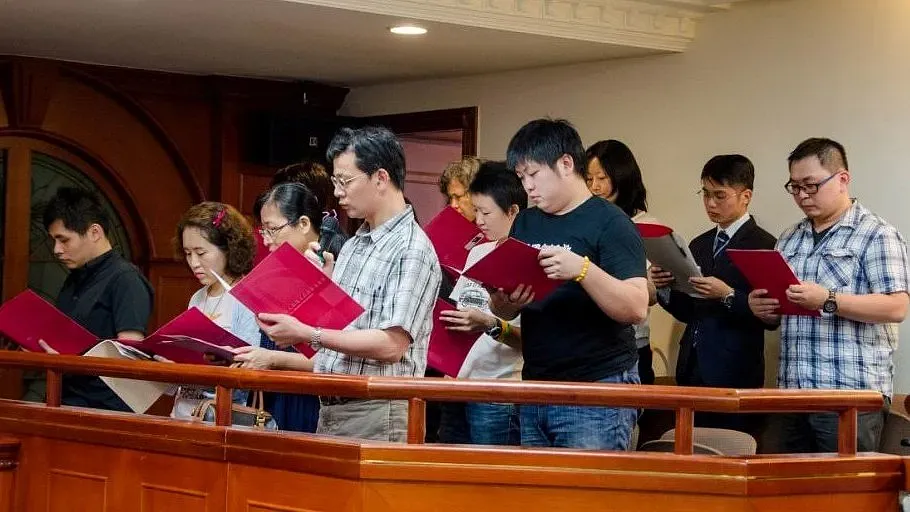
Photo/Simulated jury trial organized by the JRF in 2014, jurors taking an oath
One of来 the Judicial Yuan's primary reasons for rejecting the jury system is that it would be severely unconstitutional in Taiwan because verdicts do not come with written reasons, making post-trial verification impossible. From the perspective of constitutional guarantees of the right to litigation, this likely fails to meet the due process requirements of a fair trial; from the public's perspective, since it cannot serve as a basis for appeal, it also violates the legal sentiment of the people.
Judging from the report submitted by the Judicial Yuan to the Judiciary and Organic Laws and Statutes Committee of the Legislative Yuan on May 7, 2020, the reason the heads of the Judicial Yuan were so confident in making this categorical assertion is that the Grand Chamber of the European Court of Human Rights, in the case of Taxquet v. Belgium, required that the reasons for a jury verdict must allow the accused and the public to understand it, and therefore the reasons for rendering a guilty or not guilty verdict should be explicitly listed.
Since the opposition to the lay participation system (ts'an-shen-chih), I have been exposed to the issue of lay participation in trials for nearly 10 years. While I dare not call myself an expert, I have a rough understanding of the jury system. Based on what little I know, verdicts not requiring written reasons is a tradition of the jury system, and it is precisely this that enables juries to be free from pressure by government authorities, including the courts, and to render verdicts that protect civil rights. Among the signatories to the European Convention on Human Rights, not only the United Kingdom, but many other countries adopt a jury system or a large-scale lay participation system close to a jury (such as France). Would the European Court of Human Rights really dare to issue a judgment that almost infringes upon the freedom of signatory states to shape their litigation systems?
I was very curious and skeptical, so I took advantage of the holiday to read the judgment. Sure enough, the officials of the Judicial Yuan missed an important passage of the judgment and majorly misunderstood it.
Paragraphs 85 and 86 of the judgment first cited the opinions from previous cases such as R. v. Belgium, Zarouali v. Belgium, Planka v. Austria, and Papon, explaining that as long as the presiding judge submits questions to the jury for consideration before jury deliberation that are sufficient to structure the rationale for the jury's decision, and both the prosecution and defense can express their opinions on the submitted questions before the submission, then even if the jury's answers to these questions are unreasoned, it will not violate the Convention's requirements for a fair trial. In contrast, paragraph 88 of the judgment mentions the Goktepe case, where the professional judge refused to submit distinctive questions regarding the aggravating circumstances of individual co-defendants, making it impossible for the jury to determine the criminal responsibility of the applicant in that case, thereby violating the Convention.
Paragraphs 89 and 90 of the judgment specifically and clearly point out that a jury verdict without reasons does not naturally violate the Convention. Based on the tradition of case-law, the Convention does not require jurors to give reasons for their decisions; even if a jury renders an unreasoned guilty verdict, it does not violate Article 6 of the Convention. The Convention's requirement for a fair trial is that the accused and even the public must be able to understand the judgment. This is mainly to prevent arbitrariness, as the rule of law and the prevention of the abuse of power are the fundamental principles of the Convention. Paragraph 92 further points out that jurors are not required or permitted to give reasons based on their personal convictions; what Article 6 of the Convention requires is that the overall litigation proceedings must be sufficient to prevent arbitrariness and enable the accused to understand why they were convicted. For example, if the presiding judge submits instructions or guidance to the jury regarding facts, evidence, and legal issues that are sufficient to structure the rationale of the judgment, then even if the jury verdict has no reasons, it does not constitute arbitrariness or abuse of power.
Reading up to this point, it can be clearly and plainly stated that this judgment does not require the jury to list reasons for rendering a guilty or not guilty verdict. The officials of the Judicial Yuan misunderstood!
In the subsequent paragraphs 93 to 100, the judgment reviewed the applicant's case based on the aforementioned standards. The applicant in this case was prosecuted and tried along with 7 co-defendants. Although the indictment stated each charge against the applicant, it did not specifically indicate which evidence was used to prove the charges against the applicant. And although the presiding judge submitted 32 questions for determination to the jury, only 4 of them were related to the applicant, and these 4 short questions did not mention the precise and specific circumstances of the defendant's involvement, leaving the defendant unable to understand why they were convicted. Especially since this case was complex both factually and legally, and many witnesses and experts were summoned during the trial, it was even more necessary for the presiding judge to submit precise questions for determination to the jury. Therefore, the judgment held that the trial proceedings in this case violated Article 6 of the Convention.
Therefore, this judgment neither altered the holdings of previous cases nor stated that the jury verdict in this case violated the Convention by lacking reasons. What was determined by the judgment to violate the Convention was the litigation procedure of this case, so the officials of the Judicial Yuan truly misunderstood this judgment.
It is said that this misunderstanding led the Judicial Yuan to be full of confidence and firmly reject the jury system, so it is truly a massive misunderstanding.
In order to cope with the increasingly complex disputes of modern society and to help juries better understand the case facts and deliberate, countries adopting the jury system use practices that keep pace with the times, such as pre-trial explanations by the presiding judge, jury instructions, and even requiring the jury to answer questions for determination listed in writing, turning the voting results of these questions into a verdict form, and allowing jurors to take notes during the trial or ask questions to witnesses through the presiding judge. To be precise, what the European Court of Human Rights accepts is an evolved version of the jury system. No one is advocating that our country can only import an unevolved jury system. In fact, the several simulated trials I completed with many partners at the JRF adopted various evolutionary practices mentioned above.
Therefore, the argument that a jury verdict without reasons violates our country's constitution and should not be imported is really just setting up a straw man to shoot at.
※ Originally published in a Facebook post by the author
This article is an AI-generated translation of the original Chinese text. In the event of any discrepancy, the Chinese version shall prevail.