
"Hong Kong National Security Law" Ends Hong Kong's Autonomy! Civil Society Organizations Jointly Condemn Authoritarian China and Call for the Implementation of an Asylum Mechanism for Hongkongers
Last edited: 2026-07-27
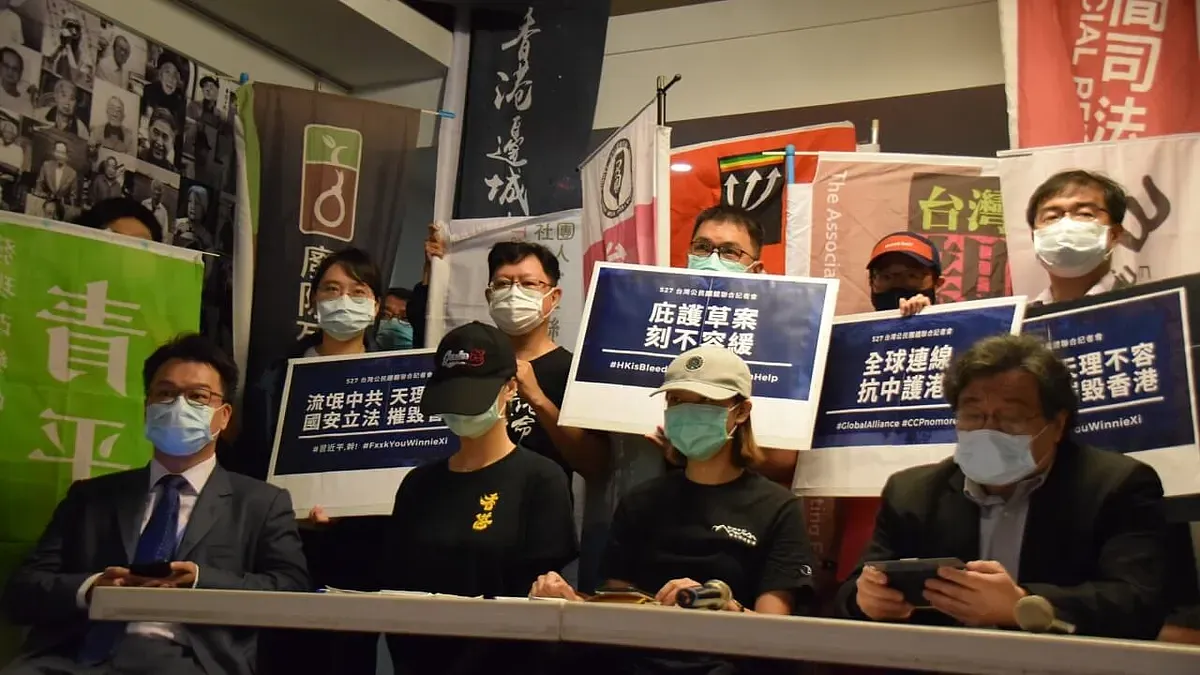
As the one-year anniversary of the anti-extradition bill movement approaches, the situation in China and Hong Kong has become increasingly severe. The National People's Congress of China bypassed the Legislative Council of Hong Kong to authorize the NPC Standing Committee to formulate the "Hong Kong National Security Law," and is expected to vote on the draft on May 28. Today (May 27), Taiwanese civil society organizations held a joint press conference to strongly condemn the authoritarian regime of China for ignoring the long-standing pursuit of freedom and democracy by the people of Hong Kong. Not only has it violently suppressed protesters, but it also attempts to completely end Hong Kong's autonomous status through the "Hong Kong National Security Law."
Kuma, chairperson of Hong Kong Outlanders, stated that in addition to forcing through the national security law, the "National Anthem Law" will also enter its second reading procedure today, and Hongkongers will surround the Legislative Council to protest against these bad laws. Kuma mentioned that the current draft of the "Hong Kong National Security Law" explicitly stipulates that China will establish a national security law enforcement agency in Hong Kong, and may at any time criminalize Hong Kong protesters under fabricated charges such as "secession" or "subversion of state power," completely restricting the free space for activities previously enjoyed by organizations or groups from international communities such as Taiwan in Hong Kong.
China Exposes Its Own Vulnerabilities, Hongkongers Continue to Resist
Justine, spokesperson for Hong Kong Outlanders, believes that by bypassing local legislation and forcing through the "National Security Law," China is not only denying universal values such as freedom, democracy, and human rights—going against global trends—but is also revealing the internal insecurity and vulnerabilities of the regime. Justine further explained that while Hong Kong is realistically within China's sphere of sovereignty, China did not even dare to formally route the national security law through Hong Kong's Legislative Council for "certification," which shows that they lack confidence in securing alliances with the majority of social strata locally in Hong Kong, and their ruling legitimacy is tottering.
Justine reiterated that "One Country, Two Systems" has always been a lie, and the "National Security Law" has further made the whole world see the reality of China's colonization of Hong Kong. Citing recent remarks made by Hong Kong Chief Executive Carrie Lam at a press conference, she pointed out that the enactment of the "National Security Law" by the Chinese NPC is imperative; even if it is not done this time, the Hong Kong-China governments, lacking any autonomy, will still promote "Article 23" in the future to end the two systems, and the people of Hong Kong should not hold any illusions about China.
Justine believes that the people of Hong Kong at this very moment will definitely stand up to resist the bad laws. She further pointed out that an authoritarian regime that goes back on its word and violates the Sino-British Joint Declaration is a threat to all open societies and civilized countries. On behalf of Hong Kong Outlanders, she called on the global community and overseas Hongkongers to network, stand together against China to protect Hong Kong, and chanted the slogan, "Hong Kong independence, the only way out."
Hong Kong Brothers and Sisters at Home and Abroad Rally, June Actions to Resist Bad Laws
Hsiao-lin (Hsiao-lin), spokesperson for the Tainan Hong Kong Concern Group, traveled north to attend the press conference. She mentioned that the "Hong Kong National Security Law" authorizes Chinese national security to enforce laws in Hong Kong and arbitrarily arrest and detain citizens in China for administrative detention and trial, with the sole purpose of eradicating all dissenting voices. She pointed out that while most people assume Hong Kong will not see millions of people sent by China into concentration camps like in Xinjiang, this could become a reality in Hong Kong within a short period of time. However, Hsiao-lin disagreed with the claim that "Hong Kong has no hope." She said that when the second reading of the "National Anthem Law" took place, Hongkongers initiated the "Three Strikes" (strikes by workers, business owners, and students) and surrounded the Legislative Council, demonstrating that the people of Hong Kong are still fighting and will not yield or surrender.
Hsiao-lin stated that the "Tainan Hong Kong Concern Group" was established by the Hong Kong community in Tainan. On June 12, the one-year anniversary of the anti-extradition bill movement, they will collaborate with the Taiwan Association for Human Rights to launch the "Tainan Sings with You" action to connect the local significance of Hongkongers and Tainan, unite together, safeguard Taiwan, and show solidarity with Hong Kong.
Global Anti-China Alliance, Taiwan and Hong Kong Civil Societies Take the Lead
Wu Jui-jen (Wu Jui-jen), member of the Academic Committee of the Economic Democracy Union and associate research fellow at the Institute of Taiwan History, Academia Sinica, provided a calm analysis of the current situation, explaining that the "Hong Kong National Security Law" signifies that China is essentially abandoning "One Country, Two Systems" and imposing comprehensive regulatory control over Hong Kong. He pointed out that China's current situation is effectively one of "internal troubles and external pressures, leading to desperate moves." Internally, it faces political accountability for the COVID-19 pandemic, political struggles among high-level leadership, and downward pressure on the domestic economy. Externally, it is accompanied by the outbreak of a new US-China Cold War, international trade sanctions, the irreversible economic decoupling between the US and China, the stabilization of Taiwan's independent status, and challenges in the restructuring of global economic and industrial chains. As China's node connecting domestic and external affairs, Hong Kong has become the first battleground of the new US-China Cold War. Wu Jui-jen emphasized that China's actions are tantamount to ending the foundational conditions of an international financial center such as freedom and the rule of law, proclaiming the death of Hong Kong's status, and will also trigger a complete rupture in the political identity of Hongkongers.
Wu Jui-jen also emphasized that pushing through the national security law is a calculated and risky move by China—a Crimean model of "taking advantage of a crisis, making the first move to create a fait accompli, and then using war to force peace." Compelled by internal and external troubles while Western nations are preoccupied with the pandemic during this period, China is taking risks to pursue the territorial expansion of Chinese imperialism. He stated that in China's calculations, the "second handover of Hong Kong" will excite Chinese nationalists, but it will inevitably lead to the "scorched-earth policy and mainlandization" of Hong Kong. Foreign capital will gradually withdraw, and the people of Hong Kong will inevitably continue to resist, only to face ongoing suppression and arrest, being forced into exile, and ultimately falling into complete ruin. Citing the last British Governor Chris Patten's remark that "the old Hong Kong will experience a lonely death," Wu Jui-jen also pointed out that the fallen Hong Kong will not disappear; instead, it will go underground, become protracted and habitual—much like Taiwan's democracy movement during the past martial law era—and the new Hong Kong will gradually be born out of new resistance.
Wu Jui-jen finally reminded that Taiwan's role cannot remain merely at humanitarian rescue. According to geopolitical analysis, after Hong Kong, the second battlefield for the US and China will be Taiwan. If Hong Kong is comprehensively suppressed, China's imperialist expansion toward Taiwan will inevitably strike overwhelmingly. He called on the Taiwanese government and civil society to heighten their vigilance and continuously provide logistical support to Hong Kong, because if the lips are gone the teeth feel cold, and Hong Kong and Taiwan are as one; saving Hong Kong means saving Taiwan.
Chiang Min-yen (Chiang Min-yen), spokesperson for the Taiwan Citizen Front, stated that in the face of the "Hong Kong National Security Law," Taiwan must also formulate timely response measures. Chiang Min-yen pointed out that as early as the beginning of the anti-extradition bill movement last year, the Taiwan Citizen Front had called upon the Executive Yuan, should the Chinese government use coercive means to completely strip Hong Kong of its relative autonomy, to invoke Article 60 of the Laws and Regulations Regarding Hong Kong and Macao Affairs and report to the President to issue an emergency decree suspending the application of certain provisions. Now that President Tsai has also publicly declared that she will assess the situation in Hong Kong and cancel its special status depending on the circumstances, Chiang Min-yen believes that President Tsai should further and clearly explain her specific policy instruments. He suggested that the Taiwanese government directly apply the Act Governing Relations Between People of the Mainland Area and the Taiwan Area to the entry treatment of regime tools such as Hong Kong officials and police, regulate that Hong Kong residents, legal persons, groups, or other institutions coming to Taiwan for investment must provide a "letter of commitment that mainland capital has no material influence," while simultaneously building friendly relations with the Hong Kong civil society, and even safeguarding the opportunities for Hong Kong protesters and those criminalized due to protests to obtain political asylum in Taiwan.
Chiang Min-yen emphasized that before the 2020 Taiwan presidential election, the global community witnessed the bloody and cruel suppression of assemblies and parades by the Hong Kong police. The violent means of China's colonization of Hong Kong further deepened the anxiety of Taiwanese citizens regarding the "fear of losing our nation," and subsequently, the people of Taiwan strongly expressed their collective determination to reject annexation by China through the general election. Chiang Min-yen believes that regardless of before or after the election, as long as China's intentions of infiltration and aggression against Taiwan do not disappear, Taiwan's actions to support Hong Kong will not only possess moral significance, but can further deter China's external expansion and ambition to annex Taiwan.
Chiang Min-yen then quoted the recent report United States Strategic Approach to the People's Republic of China published by the White House, which indicates that the U.S. government is moving away from the "friendly policy" toward China adopted over the past 40-plus years and shifting comprehensively toward a route of curbing China's expansion. Chiang Min-yen mentioned that as the strategic alliance of global containment against China gradually takes shape, both civil society and governmental levels should play active roles in leading the global community to resist the authoritarian regime of China. Chiang Min-yen stated that within the next few weeks, civil society organizations and the Hong Kong community in Taiwan will launch actions to jointly visit multiple foreign representative offices in Taiwan, calling on the international community to provide political asylum to Hong Kong protesters in response to the implementation of the "Hong Kong National Security Law." Regarding reports by British media that the British Prime Minister intends to plan related mechanisms for sheltering Hongkongers, Chiang Min-yen believes that in the wake of the "Hong Kong National Security Law," rescuing Hongkongers will gradually become the common symbol and mission of the international democratic camp.
Civil Society Proposes Draft Regulatory Order, Calls on Government to Implement Asylum Mechanism
rAttorneys-at-law Lin Chun-hung (Lin Chun-hung), spokesperson for the Taiwan obligations lawyers group supporting Hong Kong protesters, mentioned that Taiwanese lawyers have continued to support the asylum work of Hong Kong protesters coming to Taiwan. He believes that the Taiwanese government is indeed willing to provide assistance, and friendly government responses have been continuously seen during past communication processes. However, he emphasized that the loopholes in the current system prevent governmental commitments from being translated into concrete support, and clarifying Article 18 of the Laws and Regulations Regarding Hong Kong and Macao Affairs and related asylum mechanisms remains necessary; the Taiwanese government needs to demonstrate its determination to back Hong Kong here.
Lin Shu-han (Lin Shu-han), refugee issue specialist at the Taiwan Association for Human Rights, stated that over the past year since the anti-extradition bill movement, many Hong Kong protesters have left their homes and come to Taiwan facing political prosecution and threats to their personal safety. However, up to now, we still lack a legal asylum system, relying only on the vague textual space of Article 18 of the Laws and Regulations Regarding Hong Kong and Macao Affairs as a makeshift legal basis for the government to temporarily respond to the needs of Hong Kong protesters. Lin Shu-han emphasized that many specific details required for asylum work face numerous intractable problems due to the lack of legal grounds for government agencies' promises to provide assistance "in accordance with existing laws," such as unclear procedures, lack of professional manpower, difficulties in cross-departmental coordination, and a shortage of various resources for those assisted. Currently, all of these must rely on civil society cooperation and support to be provisionally and precariously resolved.
She pointed out that civil society organizations will soon propose a draft regulatory order subordinate to Article 18 of the Laws and Regulations Regarding Hong Kong and Macao Affairs, which will explicitly list the application procedures, the effects of passing the procedures, and relief channels, while formulating relevant norms targeting government manpower and budgets. She emphasized that clarifying the asylum mechanism is intended to provide government agencies with a legal basis to allocate budgets and manpower to solve problems. She also explained that in the future, in accordance with the provisions of Article 152 of the Administrative Procedure Act, "stating in writing the purpose, basis, and reasons for the enactment of the regulatory order, along with relevant materials," the draft content will be sent to the competent authority, the Mainland Affairs Council, hoping that the civil version of the draft will serve as a modest stimulus to attract valuable contributions, demonstrating civil society's joint commitment to establishing an asylum mechanism and supporting Hong Kong.
Kuma, chairperson of Hong Kong Outlanders, added that considering the devastating effects of the national security law, a large number of Hong Kong protesters are expected to come to Taiwan seeking assistance after the epidemic eases. Taiwanese civil society organizations suggest that the government make advance deployments to implement the draft regulatory order for Article 18 of the Laws and Regulations Regarding Hong Kong and Macao Affairs and clarify the asylum mechanism as soon as possible.
Attendees
Moderator
Kuma, Chairperson of Hong Kong Outlanders
Group Speakers
Justine, Spokesperson of Hong Kong Outlanders
Lin Chun-hung, Spokesperson of the Taiwan Obligations Lawyers Group Supporting Hong Kong Protesters
Hsiao-lin, Hongkonger in Taiwan and Spokesperson of the Tainan Hong Kong Concern Group
Wu Jui-jen, Academic Committee member of the Economic Democracy Union and Associate Research Fellow at the Institute of Taiwan History, Academia Sinica
Chiang Min-yen, Spokesperson of the Taiwan Citizen Front
Lin Shu-han, Refugee Specialist of the Taiwan Association for Human Rights
Media Contact
Ms. T'ang / Initiator of Hong Kong Outlanders, Advocacy Specialist of the Judicial Reform Foundation
Supporting Organizations
Hong Kong Outlanders
Taiwan Obligations Lawyers Group Supporting Hong Kong Protesters
Economic Democracy Union
Taiwan Citizen Front
Taiwan Association for Human Rights
Tainan Hong Kong Concern Group
Judicial Reform Foundation
School of Democratic China
Amnesty International Taiwan Section
Alliance of Referendum for Taiwan
Association for Parent-Child Collaborative Education
Taiwan Youth Association for Democracy
Covenant Watch
Tsai Jui-yueh Dance Research Institute
Presbyterian Church in Taiwan
Taiwan Association of University Professors
Environmental Jurists Association
Taiwan Alliance for Advancement of Youth Rights and Welfare
Environmental Rights Foundation
Taiwan Alliance to End the Death Penalty
Tibet Taiwan Human Rights Network
Green Citizens' Action Alliance
Taiwan Labor Front
Green Formosa Fund
North Society
This article is an AI-generated translation of the original Chinese text. In the event of any discrepancy, the Chinese version shall prevail.