
The Distance Between Superiors and Brutal Police: Observations on the Oral Argument Hearing of the March 24 Private Prosecution Case
Last edited: 2026-07-27
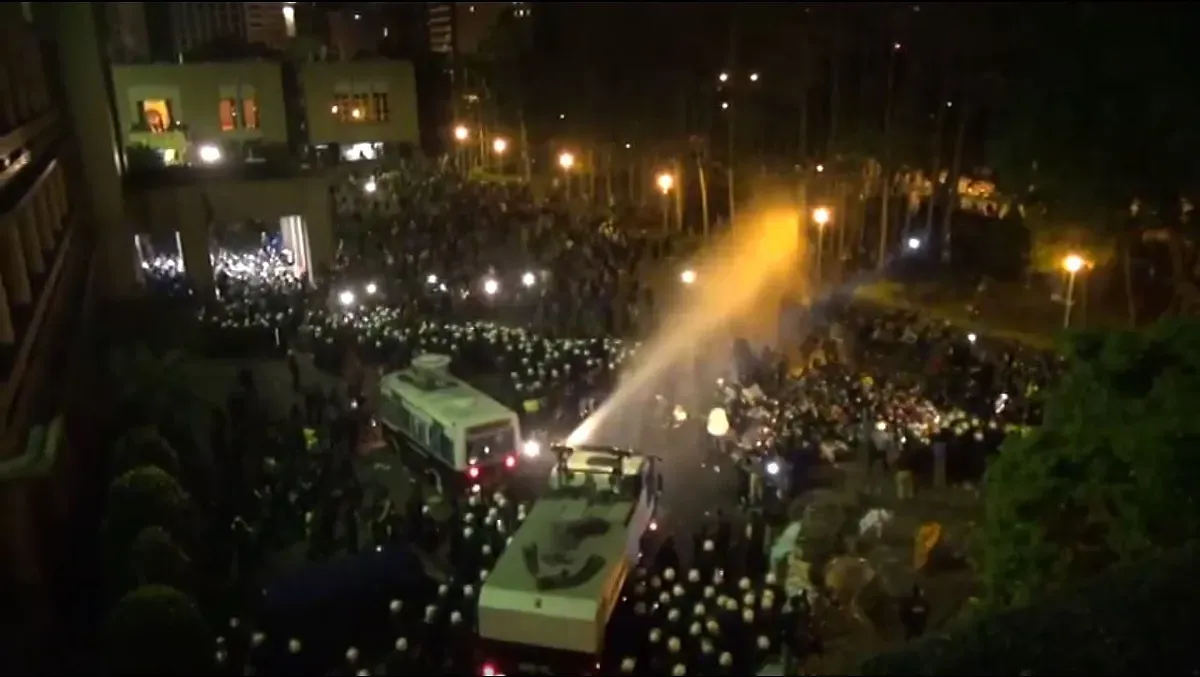
Photo / In the early hours of March 24, 2014, police used a high-pressure water cannon to spray directly at sit-in protesters
In March 2014, crowds in black clothes inside MRT cars, banners of various colors, and shoulder-to-shoulder Ch'ing-tao East Road. On the evening of the 23rd, the peaceful sit-in around the Legislative Yuan, pressured by a lack of dialogue and time, escalated into an action to occupy the Executive Yuan. In the early morning of the 24th, under the slogan of police maintaining order, blood stained the land red.
Six years later, on June 3, 2020—the day before the anniversary of the Tiananmen Square crackdown and the date for the conclusion of oral arguments in the first instance of the private prosecution concerning the March 24 Sunflower Student Movement's occupation of the Executive Yuan—21 plaintiffs filed a private prosecution against Ma Ying-jeou, Chiang Yi-huah, Wang Cho-chun, and Fang Yang-ning. Citing charges of attempted murder, serious injury, bodily injury, and coercion, they bitterly accused the superiors along the chain of command of state-sanctioned violent suppression.
Claims and Defenses
Regarding the procedural flow, the private prosecutors' counsel first presented their arguments regarding common and individual parts respectively, followed in order by the defendants and defense counsels' arguments, sentencing arguments, and finally the defendants' closing statements.
The arguments concerning the common parts were presented by four private prosecutors' counsels divided into four segments, ranging from the arrangement of the factual sequence, the tracing of the police chain of command, and the explanation of the responsibility of Chungcheng First Precinct Chief Fang Yang-ning, to the final discussion of the legal liabilities of the four individuals: Ma, Chiang, Wang, and Fang[1]. While holding individual frontline police officers accountable for violence is unquestionable, the greatest challenge in this private prosecution case lies in: how to construct the chain of command within the police system, tracing the responsibilities of superiors from the bottom up; in other words, how to prove that Ma, Chiang, Wang, and Fang "ordered" the "violent" dispersal of the people?
Faced with this challenge, the legal team of private prosecutors' counsel first used relevant evidence and facts to deduce the defendants' criminal intent, and then attempted to break through the bottleneck where traditional co-principal liability theory cannot hold superiors in the military and police systems accountable by employing the theory of "perpetrator behind a perpetrator" (Täter hinter dem Täter).
First, regarding the construction of criminal intent, given that the ratio of police to protesters was as high as four to five times, the police had no choice but to resort to force to achieve the goal of "time-limited dispersal." However, former Executive Yuan Premier Chiang Yi-huah still ordered that "the Executive Yuan must go to work tomorrow" despite knowing full well that police forces were severely insufficient, which leads to the deduction that Chiang had at least dolus eventualis (oblique intent) regarding offenses such as bodily injury. Moreover, for example, it is estimated that there were over 200 police officers of the rank of two-stripe-two-star or higher at the scene that day. In an environment with such a high density of police officers, the people gathered around the Executive Yuan not only failed to receive adequate protection, but police violence incidents occurred frequently instead. The only possible explanation is that the superiors had long reached a consensus on the bloody suppression, and thus turned a blind eye to the violence of the state apparatus at the scene.
Secondly, the legal team used the theory of "perpetrator behind a perpetrator" to explain that even if it is difficult to fully prove the criminal conspiracy of the four individuals—Ma, Chiang, Wang, and Fang—regarding "violent dispersal," given the characteristics of the police system such as "absolute obedience" and "strict hierarchy," and considering the severity of the state apparatus's violence, superiors along the chain of command should not be allowed to easily shirk their faults. Instead, they should bear the responsibility of protecting the people on their shoulders in the capacity of a "perpetrator behind a perpetrator." Attorney Yu Po-hsiang stated, "Judged by the standards of crimes against humanity under international law, generally speaking, the farther one is from the killing, the greater the responsibility."
As for the defense counsel, their arguments mainly consisted of several points: First, there is a lack of "power linkage" between the defendants and the police officers who actually committed the violence, and simply constructing a chain of command is insufficient to prove the criminal intent of superiors such as the defendants; Second, the proper approach is to root out the police officers who truly committed unlawful violence, and the arguments of the private prosecutors' counsel are tantamount to using the defendants and others as "substitutes" because they failed to catch the violent police officers; Third, during the dispersal process, the police officers who exerted violence were only a minority, which further proves that the defendants did not order violent dispersal; Finally, the occupation of the Executive Yuan, a constitutional organ, was already an illegal act and therefore not protected by the freedom of assembly and procession. Furthermore, the situation on that day was chaotic and quite a number of police officers were also injured, indicating that the "state apparatus violence" portrayed by the private prosecutors' counsel is only a part of the facts, not the full picture.
Reflections
Will the court accept the responsibility of Ma, Chiang, Wang, and Fang along the chain of command as advocated by the private prosecutors' counsel? From the perspective of the legal logic of this case alone, under circumstances where complete evidence gathering (the content of orders, the use of violence) can hardly be expected, the criminal liability of the defendants is not straightforward. The task of value choice assigned to the judge in this case is even more arduous than the subsumption of statutory elements: between the maintenance of social order and the freedom of assembly and procession, which carries more weight? When citizens engage in illegal assembly, what is the red line for police in dispersing the crowd? When holding individual police officers accountable is an almost impossible mission, should the precinct chief who issued the command, the higher-level National Police Agency Director-General, the Premier of the Executive Yuan whose approval is required before a dispersal action can be carried out, and even the President who supported the dispersal action, be held accountable for state violence?
The birth of various criminal law theories aims to make case outcomes closer to the ideal image of fairness and justice; and whether to adopt a specific criminal law theory also symbolizes what that image in the court's mind should look like—this is equally true for the "perpetrator behind a perpetrator theory" advocated by the private prosecutors' counsel in this case. Stepping back from the perspective of individual cases, the deeper meaning symbolized by the judgment result of this case is the value trade-off between social order and freedom of assembly on the scales—perhaps it is the boundary set by the judiciary for the people's freedom of assembly, or perhaps it is the red line drawn by the judiciary for law enforcement police and high-ranking superiors. And what this oral argument presented was the debate over these propositions.
Having just passed the June 4th Tiananmen Anniversary, the one-year anniversary of Hong Kong's anti-extradition bill movement is approaching, and it coincides with the surging protests in various U.S. cities against white police brutality. Discussions on the boundaries of police law enforcement will not cease, but it is hoped that on the day the judgment is pronounced on September 15, 2020, Taiwan will be able to find a better balance between human rights protection and social order.
Notes
- For the slide presentation links of the private prosecutors' counsel, please refer to: https://www.facebook.com/jrf.tw/posts/10157437133289077
This article is an AI-generated translation of the original Chinese text. In the event of any discrepancy, the Chinese version shall prevail.