
President Tsai, Can Judicial Reform Spread Its Wings Like an Eagle?
Last edited: 2026-07-27
Whether a nation can be great depends on whether those with decision-making power have a forward-looking vision, are willing to listen to the voices of the people, and possess extraordinary courage and wisdom to establish critical, enduring systems for the public.
Since 1996, Taiwan has held seven direct presidential elections. What everyone now takes for granted as a direct presidential election has become the greatest symbol distinguishing democratic Taiwan from totalitarian China. Looking back at 1992, the opposition Democratic Progressive Party (DPP) advocated for the direct election of the president, while the ruling Kuomintang (KMT) advocated for indirect elections. President Li Teng-hui went deep into the grassroots to understand the public's reasons for demanding a direct popular vote and, taking into consideration the opinions of the opposition DPP, firmly advocated for the direct popular election of the president by all citizens. Despite being counterattacked by conservative forces within the KMT and failing to pass during the National Assembly's constitutional amendment process in 1992, President Li did not give up and continued his efforts. Finally, the National Assembly resolved in July 1994 that starting from the next (9th) presidential term, the direct election of the president and vice president would be implemented. This "creative destruction" system turned Taiwan around and laid an important cornerstone for its democracy.
Before President Tsai Ing-wen's inauguration on May 20 this year, the Chinese Public Opinion Research Association conducted a poll on satisfaction with her major governance items. The results showed that after four years of President Tsai's administration, 65% of the public were satisfied with her performance, while 22% were dissatisfied. Among them, public dissatisfaction was highest regarding judicial reform, with 45% dissatisfied and 39% satisfied—the only item where dissatisfaction outweighed satisfaction. In 2016, President Tsai personally convened the National Congress on Judicial Reform, inviting a majority of non-legal professionals from civil society to participate, resulting in multiple major resolutions. Compared to past presidents, President Tsai has invested the most in judicial reform, but why has it still yielded no results to date?
A survey on the public's perception of the judiciary commissioned by the Judicial Yuan and conducted by Academia Sinica in 2019 showed that 52.5% of the people believed court judgments were unfair, 66.4% did not believe trials were independent, and 50.8% did not trust the courts. Regarding citizen participation in criminal trials, 70.8% of the people believed it would help increase trust in the judiciary. This shows that the key system for boosting public satisfaction is citizen participation in trials. The question is, which system of citizen participation should be implemented?
Regarding citizen participation in trials, the "observer participation system" (kangansheng) initially proposed by the Judicial Yuan stemmed from an attitude of assuming the judiciary is fine, but the people simply don't understand it, and once the people come to court to take a look, they will realize how hard judges work. Later, under opposition from various sectors, the Judicial Yuan proposed Japan's lay judge system (saibanin system), but its essence still distrusts the people, as 6 citizen judges are guided and constrained by 3 professional judges.
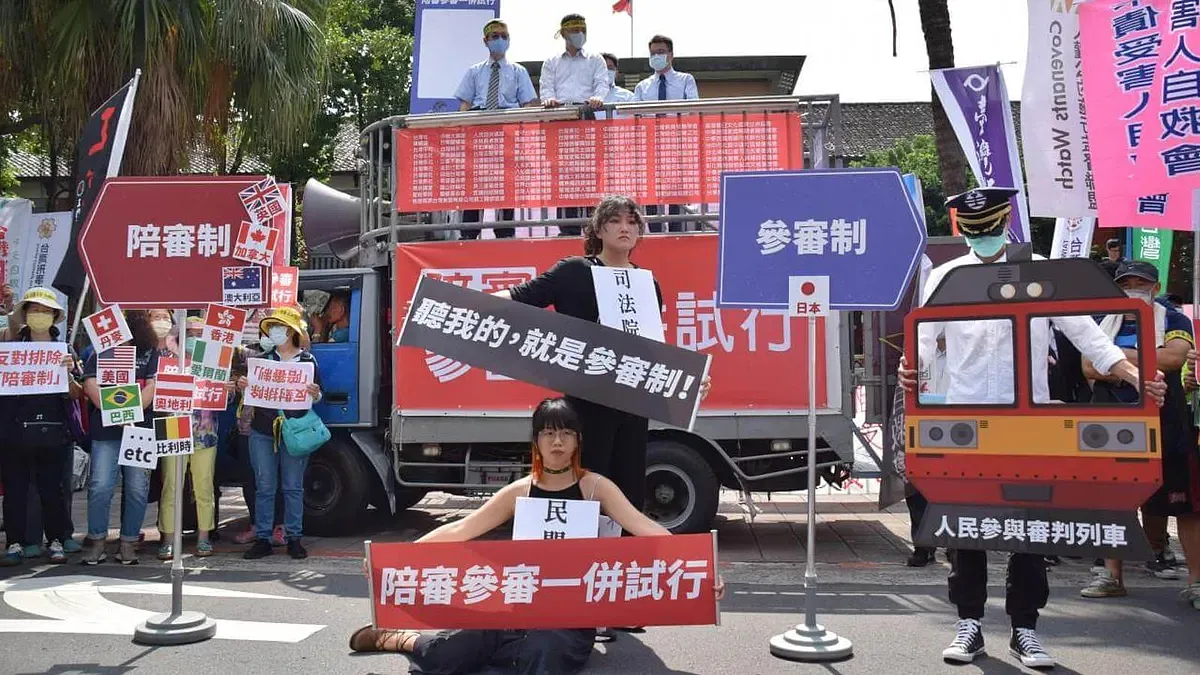
When President Tsai Ing-wen convened the National Congress on Judicial Reform, a majority of civil society members advocated for the jury system. The official Japanese lay judge system and the civil society jury system each received 7 votes, running neck and neck.
This year, ignoring the civil society members' advocacy for the jury system at the National Congress on Judicial Reform, the Judicial Yuan proposed a citizen participation trial bill in the Legislative Yuan that completely excluded the jury system—which has been adopted by 52 countries worldwide for centuries—and uniquely favored Japan's lay judge system, which has only been implemented for 11 years. It also completely rejected the pilot implementation of both the jury and lay judge systems advocated by over 170 civil society organizations. Since the Judicial Yuan insists on sticking to its starting point, why did President Tsai even bother convening the National Congress on Judicial Reform?
Why is the Judicial Yuan unwilling to listen to public opinion? It is truly baffling. This highlights one of the biggest problems of the judicial system: bureaucratic conservatism and self-righteousness. Isn't it ironic that a judiciary that has long lost public trust insists on Japan's lay judge system with an attitude of distrusting the people?
As President Tsai Ing-wen leads the DPP in holding full governance power, and given that three opposition parties currently support the pilot implementation of both jury and lay judge systems, we hope that President Tsai can have a more forward-looking vision, listen to the public's voice for the jury system, and use extraordinary courage and wisdom to establish a system for the parallel pilot implementation of both jury and lay judge systems. By employing "creative destruction," she can lay an enduring cornerstone for the democratization of the judiciary and rebuild public trust in it.
※ This article was published in the Apple Daily on June 10, 2020
This article is an AI-generated translation of the original Chinese text. In the event of any discrepancy, the Chinese version shall prevail.