
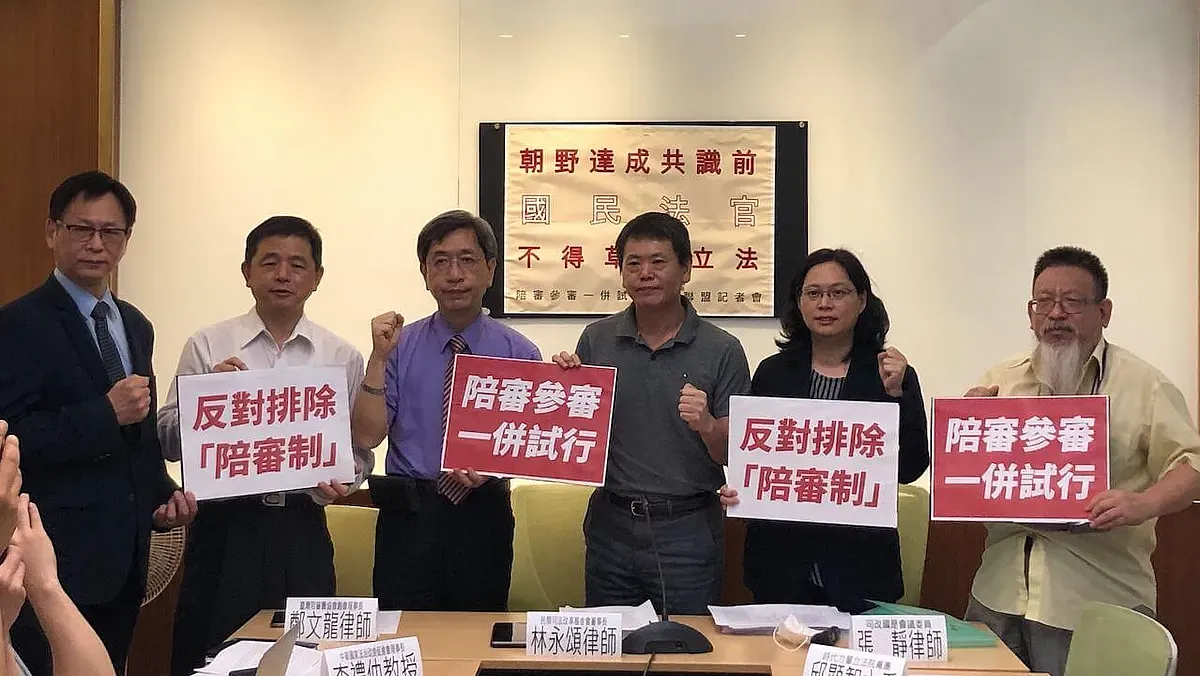
Alliance Press Conference: Lay Judges Act Should Not Be Haughtily Legislated Before a Bipartisan Consensus is Reached
Last edited: 2026-11-03
Alliance for the Simultaneous Trial and Implementation of Lay Participation Systems petitioned at the entrance of the Legislative Yuan on May 8, successfully securing the signatures of caucus conveners from three opposition parties—the Kuomintang, the Taiwan People's Party, and the New Power Party—in support of running both systems concurrently. Subsequently, the Democratic Progressive Party caucus in the Legislative Yuan invited alliance representatives to explain their stance on four occasions: May 15, May 21, May 25, and June 1, and scheduled another session on June 10 at 19:00 to hear the alliance's explanations regarding the draft amendments.
In response to criticisms and advice from the Judicial Yuan, the Ministry of Justice, and various sectors of society regarding the simultaneous trial of lay assessor and lay jury systems, the alliance has drafted concrete and feasible amendments. The draft version has been provided to all political parties in and out of government for research and reference, with key points outlined below:
-
Distinguishing the Application of Jury or Lay Assessor Systems by Crime Types
Currently, the Judicial Yuan's draft lay assessor system is designed for cases carrying a minimum sentence of 10 years or more of imprisonment, adjudicated by 3 professional judges and 6 lay judges. The alliance contends that crimes involving greater controversy among the public regarding professional judges' participation should be subject to the jury system, such as murder, violations of the Anti-Corruption Act, offenses of obstructing official duties, violations of the Assembly and Parade Act, vote-buying offenses, offenses of domestic/foreign rebellion, and the Anti-Infiltration Act. Only then can the authority effect of judges—which the Judicial Yuan's lay assessor system fails to resolve—be eliminated. In particular, Article 28 of the Democratic Progressive Party's Charter stipulates: "Amend the criminal litigation laws and regulations to establish a jury system; cases involving crimes of domestic and foreign rebellion shall establish a jury composed of representatives from various political parties, congressional representatives, and impartial figures from society for public trial." This highlights that crimes involving a high degree of political controversy are more appropriately adjudicated by juries composed entirely of citizens.
-
Stipulating the Contents of Jury Judgments
To dispel misunderstandings from various sectors that the jury system lacks judgments and cannot be appealed, the alliance suggests stipulating in the provisions: "When a judgment of acquittal is pronounced, the presiding judge's written instructions to the lay judges and the verdict shall constitute the judgment of acquittal. When a judgment of conviction is pronounced, the judgment of conviction shall include the written instructions, verdict, and the record of sentencing reasons mentioned in the preceding paragraph." This resolves the query regarding the absence of judgments in the jury system.
-
Handling of Detained Defendants When a Jury Fails to Reach a Verdict
The Judicial Yuan considers that when a jury fails to reach a verdict (hung jury), it may violate the detention period limits under the Criminal Speedy Trial Act. The alliance suggests stipulating in the provisions: "If the jury fails to render a verdict within three days, the jury foreman shall report to the presiding judge, who shall rule to order the jury to continue deliberations or declare a hung jury. A presiding judge who declares a hung jury shall do so in open court and immediately issue a ruling dismissing all lay judges. If the prosecutor fails to file a written motion within thirty days after the declaration mentioned in the preceding paragraph to re-execute the selection procedure for lay judges and renew the trial procedure, the judge shall release the detained defendant. When the prosecutor files the motion mentioned in the preceding paragraph, the detention period for the detained defendant shall be recalculated in accordance with the provisions of Article 5, Paragraph 2 of the Criminal Speedy Trial Act. If the prosecutor fails to submit the motion mentioned in Paragraph 3 within one year, it shall be deemed a withdrawal of prosecution." This attempts to strike a balance in the trade-off between human rights protection and criminal prosecution.
-
Requirements for Appeal and Retrial of Jury Judgments
The alliance suggests that the requirements for appealing a jury judgment can be stipulated in the provisions as follows: "Where lay judges under the jury system render a unanimous verdict of acquittal for a defendant, the prosecutor may not appeal. However, this shall not apply under any of the following circumstances: 1. There are specific and major violations of laws and regulations in the presiding judge's trial procedure. 2. Lay judges have specific illegal conduct. 3. Lay judges do not possess the qualifications prescribed in Article 12, Paragraph 1, or fall under the circumstances prescribed in Article 13 or Article 14. When a defendant appeals in accordance with the provisions of the Code of Criminal Procedure, subparagraph 3 of the preceding paragraph may also serve as grounds for appeal." Prosecutors and defendants shall respectively file appeals based on different requirements.
The alliance suggests that the requirements for a retrial of a jury judgment can be stipulated as follows: "After a judgment becomes final, in addition to applying for a retrial in accordance with the provisions of the Code of Criminal Procedure, if a lay judge participating in the judgment has been proven to have committed a crime in the performance of duties in that case, to an extent sufficient to affect the original judgment, a retrial may also be applied for." This safeguards the defendant's right to apply for a retrial.
-
Effectiveness Evaluation Committee
The alliance believes that to ensure the Effectiveness Evaluation Committee can exclude the influence of conservative forces within the judiciary, the composition of its members is suggested as follows: "The Effectiveness Evaluation Committee shall have seventeen members, consisting of two representatives from the Judicial Yuan, one representative from the Ministry of Justice, one representative each for judges and prosecutors, two representatives for attorneys, one representative for each political party caucus in the Legislative Yuan, four legal professional scholars and experts, and four impartial members of society without a legal professional background; one member shall be elected by the members to serve as chairperson."
Among them, the alliance suggests that the four representatives of legal background scholars and experts and the four representatives of impartial social figures without a legal background be recommended by civil groups to the caucuses of various political parties in the Legislative Yuan, and each party caucus shall independently decide on one legal background scholar/expert representative and one impartial social figure representative without a legal background. This avoids the drawback of the Judicial Yuan's draft where all members are elected by legal professionals.
Finally, the alliance believes that the lay judges system concerns the success or failure of judicial reform, and hopes to garner unanimous support from political parties across the pan-green and pan-blue spectrum to jointly promote the implementation of the system. If the ruling and opposition parties fail to reach a consensus on the simultaneous trial of lay assessors and juries, the alliance demands that the Legislative Yuan's extraordinary session at the end of June should not hastily schedule the deliberation of the "Draft Act on Criminal Trials Involving Citizen Participation". If the DPP insists on forcing legislation through, civic organizations will mobilize sit-ins, parades, and other forms of petition and protest to block the passage of the bill at all costs.
Attendees
Spokesperson Representatives of Alliance Groups
Ch'en Yung-sung, Attorney at Law / Chairperson (Convenor), Judicial Reform Foundation
Cheng Wen-lung, Attorney at Law / Founding Chairperson (Convenor), Taiwan Association for Assessor-Jury Systems
Chang Ching, Attorney at Law / Member, National Congress on Judicial Reform
Li Li-chung, Professor / Chairperson, Chinese National Association for the Promotion of Rule of Law Reform
Party Spokesperson Representatives
Lin Wei-chou, Legislator / Kuomintang Legislative Caucus
Chiu Hsien-chih, Legislator / New Power Party Legislative Caucus
Lai Hsiang-ling, Legislator / Taiwan People's Party Legislative Caucus
Contacts
Hsiao I-min / Office Director, Judicial Reform Foundation
Lin Ping-chuan / Deputy Secretary-General, Taiwan Association for Assessor-Jury Systems
This article is an AI-generated translation of the original Chinese text. In the event of any discrepancy, the Chinese version shall prevail.