
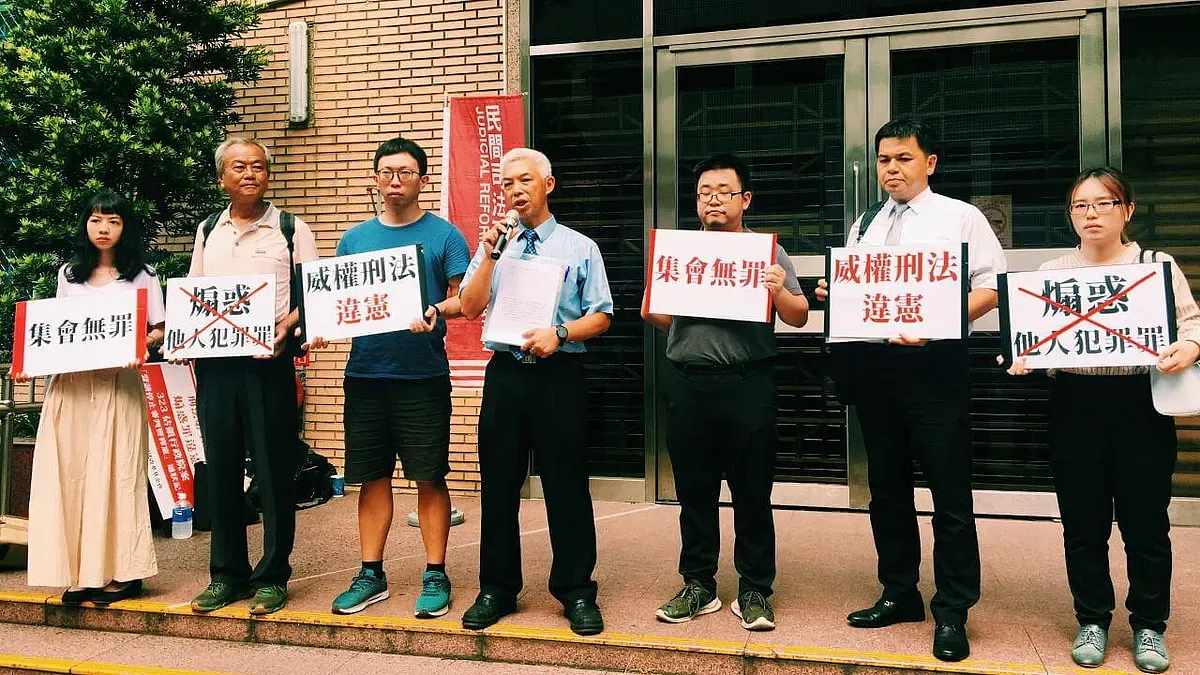
Article 153 of the Criminal Code on Incitement is Unconstitutional! Press Conference on the Application for Suspension of Trial and Constitutional Interpretation in the March 23 Executive Yuan Occupation Case
Last edited: 2026-07-27
On April 28, 2020, the second-instance judgment of the "March 23 Executive Yuan Occupation Case" was rendered. The second-instance court overturned the first-instance acquittals of seven defendants accused of "inciting others to commit offenses" and convicted them instead. More than thirty years after Taiwan's transition from authoritarianism to democracy, in a highly democratized contemporary era, citizens calling upon compatriots to engage in peaceful assembly and express political claims are nevertheless found guilty of incitement by the courts. This not only highlights that judicial personnel still retain deeply ingrained authoritarian legacies of heavily controlling the people, but it has also sparked debates in academia and legal practice over the abolition or retention of Article 153 of the Criminal Code on the offense of incitement.
Article 153 of the Criminal Code states: "Whoever publicly commits one of the following acts by means of text, drawings, speeches, or other methods shall be sentenced to imprisonment for not more than two years, detention, or a fine of not more than 30,000 NTD: 1. Inciting others to commit an offense. 2. Inciting others to violate laws and regulations, or to resist lawful orders." This provision indeed raises issues of violating the principle of proportionality, and its constituent elements risk violating the principle of clarity, potentially resulting in an excessively broad scope of punishment and causing undue infringement upon the freedom of assembly. Today, volunteer defense counsel Yu Po-hsiang, speaking on behalf of the team, pointed out that this offense turns civil disobedience into a cost and a threat. Anyone attempting to use the freedom of association and assembly to urge the general public to join in social reform may instead face sanctions under this provision, which evidently contradicts the spirit of a democratic state in safeguarding the freedom of assembly.
The volunteer defense team and the clients filed an appeal in this case last month (including 7 defendants for the offense of inciting others to commit a crime and 1 defendant for the offense of destroying items in the custody of a public official), and have successively submitted their statements of reasons for appeal. Today, the lawyers and clients came to the High Court to submit two additional petitions to be forwarded to the Supreme Court: the "Motion for Suspension of Trial and Petition for Constitutional Interpretation" and the "Motion for Oral Argument."
We request the Supreme Court to suspend the proceedings of this case and petition the Grand Justices for a constitutional interpretation, so that Article 153 of the Criminal Code, which restricts freedom of speech, has the opportunity to be declared unconstitutional. Let the erroneous legal remnants of the authoritarian era be subjected to constitutional review, rather than rashly serving as the basis for the defendants' conviction! If the court considers the provision constitutional and sees no need to suspend the trial, it should still allow the public to understand the judge's reasoning through the debate process—specifically, whether it is possible to adopt a constitutionally consistent, narrow interpretation of such provisions so that the law can strike a balance between freedom of assembly, association, and speech, thereby generating a positive impact on Taiwan.
Attending Representatives
Attorneys from the March 18 Anti-Black Box CSSTA Volunteer Defense Team
Yu Po-hsiang, Attorney-at-Law
Liu Chi-wei, Attorney-at-Law
Chao Wei-ch'eng, Attorney-at-Law
Ts'ai Hsiu-fang, Attorney-at-Law
Clients
Wei Yang
Hsü Shun-chih
This article is an AI-generated translation of the original Chinese text. In the event of any discrepancy, the Chinese version shall prevail.