
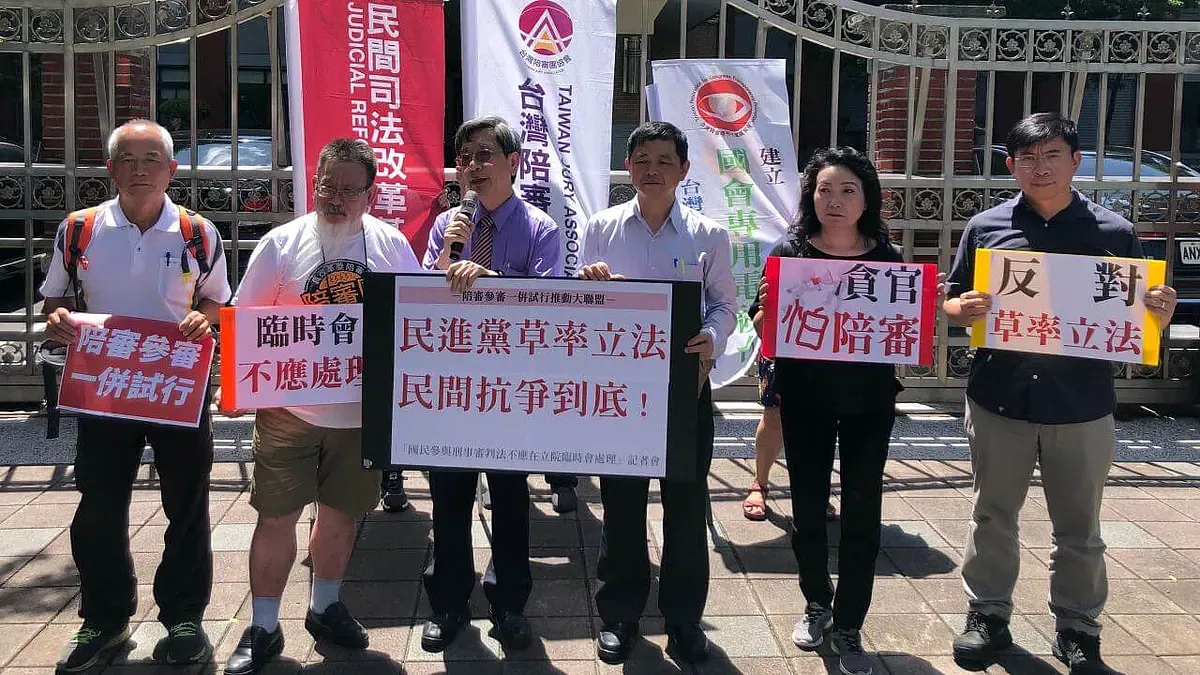
DPP Legislates Hastily, Civil Society Resists to the End - Press Conference on Opposing the Deliberation of the Act on國民參與刑事審判法 in the Legislative Yuan's Extraordinary Session
Last edited: 2026-07-27
The Alliance for the Parallel Trial of Lay Participation and Jury Systems, composed of 170 civil society organizations including the Judicial Reform Foundation and the Taiwan Association for Parliamentarian/People's Jury, held a press conference titled "DPP Legislates Hastily, Civil Society Resists to the End" at 10:00 AM on June 18 at the front gate of the Legislative Yuan. They publicly announced that the six negotiation sessions held since May between the DPP legislative caucus and the Alliance regarding the Act on Lay Participation in Criminal Trials had officially broken down. The Alliance called on the Legislative Yuan not to place the Act on the agenda of the extraordinary session; if the DPP caucus insists on scheduling it for review, the Alliance will take further action in protest.
-
The Alliance's advocacy for the parallel trial of lay participation and jury systems has gained support from 170 civil society groups and the caucus conveners of three opposition parties
Lay participation in criminal trials refers to ordinary citizens serving as lay judges to participate in criminal trial proceedings in court. Depending on the operational differences, the system can be categorized into the "jury system," where a jury composed of citizens independently decides whether the defendant is guilty while professional judges determine the sentence, and the "lay assessor system," where citizens and professional judges jointly decide both guilt and sentencing.
The draft Act on Lay Participation in Criminal Trials proposed by the Judicial Yuan adopts the Japanese lay assessor system. The Alliance believes that both the jury and lay assessor systems have their pros and cons, and Taiwan lacks domestic empirical research on both systems. To rashly adopt the lay assessor system while excluding the jury system would result in a lack of domestic empirical research on the jury system, making it impossible to compare their advantages and disadvantages. Therefore, the Alliance advocates that during the initial six-year evaluation period of introducing lay participation in trials, both the jury and lay assessor systems should be tested in parallel to gather sufficient data to verify which system is better suited for Taiwan.
On May 8 at 9:30 AM, also in front of the main entrance of the Legislative Yuan, the Alliance held a press conference titled "Runaway Train of Public Participation in Trials: Who Will Call to Stop?" Not only did they put forward the demand for the "parallel trial of lay participation and jury systems," which has to date garnered endorsements from 170 organizations and 949 individuals, but they also secured the attendance and signatures of support from KMT caucus convener Lin Wei-chou, New Power Party caucus convener Chiu Hsien-chih, Taiwan People's Party caucus convener Lai Hsiang-lin, deputy convener Chang Chi-lu, and Legislator Kao Hung-an. No representative from the DPP caucus attended the Alliance's press conference.
-
Negotiations between the DPP and the Alliance broke down; the Alliance opposes scheduling the draft lay participation act into the extraordinary session
In her inauguration speech on May 20, President Tsai Ing-wen also mentioned: "Judicial reform is still in a transitional period. The achievements at the present stage still have some distance to go from the people's expectations. I will continue to listen to opinions from all sides and will not stop my footsteps. The people's dissatisfaction is the driving force for continuous reform." She added: "Within the next four years, the lay assessor system must be launched so that the people can enter the courtroom to serve as lay judges, becoming a catalyst for reform, shortening the distance between the judicial system and the people, better meeting expectations, and winning trust."
Although the DPP caucus did not attend the Alliance's press conference on May 8, it invited official and Alliance representatives to hold negotiations. From May 15 to June 16, a total of six negotiation sessions were held. Ultimately, because the Judicial Yuan and the Ministry of Justice did not adopt the Alliance's opinions and left no room for compromise, and the DPP caucus refused to support the version of the draft proposed by the Alliance, no consensus could be reached and the negotiations broke down. During the sixth negotiation session on June 16, the DPP caucus stated that it would still deliberate the draft Act on Lay Participation in Criminal Trials during the Legislative Yuan's extraordinary session scheduled from June 29 to July 24.
The Alliance believes that the Act on Lay Participation in Criminal Trials involves a major transformation of the judicial system and will have a profound impact on future criminal trial systems and public trust in the judiciary, and therefore should be handled with caution. The lay assessor system proposed by the Judicial Yuan, modeled after Japan's, has neither received full support from first-instance judges and the legal professional community who actually operate this system, nor has it allayed the doubts of civil society groups and opposition legislators regarding the Judicial Yuan's insistence on adopting a single lay assessor system for trial. Much less has it achieved the lay assessor system envisioned by President Tsai Ing-wen in her inauguration speech, which aims to "make the distance between the judicial system and the people no longer distant, better meet expectations, and win trust."
The Alliance also held a press conference on June 10 titled "Before Consensus is Reached Across Party Lines, Lay Judges Must Not Be Legislated Hastily," which was attended and supported by KMT caucus convener Lin Wei-chou, New Power Party caucus convener Chiu Hsien-chih, and TPP caucus convener Lai Hsiang-lin. Currently, there are numerous versions of the draft Act on Lay Participation in Criminal Trials, and many provisions were reserved during the review by the Judiciary and Organic Laws and Statutes Committee. The DPP caucus has never held consultations with various opposition party caucuses, making it impossible to carefully deliberate every single provision. Therefore, the Alliance calls for halting hasty deliberation in the extraordinary session and instead conducting reviews in the next legislative session.
In summary, the Alliance believes that the draft Act on Lay Participation in Trials currently promoted by the Judicial Yuan is a judicial reform policy lacking support from the legal professional community and the general public. If the DPP caucus insists on refusing to communicate and negotiate with opposition caucuses, pushing forward with deliberation and resorting to voting during the extraordinary session, it will only deepen public distrust in the judiciary. During the extraordinary session, the Alliance plans to mobilize civil society groups to stage sit-ins, march around the Legislative Yuan, and engage in other protests outside the legislature to voice its stern opposition.
Attending Representatives
Lin Yung-sung / Chairperson (Convener), Judicial Reform Foundation
Cheng Wen-lung / Founding Chairperson (Convener), Taiwan Association for Parliamentarian/People's Jury
Chang Ching / Member, National Congress on Judicial Reform
Chang Hung-lin / Executive Director, Citizen Congress Watch
Wang Wei-chun / Chairperson, Association for the Promotion of ROC Children's Rights, Member, National Congress on Judicial Reform
Su Huan-chih / Convener, Taiwan Renewal Party
Li Li-chung / Chairperson, Chinese National Association for the Promotion of Rule of Law Reform
Kao Chi-tsan / Chairperson, Taiwan Association for Parliamentary Transparency
Press Contacts
Hsiao Yi-min / Office Director, Judicial Reform Foundation
Lin Ping-chuan / Deputy Secretary-General, Taiwan Association for Parliamentarian/People's Jury
This article is an AI-generated translation of the original Chinese text. In the event of any discrepancy, the Chinese version shall prevail.