
Clear Procedures Must Be Established for Assisting Hong Kong Residents; Private Sector Representatives Should Be Included in Project Review and Implementation Oversight
Last edited: 2026-07-27
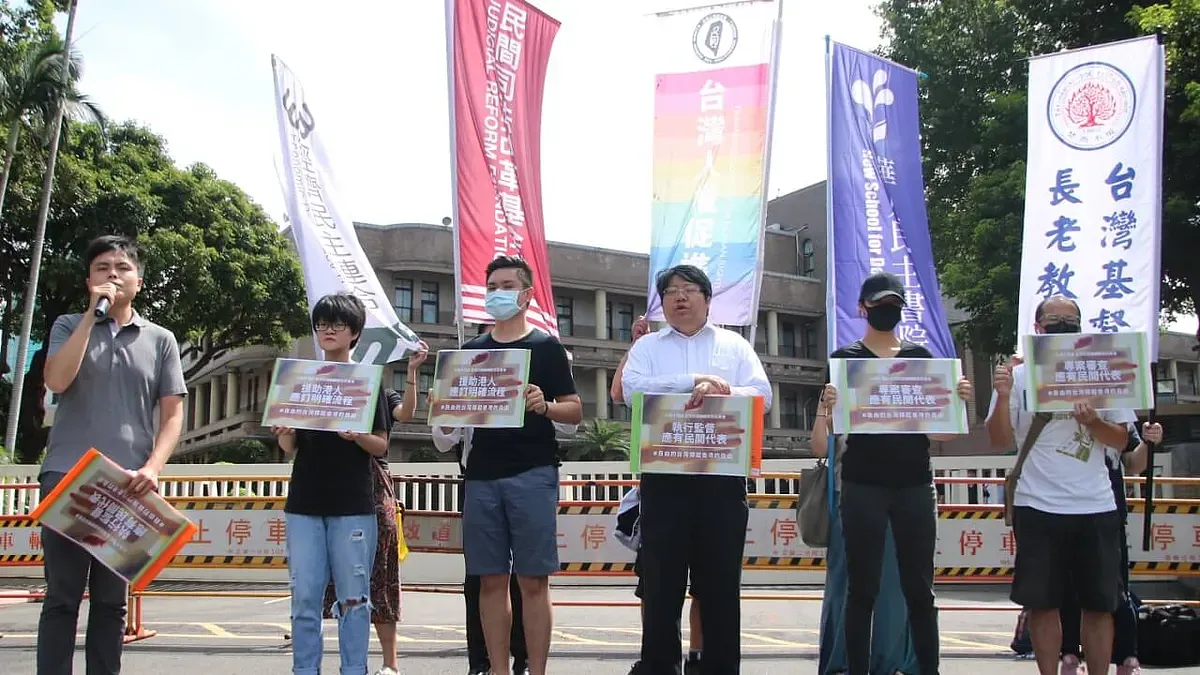
Photo/ TING-CHEN, TAIWAN ASSOCIATION FOR HUMAN RIGHTS
The Mainland Affairs Council held a press conference yesterday (the 18th) to officially announce the specific details of the "Hong Kong Humanitarian Aid and Care Action Project." Today (the 19th), the Hong Kong Outlanders, Economic Democracy Union, Taiwan Association for Human Rights, Judicial Reform Foundation, and Taiwan Lawyers for Hong Kong Protestors jointly held a response press conference, demanding that the Executive Yuan remain vigilant regarding changing developments in Hong Kong, actively coordinate among ministries and agencies, and promptly review and complete the yet-to-be-perfected aspects of the project.
Chiang Min-yen, spokesperson for the Taiwan Civil Front and moderator of the press conference, stated that since the anti-extradition bill movement began a year ago, the civil society groups attending today have assisted Hong Kong protestors in applying for asylum and carried out practical asylum work. They are now very pleased to see the MAC release policy planning that fulfills its promise to assist Hong Kong residents. Chiang Min-yen noted that the MAC's plan to "establish an official window, assist individual cases with living arrangements, and take over private-sector asylum work" represents highly commendable policy progress and administrative arrangement.
Citing Hong Kong media reports, Chiang Min-yen stated that the "Hong Kong National Security Law" may be officially implemented in Hong Kong as early as early July. According to the current draft of the "Hong Kong National Security Law" promulgated by the Standing Committee of the National People's Congress of China, China will establish national security law-enforcement agencies in Hong Kong. At that time, a large number of protestors are bound to be prosecuted under charges such as "subverting state power, secession, terrorist activities, and colluding with foreign or external forces," facing extremely high sentences. Chiang Min-yen mentioned that last Saturday, up to 7,000 citizens participated in the rally "Protests Never End, Taiwan and Hong Kong Walk Together—One Year of the Anti-Extradition Bill Movement," shouting demands such as "Resist Chinese Imperialist Expansion" and "Complete the Aid Mechanism." Chiang Min-yen believes that Taiwanese society's support for Hong Kong remains undiminished. As long as the government has sufficient determination, when the project office officially begins operations on July 1st, Taiwan's government and civil society will surely be able to work together to make more adequate preparations for Hong Kong protestors.
Protests Never End, Taiwan and Hong Kong Walk Together
Kuma, chairperson of the Hong Kong Outlanders, pointed out that even as Hong Kong people face stronger oppression and threats from the Chinese government, Taiwan's MAC held a press conference to announce the "Hong Kong Humanitarian Aid and Care Action Project," providing concrete and substantive assistance to Hong Kong people and fulfilling President Tsai's promise to aid Hong Kong residents. This contrast fully demonstrates the huge difference between a totalitarian society and a free and democratic society. To this end, Kuma expressed the utmost gratitude to all Taiwanese friends who support Hong Kong people, as well as to the dedication and persistence of the MAC colleagues. Kuma especially thanked Taiwanese civil society groups for their care of exiled Hong Kong protestors during this period, and looks forward to the Taiwan government continuing to listen to the suggestions of civil groups in the days to come, persevering on the path of defending human rights, and walking together with Hong Kong.
Clear Procedures Must Be Established for Assisting Hong Kong Residents
Attoney Lin Chun-hung, spokesperson for Taiwan Lawyers for Hong Kong Protestors, spoke from his experience in assisting travelers, stating that since the outbreak of the anti-extradition movement last year, many Hong Kong protestors have successively come to Taiwan seeking assistance. Civil groups have continuously called for the clarification of the asylum mechanism for Hong Kong protestors, and in June even proposed a private-sector draft of the "Enforcement Rules of Article 18 of the Laws and Regulations Regarding Hong Kong and Macao," hoping that the Executive Yuan and the MAC would value their demands and resolve the common dilemmas encountered in individual cases through institutionalization.
Lai Chung-chiang, convener of the Economic Democracy Union, stated that referring to the previously proposed private-sector draft of the "Enforcement Rules of Article 18 of the Laws and Regulations Regarding Hong Kong and Macao," several latent concerns that the current "Aid Project" may cause can still be seen. Application requirements, procedures, visa validity, and remedies when an application is rejected all await further clarification. Lai Chung-chiang explained that one of the standards of "international competitiveness evaluation" is regulatory transparency, and he hopes the Executive Yuan adheres to the principle of transparent regulatory procedures so that Hong Kong residents coming to Taiwan have clear information to consult.
Lai Chung-chiang stated that for the sake of clarity, the private-sector draft advocates that the mechanism should stipulate that if a party applies for the project, regardless of approval or rejection, it should be characterized as an administrative disposition, and written notice should be served to the party. If an application is rejected, an administrative appeal or legal remedy may be filed in accordance with relevant laws; it should also be clearly stipulated that if the party files an administrative appeal, temporary procedural safeguards should also be granted, giving them the right to apply for a stay of execution; if the party applies for a stay of execution, deportation should be suspended pending a final decision on the stay of execution. He believes that even if the government is not yet willing to formulate enforcement rules, it can at least publish the current operating procedures in advance to prevent unclear procedures from giving ill-intentioned groups room to defraud Hong Kong residents. He emphasized that while the government naturally has a duty of confidentiality regarding specific case information, this is no reason to make the application process unclear.
Private Sector Representatives Should Be Included in Project Review and Implementation Oversight
Wang Hsi, legal officer at the Taiwan Association for Human Rights, pointed out that Taiwan passed the Enforcement Act of the Two Covenants back in 2009. According to the International Covenant on Civil and Political Rights, even if an individual's application is definitively rejected, they still must not be expelled to a country where they would face torture or inhuman treatment, which is the so-called principle of non-refoulement. Accordingly, Wang Hsi particularly emphasized that even in cases of deportation, matters must still be handled rigorously, and the individual's choice of destination—such as relocating to the United States, Australia, Canada, or other countries—must be respected to prevent the individual from suffering torture or inhuman treatment due to deportation.
Wang Hsi stated that in the currently released plan, the project review meeting is the governmental review mechanism that ultimately decides whether an applicant can pass project aid. However, the operations and members of the current project review meeting remain unclear. Consequently, if applicants are fortunate enough to pass, perhaps no problems will arise. Wang Hsi emphasized that once a case is subsequently turned down by the project review meeting, because the procedure for initiating judicial remedies is unclear, the party will not know how to defend themselves in court. Therefore, the private-sector draft set proportional thresholds for professional fields and external experts concerning review representatives on the project review meeting.
Finally, Wang Hsi explained that anticipating that the project work would require extensive cross-ministerial coordination and division of labor, as well as the inheritance of experience from civil society groups, a "Supervisory Panel" was established in the private-sector draft, which explicitly mandates the participation ratio of external representatives. This allows scholars, experts, lawyers, and representatives of civil groups to work together with government cross-ministerial bodies to jointly oversee and promote the care and settlement work of the Foundation. Wang Hsi expressed regret that the government's current plan still lacks a "Supervisory Panel" with private-sector representatives. Over the long term, this creates difficulties for civil groups in exercising oversight, prevents the inheritance of experience, and makes it hard for opinions to be effectively heard within a more comprehensive system. Most worrisome of all is the dilemma where, due to unclear division of powers and responsibilities among cross-ministerial departments and buck-passing between agencies, many individual cases fail to receive active assistance—a predicament that risks continuing due to the lack of a supervisory panel, and has yet to be satisfactorily resolved by the publication of the new plan.
This article is an AI-generated translation of the original Chinese text. In the event of any discrepancy, the Chinese version shall prevail.