
JRF Newsletter
Hearing the Voices of Women in Protest: An Interview with Li Kuan-Ling, a Defendant in the March 23 Executive Yuan Occupation Case
Last edited: 2026-07-27
Editor's Note: The clients assisted by the March 18 Pro Bono Lawyer Platform exhibit a stark gender disparity. Taking the ongoing March 24 private prosecution case as an example, among the 21 private prosecutors, only 4 are cisgender women; similarly, in the March 23 Executive Yuan occupation case, out of 17 defendants, only 1 is a cisgender woman. Many factors contribute to gender disparities in social movement participation, and when it comes to the issue of state violence, women's voices and presences seem even harder to find.
Li Kuan-Ling is the sole female defendant in the March 23 Executive Yuan occupation case. Before planning this issue of the newsletter, we had almost overlooked this point, as our clients were categorized by the charges against them and whether they could appeal following the verdict. It was only while discussing potential interviewees that we realized we could not simply overlook the contributions of men versus women to this movement! Therefore, we decided that we must hear Li Kuan-Ling's voice.
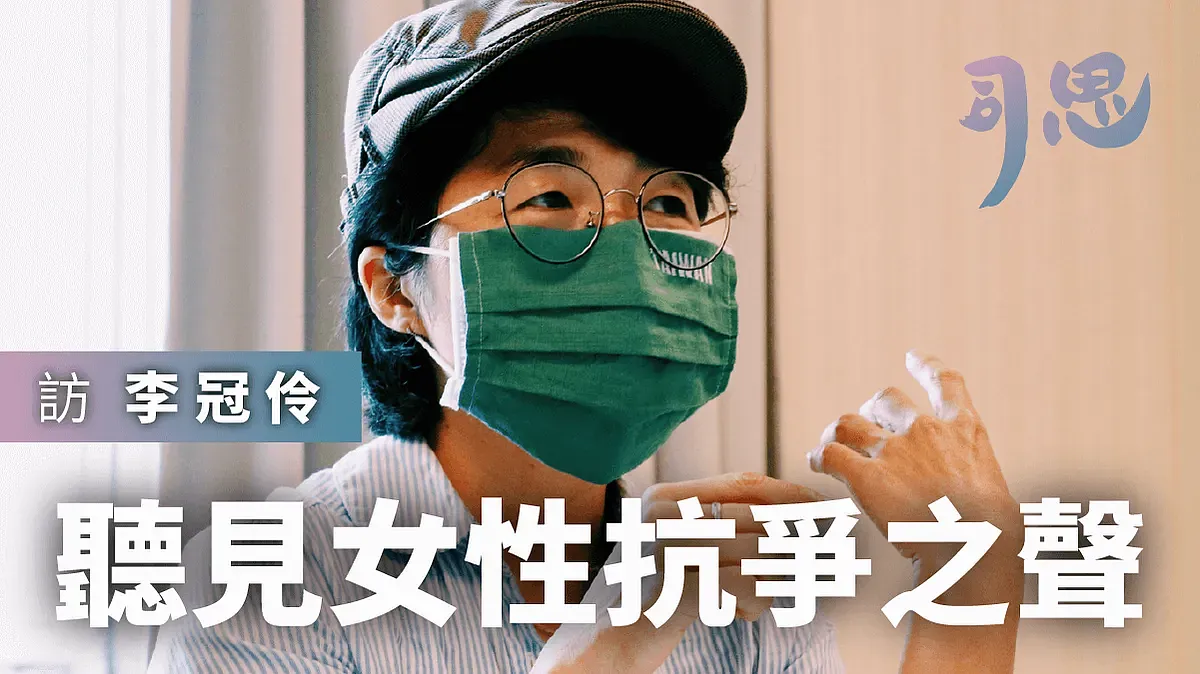
The author of this piece managed to reach out to Ao-Ch'ing, whose Facebook cover photo shows her speaking on the street with a microphone, accompanied by the caption "Stop saying politics has nothing to do with me." I thought she would be the most suitable person to conduct this interview. She also brought along her classmate from the Department of Law at National Chengchi University, Yen-Ch'eng, who captured Li Kuan-Ling's resolute gaze behind her mask during the interview.
Walking into the discussion room, she wore a simple button-down shirt, an illustrator's cap, and a face mask embroidered with the word "TAIWAN." Her gaze was not piercing, but carried a gentle and steadfast determination. She once participated in the March 23 Executive Yuan occupation during the Sunflower Student Movement. Yet, she is not someone frequently discussed by the public, nor is she a student movement leader constantly featured in the news media. She has never joined a political party or engaged in political activities, but she remains an unwavering contributor to Taiwan's social movements. On April 28 this year, the Taiwan High Court delivered its second-instance verdict for the March 23 Executive Yuan occupation case; she was among the defendants deemed guilty by the court. Her name is Li Kuan-Ling.
From Campus to the Streets: Never Silent, Striving to Be Heard
During her university years, she chose the Department of Chinese Literature and began immersing herself in numerous social issues. Regarding education reform related to her department, she took part in many activities under the guidance of her professors. She recalled, "That was when I had many awakenings regarding social issues; education reform issues are not confined to the campus—they can step into society." At the time, however, the campus atmosphere was not yet fully open, and many things could not be spoken or done overtly; yet everything was quietly underway. Thus, she described social movements at the time as a fog—much was still not understood, but you simply had to brush the fog aside and move forward step by step.
What truly made Li Kuan-Ling understand "what protest is" was an incident she experienced while working on the school magazine staff. At the time, she wrote an article concerning student autonomy. Because it touched upon the sensitive topic of the "1994 National Taiwan Normal University Seven Wolves Incident," she faced the threat of expulsion by the university president. Ultimately, through communication and coordination by teachers and students, the magazine was successfully published, which indirectly led to the president's departure. "The school magazine incident wasn't a resounding success, nor did it continue to ripple outward, but it allowed us to discuss self-awareness and self-reflection, which was immensely helpful for my future thinking on social issues," Li Kuan-Ling calmly reflected on the various twists and turns of her youth.
Amidst her extracurricular activities during her studies, Li Kuan-Ling met good comrades who would later join her in social movements, witnessing civil society's thriving and warm networks, which allowed her to boldly challenge the system while retaining her care for people. Originally planning to run for student representative, she encountered an uncontested election issue. She wrote an article calling attention to the fairness of the electoral system, only to be criticized by her opposing candidate; yet after several exchanges, they became good friends and together participated in the Kungliao anti-nuclear movement. During Typhoon Morakot, she served as a front-line volunteer, finding like-minded friends ranging from political victims to grassroots party members. "Social issues are not just about fighting; they are also about providing assistance. Just as we demand resources from society, we must also consider how we can contribute." Through her volunteering experience, she also learned the attitude and responsibility that social movement participants ought to possess toward society.
She also noted that female protesters often pay hidden costs—sometimes unacknowledged—to ensure the smooth operation of a movement or to maintain harmony among partners. Within the macho environment of social movements, Li Kuan-Ling herself was given de-feminized nicknames like "Ah-Tuan" or "Brother Tuan" in activist circles, which seemed to function as a form of protection. When male activists cracked sexist jokes, some women gradually grew indifferent, felt it didn't matter, or even accepted and grew accustomed to these unreasonable ridicules and dismissals. However, she believed this would erase the true nature that a movement ought to have. She was never such a person.
Listening to Li Kuan-Ling recount these past events, even through her mask, one could still sense her moods—sometimes jubilant, sometimes serene—as she told each story. Years have passed, and Taiwan's social movements have flourished. The mists have cleared, the sunlight has filtered through, leaving behind every chapter of blindly forging ahead into the past.
The Night of March 23: Those Unfinished Songs
At the time of the interview, the verdict for the March 23 Executive Yuan occupation case had just been rendered. When asked about her most vivid memory from the night of March 23, she recalled witnessing protesters being beaten one by one, leaving the crowd engulfed in fury. Faced with the high tension on-site, where people felt panicked and had nowhere to vent their frustration, Li Kuan-Ling attempted to soothe the crowd that night by singing. As police forcefully made arrests and handcuffed protesters, seeing the tense atmosphere between both sides, Li Kuan-Ling led the enraged protesters in song. However, seeing the police continue to use violent suppression, leaving people bleeding and injured, before even a single song could be finished, the scene descended into chaos once again.
"Even though none of us knew each other, I still led everyone in singing some songs so that our strength could regroup, allowing us to know what to do next." Dating back to the Tang-wai movement era, sit-ins had always incorporated singing. Li Kuan-Ling hoped that by leading the crowd in song, people could momentarily set aside their anxiety and fear to the rhythm of the music, thereby gathering the otherwise fragmented civic power through song. Even though the on-site situation had too many variables, Li Kuan-Ling always believed in the power of music as an indispensable anchor during protests. Standing there on-site, she sounded completely devoid of fear.
"You Must Keep Appealing, Because You Did Nothing Wrong"
Li Kuan-Ling grew up in a traditional Taiwanese family, with a relatively repressive upbringing. Her father expected her to secure a civil service job like her older sister and younger brother. Initially, her family neither understood nor could empathize with why she cared so deeply about these issues.
Having participated in social movements for many years, at first, it was treated like a taboo and rarely discussed at home. Yet she could sense that over the years, her family had always silently offered boundless concern. "On the day I went to the March 18 movement, my mother called me. I was on the front lines at the time, and my mother asked me what I was doing. I said I was out buying things near home, and she said, 'Don't lie to me, I can see you right here (on television)!" Li Kuan-Ling said with a smile. Driven by care and a desire to understand her current situation, her parents gradually grew willing to proactively engage with social issues. Every time they met, they gained one more topic of greetings and conversation. Over the years, the taboo topic at home gradually began to open up.
Discussing the recent second-instance verdict, Li Kuan-Ling noted that under the ruling, she could still continue to appeal. "They (my parents) said, 'You must continue to appeal the second-instance verdict, because you didn't do anything wrong.'" In a single sentence, she revealed the transformation her parents had undergone over the years—from initially avoiding the subject, to gradually becoming empathetic, and finally accepting her and standing by her side. Raised in a traditional family, Li Kuan-Ling had once been an oddball desperately trying to break free from her family's expectations; yet after years of protest, no matter how fierce the external storms or how cold the system, looking back, her family's love has always remained tenderly and selflessly enveloping her.
"I Participated in the Movement Not to Be Remembered by Anyone."
No one enjoys the feeling of being forgotten; most people hope their deeds and contributions to a movement will be remembered by the world and by history. When asked about her thoughts on being "forgotten," Li Kuan-Ling joked, "Really? At least the court will remember me." Information about Li Kuan-Ling on the internet is scarce. Searching for the three characters "Li Kuan-Ling" yields only two or three photos in front of the courthouse. Through this interview, one could say we got to know her starting from scratch.
"I participated in the movement not to be remembered by anyone." Nearly six years have passed since the March 23 Executive Yuan occupation, and the general public has returned to normal life. Yet Li Kuan-Ling has spent six long years running back and forth for legal proceedings. She had originally hoped to drop the litigation, quietly walk away from the incident, and return judicial resources to those in society who needed them more. However, people advised her to view the litigation as part of the protest, which finally persuaded her to continue appealing under the group's name.
Rather than being remembered, Li Kuan-Ling cares more about bringing impact to social movements and reform. She hopes to become a ripple on the surface of a lake—a gentle tap at the center that gradually expands its influence across all of society. Whether students or individuals willing to understand social issues, she hopes citizens can recognize their own influence and work together to make Taiwan a better place. Mentioning the "leaderless" phenomenon in Hong Kong's Anti-Extradition Law Amendment Bill Movement, Li Kuan-Ling expressed admiration and curiosity, while also hoping that Taiwan will one day achieve a social movement where "everyone is a leader."
This article is an AI-generated translation of the original Chinese text. In the event of any discrepancy, the Chinese version shall prevail.