
DPP Lacks Credibility in Excluding Jury Trial; Civil Society Invites U.S. Lawyer to Clear Up Doubts ~ Second Day of Sit-In Protest Against Inclusion of Lay Participation Bill in Legislative Extraordinary Session
Last edited: 2026-07-27
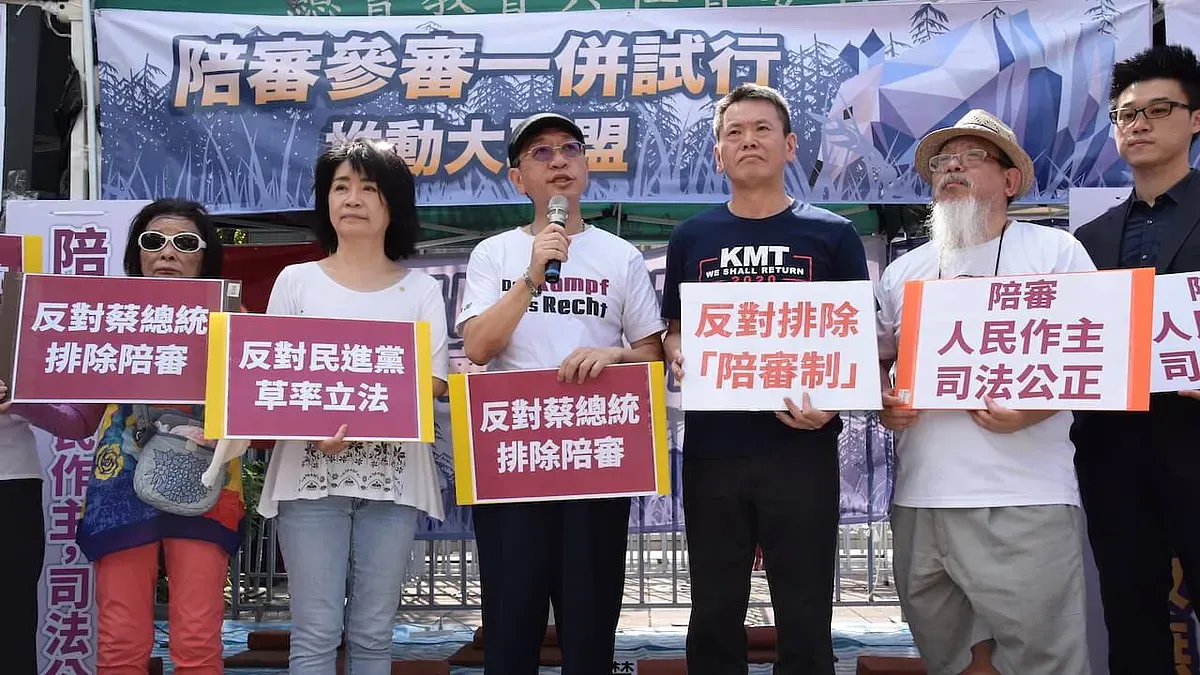
Formed by civil society organizations including the Judicial Reform Foundation and the Taiwan Association for Parliamentarian-People Trials, the "Grand Alliance for Parallel Trial of Jury and Lay Participation" held a press conference titled "DPP Lacks Credibility in Excluding Jury Trial, Civil Society Invites U.S. Lawyer to Clear Up Doubts" at 9:30 AM on June 30 at the main entrance of the Legislative Yuan. The alliance pointed out that while the DPP advocated for jury trials when it was in the opposition, it now pushes for lay participation and opposes the parallel implementation of both systems since coming to power, revealing a lack of credibility. Meanwhile, the alliance invited an American lawyer to share experiences regarding jury trials to clarify various societal doubts concerning the adoption of a jury system in Taiwan.
The alliance began sitting-in outside the Legislative Yuan on June 29 to protest the DPP legislative caucus's proposal to include the Draft Act on National Participation in Criminal Trials in the Legislative Yuan's extraordinary session, entering its second day today. Alliance convener and Judicial Reform Foundation Chairman Lin Yung-sung pointed out that Article 28 of the DPP's action platform, revised and passed in 1999, explicitly stated: "Revise criminal litigation laws and regulations to establish a jury system." In 2012, when the DPP was in the opposition, caucus whip Ker Chien-ming and 26 other DPP legislators also proposed a jury system bill. In 2014, Legislator Ker Chien-ming even mentioned in a committee speech: "We hope that various different systems can be thoroughly discussed in the Legislative Yuan. Of course, this requires a period of education, and the problems I just mentioned must be eliminated, so we should not be overly hasty. Alright?" In 2015, during a seminar held by the Judicial Reform Foundation, Legislator Ker Chien-ming even mentioned in a press interview: "I am the proposer of the jury system. The Judicial Yuan is promoting the so-called participation system, and some are promoting the lay participation system. This is a major issue of judicial reform, especially since we all know that judicial reform is about returning judicial power to the people." When in the opposition, Legislator Ker Chien-ming clearly stated his choice to support the jury system among lay participation, jury trials, and a system of observer judges.
Chairman Lin Yung-sung further pointed out that after the DPP came to power, when the Taiwan Association for Parliamentarian-People Trials asked legislators to endorse jury legislation, a total of 17 DPP legislators—including 15 DPP legislators led by Ker Chien-ming in 2016 plus 2 new DPP legislators in 2020—signed in support of the jury system. Now, holding executive power and a legislative majority, the DPP has turned to promoting lay participation, which lacks credibility. What is worse, the DPP intends to pass it during the legislative extraordinary session, making it impossible to "thoroughly discuss various different systems in the Legislative Yuan" as Legislator Ker Chien-ming said in 2014.
Chairman Lin Yung-sung emphasized that during the process of promoting the lay participation system, Legislator Ker Chien-ming deemed the parallel system version proposed by the alliance to be a "frankenstein vehicle" (improvised vehicle); however, the Judicial Yuan's version is actually a frankenstein vehicle as well, because the Judicial Yuan's version adopts the jury system for the selection of citizen judges and the lay participation system for the deliberation procedure. Chairman Lin Yung-sung pointed out that a frankenstein vehicle is not necessarily bad, and the key lies in how they are integrated. In addition, President Tsai said that the Judicial Yuan's version is both lay participation and jury trial, but the most important deliberation procedure adopts lay participation, showing a misunderstanding of the policy. Finally, experience from Japan shows that the conviction rate under the lay participation system compared to professional judges still exceeds 99%, with no change whatsoever.
KMT caucus whip Lin Wei-chou pointed out that the national participation trial is the most important bill and a major reform of judicial reform. Before the extraordinary session began, the KMT continuously communicated with the DPP, hoping that the national participation trial bill should not be handled in an extraordinary session, because an extraordinary session lacks committees, which preempts the opposition party's discussion and leads directly to a vote, making it suitable only for emergency and major bills such as relief and epidemic prevention. The KMT advocates handling it in a regular session, which features committees, public hearings, and allows outside voices to participate. To take a step back, if it must be handled in an extraordinary session, the jury system should also be included in the discussion; yet the DPP excluded the New Power Party's jury system bill in the extraordinary session. Taking another step back, the Taiwan People's Party also proposed a parallel system bill, but the DPP vetoed its inclusion, showing that the DPP only wants to pass the lay participation system—something the KMT finds completely unacceptable. The KMT believes that all systems should be discussed together; among the three opposition parties, all support the jury system or dual-track parallel system, and only the DPP, whose party platform writes of the jury system, opposes it. Lin Wei-chou stated that the KMT will persist in protesting to the end and opposing to the end.
KMT convener Lee Kuei-min mentioned that when the Judicial Yuan proposed the observer judge system in 2012, and when the Judicial Yuan's direction shifted from the observer judge system to the lay participation system in 2016, it merely changed the name from observer judgment to lay participation and observer judges to citizen judges, while the provisions remained largely unchanged. Since everyone opposed the observer judge system, they should oppose the lay participation system. Convener Lee advocates that the jury system must be included to withstand scrutiny, ensure the final pure land of the judiciary, and provide a fair place—a right conferred by the democratic system. Convener Lee emphasized that any error in judicial reform harms all people in Taiwan. The DPP has not provided the people with a fair trial system. In addition, Convener Lee mentioned that there are two conveners for the Judiciary and Organic Laws and Statutes Committee. According to the drawing of lots, Convener Lee Kuei-min is responsible for Judicial Yuan affairs, and the other convener (Legislator Chou Chun-mi) is responsible for the Ministry of Justice. However, although the Draft Act on National Participation in Criminal Trials was proposed by the Judicial Yuan, it was snatched and scheduled by the other convener, who even argued that restrictions only apply to business reports and not bills, demonstrating the exhaustion of institutional maneuvers and plotting by the DPP. Convener Lee pointed out that she had convened two public hearings, hoping that genuine public opinion could be fully expressed in the public hearings to clarify issues. Originally, she hoped to compile controversial issues for review after holding several public hearings, but the other convener scheduled the bill first. During committee review, over a hundred provisions were reviewed until nearly midnight before being sent out of the committee, leaving no way for everyone to have a thorough discussion. Convener Lee emphasized that committees are the most important part of a democratic country because only committees allow for clause-by-clause discussion. The DPP could not withstand scrutiny and rushed it out of the committee in a single day; the more than 30 provisions that were reserved were retained only because DPP legislators themselves could not bear to watch. The protests launched by the KMT yesterday (the 29th) were for the people; judicial reform has no political stance, only right and wrong, and the extraordinary session must absolutely not pass the lay participation system. It is hoped that the legislature can hear everyone's voice, and a fair trial system is the final pure land.
Former Minister of National Defense Tsai Ming-hsuan also came to show support, stating that the majority of public opinion supports the jury system, and caucus whip Ker also supported the jury system in the past, yet his stance has changed today. Minister Tsai argued that Taiwan has acceded to the two Covenants, which protect human rights from harm; however, the lay participation system proposed by the Judicial Yuan still leaves judges under authoritarian influence to control the process of judicial cases. Japan passed the lay participation system 10 years ago, and there have been many opinions following its operation in Japan. Minister Tsai pointed out that the people should be allowed to truly participate and express their opinions. The United States Constitution's Amendment mentions the implementation of a jury system, with the purpose of compensating for judges' lack of experience to reduce wrongful convictions, preventing government interference in the judiciary, and avoiding judicial corruption and bribery.
U.S. trial lawyer Wang Wei-hua also came to share the benefits of the jury system. First, judges' work can produce systematic bias against defendants, and jurors' empirical rules can resolve such matters. Second, the jury system features 12 jurors discussing together, allowing diverse voices and different viewpoints from society to be thoroughly discussed and experiences shared. Finally, the jury system prevents judges from influencing jurors' psychological conviction; for instance, if a judge says something to jurors that should not be said, it will be overturned by the appellate court.
Attending Representatives
Lin Yung-sung, Attorney-at-Law / Chairman, Judicial Reform Foundation (Convener)
Cheng Wen-lung, Attorney-at-Law / Founding Chairperson, Taiwan Association for Parliamentarian-People Trials (Convener)
Chang Ching, Attorney-at-Law / Member, National Congress on Judicial Reform
Lin Wei-chou, Legislator / KMT Caucus Whip, Legislative Yuan
Lee Kuei-min, Legislator / Convener of the Judiciary and Organic Laws and Statutes Committee, California Attorney, USA
Tsai Ming-hsuan, Attorney-at-Law / Former Minister of National Defense, U.S. Attorney
Wang Wei-hua, Attorney-at-Law / U.S. Trial Lawyer
Press Contacts
Judicial Reform Foundation / Director Hsiao I-min
Taiwan Association for Parliamentarian-People Trials / Deputy Secretary-General Lin Ping-chuan
This article is an AI-generated translation of the original Chinese text. In the event of any discrepancy, the Chinese version shall prevail.