
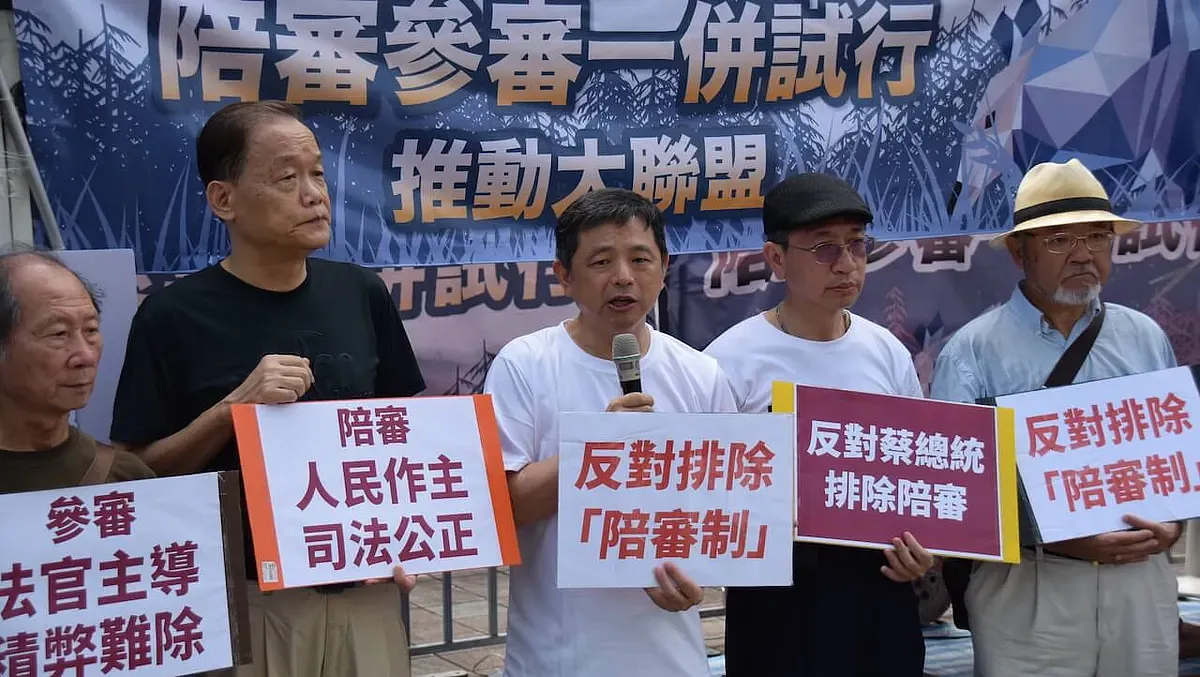
Can Deliberation Happen Without Professional Judges? Jurors from Home and Abroad Speak Out—Day 3 of the Sit-in Protest Against the Inclusion of the Lay Participation Bill in the Legislative Yuan's Extraordinary Session
Last edited: 2026-07-27
The "Grand Alliance for Concurrent Trial Implementation of Lay Assessor and Jury Systems"—composed of civil society organizations such as the Judicial Reform Foundation and the Taiwan Association for Assessor System—held a press conference at 9:30 a.m. today (the 1st) in front of the Legislative Yuan's main entrance, titled "Can Deliberation Happen Without Professional Judges? Jurors from Home and Abroad Speak Out." They invited ordinary citizens who have served as jurors domestically and internationally to share their experiences of how jury trials operate, clarifying that even without professional judges present, jurors without legal training are fully capable of conducting deliberations on their own and making profound discussions and analyses. The government should have confidence in the people of Taiwan.
Lin Yung-sung (林永頌), Chairperson of the Judicial Reform Foundation, reiterated that the Democratic Progressive Party (DPP) should not hastily process the Draft Act on National Participation in Criminal Trials, as more than 30 articles were reserved by the committee and multiple versions exist. He also mentioned that Democratic Progressive Party Caucus Convenor Ker Chien-ming (柯建銘) stated during party caucus consultations yesterday (the 30th) that the DPP switched to promoting the lay assessor system because the times and circumstances are different. Chairperson Lin Yung-sung believes that while the temporal and spatial environment has indeed changed—with the people becoming more progressive and the DPP gaining power through governance—the reality for citizens encountering an unjust judiciary remains unchanged. It is not as though judicial officers are free from removal or that the people have obtained state compensation. Ker Chien-ming also mentioned that excluding the jury system was the decision of those at the top. Chairperson Lin Yung-sung expressed hope that those at the top will not be defeated by the conservative, bureaucratic judicial administrative system, and that the DPP will not be bound by the groundless fear of not daring to trust the people, urging those in power to understand that the people need a sound judicial system. Furthermore, yesterday (the 30th) saw the passage of the Hong Kong National Security Law, Article 46 of which stipulates that the National Security Law does not apply to the jury system. Chairperson Lin emphasized that authoritarian states dare not use juries, and he hopes that Taiwan's ruling authorities possess the wisdom and courage to implement a democratic jury system, thereby highlighting the distinction between Taiwan and totalitarian nations. Finally, the Alliance previously engaged in a dialogue with President Tsai Ing-wen, during which President Tsai questioned whether the people could truly manage without judges discussing things alongside them. Chairperson Lin emphasized: if one does not trust the people, why implement public participation in trials? Whether it is the lay assessor system or the jury system, must we not trust the people?
Cheng Wen-lung (鄭文龍), President of the Taiwan Association for Assessor System, emphasized that just as Xi Jinping fears juries, he did not expect President Tsai to fear juries as well. It turns out the DPP actually fears the jury system, which represents judicial democratization. Why is President Tsai standing on the same position as Xi Jinping? President Cheng stressed that politics requires integrity: the DPP party platform explicitly states that the offenses of domestic turmoil and foreign aggression shall be subject to a jury system. The civil society's version featuring the dual-system parallel approach mandates juries for politically sensitive cases such as offenses of domestic turmoil, assemblies and parades, and obstruction of official duties. In 2012, the DPP also proposed a draft Jury Act. Why is the DPP violating its promise by rejecting juries and instead passing a lay judge system devoid of a jury system? President Cheng reiterated that Taiwan must become more democratic and politics must uphold integrity; the Alliance's sit-in protest is a demand for politicians to have integrity. The Tsai administration does not believe the people have the capability, and today's press conference aims to prove that the people of Taiwan do have that capability.
Kuo Chung-kuo (郭重國), who has had three experiences with juror selection and deliberation in the United States, also attended to share his insights. He noted that American judges explain the operation of the jury system in detail to jurors, ensuring people understand its significance. Kuo Chung-kuo also mentioned that statistics show 95% of jury verdicts are correct, and since the U.S. implemented juries over 200 years ago, could the educational attainment of Americans 200 years ago really have been better than ours today? Kuo Chung-kuo went on to share that prospective jurors are interviewed by prosecutors and defense counsel to select relatively neutral individuals to serve as jurors; he himself had both failed to be selected and been successfully chosen. Once selected to serve as a juror, one has no contact with the outside world during the proceedings to avoid external influence. Kuo Chung-kuo noted that a jury verdict requires the unanimous agreement of all 12 jurors. When they informed the judge at the time that unanimity could not be reached, the judge reminded the jurors to think and discuss further. After three days of deliberation, a consensus still could not be reached, resulting in a hung jury—demonstrating how difficult it is to get 12 people to agree on a matter, given their differing educational backgrounds and experiences. As the saying goes, "two heads are better than one" (or rather, three cobblers with their wits combined equal Zhuge Liang the master strategist). Kuo Chung-kuo believes that judges, simply because they possess more courtroom knowledge, do not necessarily make more correct judgments; rather, their experience tends to be limited.
Chang Tsai-ping (張再平), who was selected by lottery by the Taipei City Government to serve as a mock trial juror, shared the process of adjudicating the case at the time. The case reviewed was a real one in which the defendant had been found guilty in both the first and second instances—a fact unknown to the jurors. However, following the jurors' review and discussion, they ultimately conducted a secret ballot and unanimously concluded that the defendant was not guilty. Chang Tsai-ping believes that when judges are negligent or harbor strong subjective biases, miscarriages of justice easily arise, and many wrongful convictions are still undergoing litigation in Taiwan today. Chang Tsai-ping emphasized that Taiwan's legal community must recognize why, in many areas such as technology, Taiwan looks to the United States as a model, yet takes a completely different path regarding public participation in trials. He believes juries will make judgments based on their conscience and impartially examine both perpetrators and victims. The ordinary people of Taiwan have the right to be tried by a jury, and a small change can improve the judicial system; we cannot lose this opportunity simply on the grounds that the people of Taiwan lack capability.
Tsai Li-ling (蔡麗玲), who was similarly selected to serve as a juror, stated that the jury deliberated on the case for over three hours at the time, ultimately reaching a unanimous verdict finding the defendant not guilty. Tsai Li-ling believes that the public is extremely dissatisfied with the judiciary and holds judicial judgments in low regard, and that the jury system can appropriately mend the problems of the judicial system. Yet now, the system is being rejected under the utterly ridiculous pretext that the people of Taiwan are not qualified, attempting to hoodwink the public with the lay judge system instead. Tsai Li-ling emphasized that Taiwan is full of talented people; unless the judicial system has something it needs to hide, there is no need to reject the jury system on the grounds that the people are unqualified.
The Alliance has been holding a sit-in protest outside the Legislative Yuan since June 29 to protest the DPP legislative caucus's proposal to include the Draft Act on National Participation in Criminal Trials in the Legislative Yuan's extraordinary session. Today marks the third day, and the Alliance will continue its sit-in protest against the inclusion of the lay assessor draft bill in the extraordinary session.
Attending Representatives
Lin Yung-sung, Attorney at Law / Chairperson, Judicial Reform Foundation (Convener)
Cheng Wen-lung, Attorney at Law / Founding Chairperson, Taiwan Association for Assessor System (Convener)
Kuo Chung-kuo / U.S. Juror
Chang Tsai-ping / Taiwan Mock Trial Juror
Tsai Li-ling / Taiwan Mock Trial Juror
Press Contacts
Judicial Reform Foundation / Director Hsiao I-min (蕭逸民)
Taiwan Association for Assessor System / Deputy Secretary-General Lin Ping-ch'üan (林秉權)
This article is an AI-generated translation of the original Chinese text. In the event of any discrepancy, the Chinese version shall prevail.