
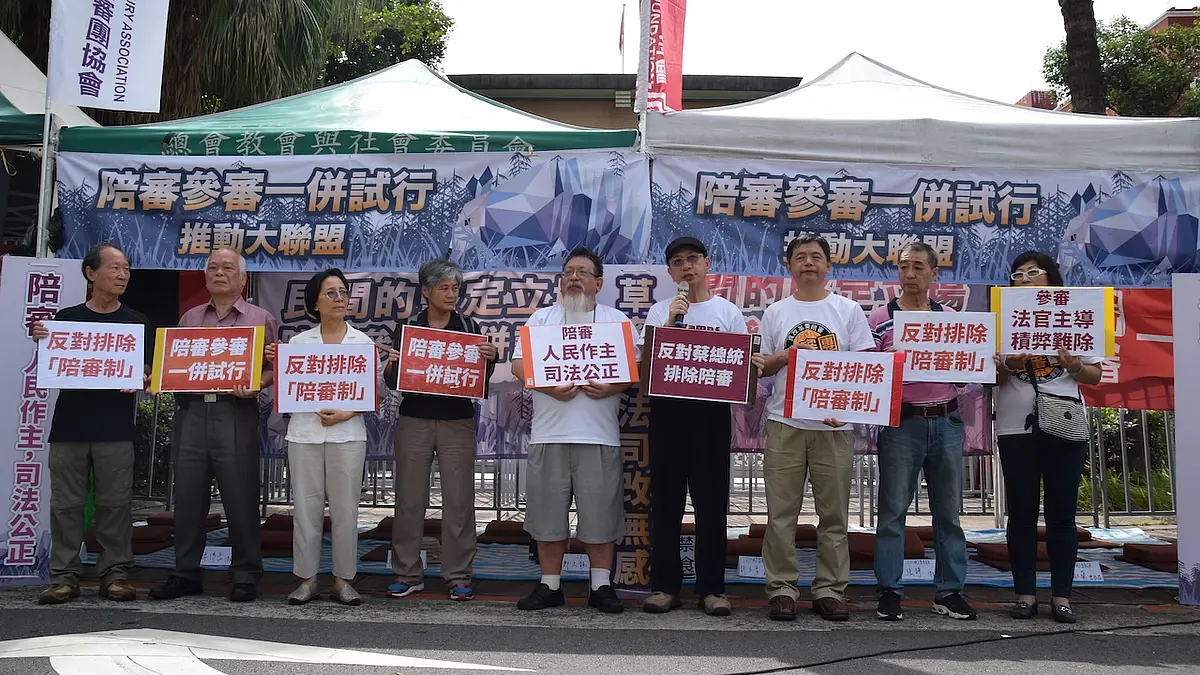
Judicial Reform Committee Members Strongly Support Dual Systems Running Concurrently; President Tsai Ing-wen Must Not Act Arbitrarily—Day Four of Sit-in Protest Against the Inclusion of the National Lay Participation in Criminal Trials Bill in the Legislative Yuan's Extraordinary Session
Last edited: 2026-07-27
Formed by civic organizations including the Judicial Reform Foundation and the Taiwan Association for Independently Certified Jurors, the "Grand Alliance for the Simultaneous Trial Run of Lay Participation and Jury Systems" will hold a press conference at 9:30 AM on July 2 outside the gates of the Legislative Yuan, titled "Judicial Reform Committee Members Strongly Support Dual Systems Running Concurrently; President Tsai Ing-wen Must Not Act Arbitrarily." The Alliance has invited former Grand Justice Hsu Yu-hsiu, who convened the fourth subgroup of the Presidential Office's National Congress on Judicial Reform, along with members of the fourth subgroup, to explain that a majority of members support the simultaneous trial run of both the jury and lay participation systems, and to urge the public not to misrepresent the dual-system approach as the least favored proposal.
During the 2017 National Customs Conference on Judicial Reform convened by the President, public participation in trials was discussed in the fourth subgroup. In a vote among the 18 attending members (excluding the convener), the lay participation and jury systems received 7 votes each, while the concurrent adoption of both systems received 5 votes (see table below). None achieved a majority, and thus no resolution was adopted. The Judicial Yuan has repeatedly opposed the concurrent implementation of both systems by falsely claiming it was the least supported proposal during the National Congress on Judicial Reform.
The Legislative Yuan originally scheduled consultations for the Draft Act on National Participation in Criminal Trials yesterday (July 1), but later cancelled them. Chairman Lin Yung-sung reiterated that the Alliance opposes rushing the bill through the extraordinary session, and that if it must be passed, both the jury and lay participation systems should be trialed concurrently. Chairman Lin noted that DPP Caucus Whip Ker Chien-ming claimed that running both systems concurrently would bring disaster to Taiwan because judges have no actual experience operating both lay participation and jury systems, making concurrent trials unworkable. Chairman Lin stated that this is a baseless accusation; running both systems concurrently poses no problem because, aside from deliberations on guilt or innocence, the procedures for selecting lay judges and conducting trials are largely identical and not entirely disparate systems. Furthermore, under the Judicial Yuan's version, only 600 cases per year require public participation, meaning that implementing dual systems for this caseload will not pose any difficulties. Chairman Lin emphasized that where there is a will, there is a way, and where there is none, there are a hundred excuses. The current draft includes a two-year preparation period, so it could easily be passed during the next legislative session. The national lay participation bill is a livelihood bill, not a political one, and passing it during an extraordinary session is rare.
Attorney Chang Ching, a member of the Judicial Reform National Congress, recalled that when the fourth subgroup discussed public participation in trials during the 2017 congress, the vote on May 12, 2017, resulted in a 7-7 tie between members supporting lay participation and those supporting the jury system. However, by June, the Judicial Yuan backed the lay participation system for implementation. Attorney Chang mentioned that this year (2020), he personally called the members of the Judicial Reform National Congress to poll their opinions, and 11 members supported the concurrent adoption of both systems, making it the majority view among the judicial reform committee members. Attorney Chang emphasized that judges actually have to handle more under the lay participation system than under the jury system; if a judge can operate lay participation, they can operate a jury trial, because how a judge directs proceedings ordinarily is how they would direct a jury, with the sole addition of pre-trial instructions. Attorney Chang opposed the Judicial Yuan's version of instructions, which take place behind closed doors without transcripts or recordings, as this creates an authority effect that unduly influences lay judges. Instructions in the jury system must take place in open court, are fully recorded, and can serve as grounds for appeal. Attorney Chang stated that while Caucus Whip Ker Chien-ming called the dual-system approach a "frankenstein vehicle" that will bring disaster to the people, Chang believes the Judicial Yuan's lay participation version—which absorbs the advantages of the jury system—is the true frankenstein vehicle destined to bring disaster to the public.
General Manager Chen Shu-lan, also a member of the Judicial Reform National Congress, was present to explain that as a committee member, she represented not only civil society but also laypersons in the justice system. Over half of the members of the Judicial Reform National Congress were laypersons who expressed their views in the fourth subgroup, representing a fundamental right of the people. However, during the legislative process, the committee members' opinions were not respected, which is why she will continue to monitor the Presidential Office and the Legislative Yuan regarding their effectiveness in implementing the resolutions of the judicial reform congress. General Manager Chen suggested three reasons why the Democratic Progressive Party dares not pursue the jury system: First, judges are unwilling to transparently confront low public trust in the judiciary. Second, prosecutors and investigators are unwilling to work hard or present compelling evidence in court to win the judges' approval. Third, the government does not believe the people are capable of adjudication; while the public became shining examples during the pandemic, the government refuses to believe citizens can play an important role in the judiciary. Finally, Chen urged the entire citizenry to jointly monitor the Legislative Yuan to ensure that the jury system at least maintains a foothold and is not buried away.
Hsieh Ming-chu, Vice President and a lay member of the Judicial Reform National Congress, stated that during the meetings, the Judicial Yuan clearly and explicitly hinted at its support for the lay participation system. Yet, the members still earnestly sought to understand the systematic differences between the jury and lay participation systems. She expressed bewilderment as to why, after the conclusion of the judicial reform congress, the government stubbornly insisted on pushing the lay participation system forward without apparent regard for understanding the problems encountered by Japan's lay judge system. Vice President Hsieh noted that although many members are non-lawyers, they possess exceptionally high qualities, and she believes the people of Taiwan are fully capable; the government should not blindly dismiss the jury system.
Former Grand Justice Hsu Yu-hsiu, convener of the fourth subgroup of the Judicial Reform National Congress, asked why the people—whom President Tsai seemingly distrusts—are deemed capable of adjudication under the lay participation system. She further questioned why, if the people are untrustworthy, professional judges are trusted instead; and if professional judges are entirely trusted, there would be no need to promote public participation in trials today. She urged President Tsai to publicly restate her private remarks regarding her distrust of the people. The former Grand Justice also pointed out that the government has had three years to prepare for public participation in trials since the resolution of the judicial reform congress was passed, yet the preparation report is utterly substandard, demonstrating a complete lack of understanding and expertise regarding the lay participation system.
The Alliance has been holding a sit-in outside the Legislative Yuan since June 29 to protest the DPP legislative caucus's proposal to include the National Participation in Criminal Trials Bill in the extraordinary legislative session. Today marks the fourth day, and the Alliance will continue its sit-in protest against the inclusion of the national lay participation draft bill in the extraordinary session.
| Proposal | Members Supporting in 2017 Vote |
| Proposal 1: Adopt the American Jury System | Lu P'ing, Ho Cheng-cheng, Lin Ch'ang-ch'ing, Ch'en Yao-hua, Ch'en Shu-lan, Chang Ching, Yen Chüeh-an |
| Proposal 2: Adopt the Japanese Saiban-in System | Chiang Yüan-ch'ing, Chiang Hui-min, Lin Ch'ao-chün, Kao Ju-p'ing, Ch'en Hsien-yü, Ch'en Ch'in-hsien, Tsai Yüan-shih |
| Proposal 3: Run the lay participation and jury systems concurrently for five years, and conduct a comprehensive review after five years to decide which system to adopt | Li Nien-tsu, Chang Ching, Lai Yüeh-mi, Hsieh Ming-chu, Yen Chüeh-an |
| Proposal 4: The Judicial Yuan shall choose either the Japanese-style lay participation or American-style jury system for a trial period of at least five years, and conduct a comprehensive review after five years to decide which system to adopt | Chiang Hui-min, Ho Cheng-cheng, Lin Ch'ao-chün, Kao Ju-p'ing, Ch'en Hsien-yü, Tsai Yüan-shih, Hsieh Ming-chu |
| Members Supporting in 2020 | |
| Simultaneous Trial Run of Jury and Lay Participation Systems (Same as Proposal 3) | Hsu Yu-hsiu, Lu P'ing, Ho Cheng-cheng, Lin Ch'ang-ch'ing, Ch'en Yao-hua, Ch'en Shu-lan, Chang Ching, Yen Chüeh-an, Li Nien-tsu, Lai Yüeh-mi, Hsieh Ming-chu |
Attending Representatives
Attorney Lin Yung-sung / Chairman, Judicial Reform Foundation (Convener)
Attorney Cheng Wen-lung / Founding Chairperson, Taiwan Association for Independently Certified Jurors (Convener)
Former Grand Justice Hsu Yu-hsiu / Convener of the Fourth Subgroup, Judicial Reform National Congress
Attorney Chang Ching / Member of the Judicial Reform National Congress
Professor Ch'en Yao-hua / Member of the Judicial Reform National Congress, Professor at Department of Philosophy, Soochow University
General Manager Ch'en Shu-lan / Member of the Judicial Reform National Congress, General Manager of Business Operation Center, Sunshine Social Welfare Foundation
Vice President Hsieh Ming-chu / Member of the Judicial Reform National Congress, Vice President of Tokyo Language Institute
Press Contacts
Judicial Reform Foundation / Director Hsiao I-min
Taiwan Association for Independently Certified Jurors / Deputy Secretary-General Lin Ping-ch'üan
This article is an AI-generated translation of the original Chinese text. In the event of any discrepancy, the Chinese version shall prevail.