
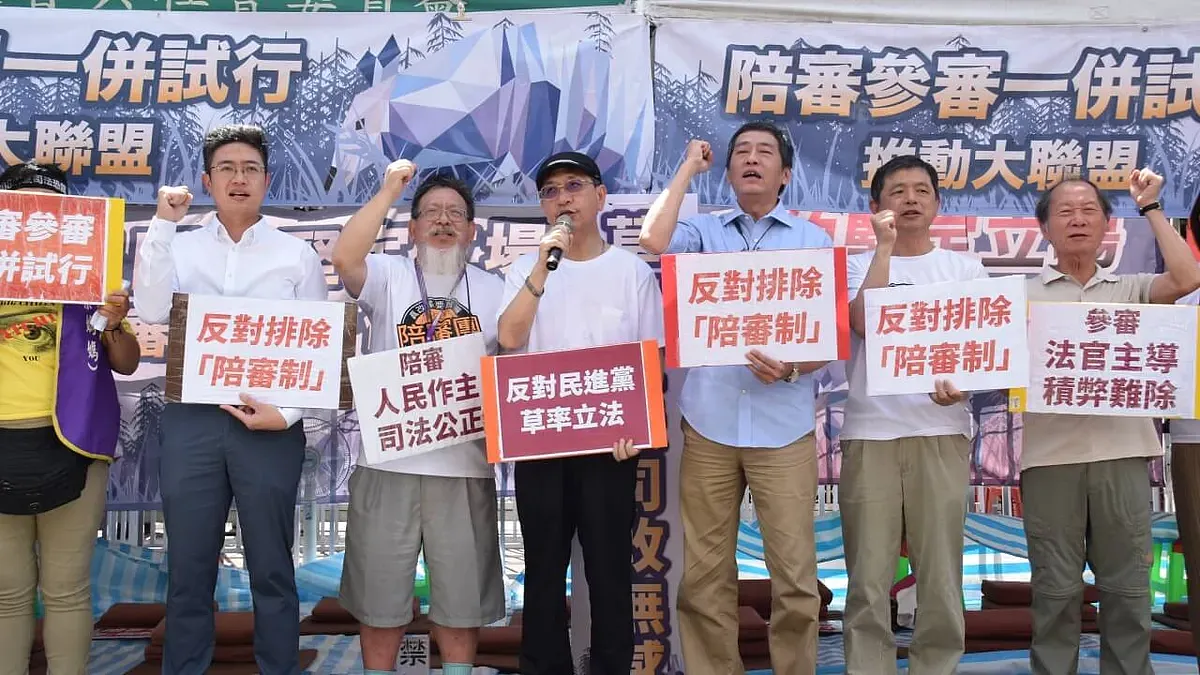
Civilian Mock Jury Trials Prove Feasible, President Tsai Should Publicly Debate Lay Assessor System—Day 5 of Sit-In Protest Against the Legislative Yuan's Extraordinary Session Inclusion of the National Lay Assessor Bill
Last edited: 2026-07-27
Formed by NGOs such as the Judicial Reform Foundation and the Taiwan Association for Indispensable Jury, the "Joint Promotion Alliance for the Simultaneous Trial of Jury and Lay Assessor Systems" held a press conference at 9:30 a.m. on July 3 at the main gate of the Legislative Yuan, titled "Civilian Mock Jury Trials Prove Feasible, President Tsai Should Publicly Debate Lay Assessor System." Village wardens and attorneys who previously participated in mock jury trials organized by the Taiwan Association for Indispensable Jury were invited to explain that implementing a jury system in Taiwan is feasible. The Alliance called upon President Tsai Ing-wen to engage in a public debate with them if she continues to support the Judicial Yuan's draft bill for a lay assessor system.
The Extraordinary Session of the Legislative Yuan will hold party caucus consultations on the draft Act on National Participation in Criminal Trials this morning (July 3). Chairperson Lin Yung-sung of the Judicial Reform Foundation stated that while Hong Kong's National Security Law excludes juries, it is hoped that President Tsai will not exclude the jury system nor limit the reform to a single system, and requested President Tsai to step forward and publicly debate the lay assessor system versus the jury system. The Judicial Yuan issued a press release yesterday (July 2) stating that running both systems concurrently is unfeasible, arguing that allowing defendants to choose between the lay assessor system and the jury system is unfair, and that having two defendants choose different systems would be operationally unmanageable. However, Chairperson Lin argued that the Judicial Yuan is uncommitted and has failed to do its homework, seemingly forgetting that the version negotiated with the civil society actually allows the defendant to choose. Furthermore, civil society has also revised its version for the simultaneous trial of both systems, distinguishing them by the type of offense to resolve the issue of defendant choice; this revised version by civil society has already been made public, yet the Judicial Yuan continues to harp on outdated arguments. Additionally, the Judicial Yuan claimed that trying both systems concurrently would waste taxpayers' money; however, the Judicial Yuan's version only entails about 600 cases per year—fewer than five cases per month for each court—a volume that courts can definitely handle. Moreover, in the civil society version, the two systems are similar. Next, the Judicial Yuan objected on the grounds that courtrooms would look different, but this is actually a trivial matter because not every courtroom needs to be remodeled. Finally, the Judicial Yuan pointed out that if the lay assessor system does not work well, it can be switched to the jury system. Chairperson Lin used a running race as a metaphor, stating that only the lay assessor system is allowed to run in the race, while the jury system is barred from running yet somehow allowed into the finals—this is unreasonable. The Alliance called upon the Democratic Progressive Party to exercise wisdom and courage, unhindered by conservative judicial administration.
Attorney Chang Ching, who participated in a mock jury trial organized by the Taiwan Association for Indispensable Jury and served as a judge, stated that presiding over a jury system is much easier for judges than presiding over a professional court or a lay assessor system. The Judicial Yuan's claim that judges cannot operate both systems is self-deprecating and undermines the professional knowledge and intelligence of judges. If judges can lawfully operate a jury trial, they can operate a lay assessor trial, but the reverse is not necessarily true. Attorney Chang once instructed Judge Hung Ying-hua—who also served as a judge in a mock jury trial—on how to operate a jury system, and it took only 20 minutes for Judge Hung to understand. Furthermore, it is very difficult to unlawfully manipulate jurors in a jury system because instructions to jurors must be given in open court, and any violation would constitute grounds for appeal. In contrast, in a lay assessor system, it is easy for judges to unlawfully induce lay assessors in rooms without audio or video recording. Therefore, Taiwan's judges are fully capable of operating a jury system.
Attorney Lin Wen-kail, who participated in a mock jury trial organized by the Taiwan Association for Indispensable Jury and served as a prosecutor, mentioned that Taiwan has no racial, religious, or gender discrimination, and since Europe and the Americas are capable of properly implementing the jury system, there is no reason Taiwan cannot do the same. Furthermore, the conscientiousness of jurors and their compliance with rules exceed our imagination, and juror bias can be resolved during the voir dire process of selecting jurors. Attorney Lin emphasized that jurors, having been exposed to identical evidence and materials, make better judgments than judges, because legal education only teaches the application of law and does not teach us how to ascertain facts. Moreover, when facing ordinary civilian jurors, prosecutors and defense counsel will explain matters in plain language, making this an excellent way to promote plain legal language. Finally, the jury system can relieve judges of the pressure of bearing the responsibility for rendering guilty or not-guilty verdicts; hence, there is truly no reason to exclude the jury system.
Attorney Chang Chun-lun, who participated in a mock jury trial organized by the Taiwan Association for Indispensable Jury and has served as both a prosecutor and defense counsel, noted that judges under the current system suffer from professional burnout, which leads to wrongful convictions—a problem that the jury system can resolve. Furthermore, a major issue with the lay assessor system is that lay assessors participate in sentencing, and debates on sentencing by both sides of the court will influence lay assessors' determination of guilt or innocence. In addition, under the lay assessor system, judges have to write judgments, which tends to pressure them into making lay assessors follow their opinions so the judgments can be completed smoothly. Attorney Chang hopes to reference South Korea and Hong Kong, which have adopted the jury system; Hong Kong's National Security Law stipulates that certain cases shall not be tried by jurors precisely because judges are easier to manipulate. The jury system represents the safeguarding of democratic spirit, and the Judicial Yuan should not think from an institutional self-interest perspective.
Attending Representatives
Attorney Lin Yung-sung / Chairperson, Judicial Reform Foundation (Convener)
Attorney Cheng Wen-lung / Founding Chairperson, Taiwan Association for Indispensable Jury (Convener)
Attorney Chang Ching / Member, National Congress on Judicial Reform; Participant, Mock Jury Trial
Village Warden Chan Chin-chien / Village Warden, Wanxing Village, Wenshan District, Taipei City; Participant, Mock Jury Trial
Attorney Lin Wen-kail / Attorney, Formosa Transnational Attorneys-at-Law; Participant, Mock Jury Trial
Attorney Chang Chun-lun / Attorney, Epoch Attorneys-at-Law; Participant, Mock Jury Trial
Press Contacts
Judicial Reform Foundation / Director Hsiao I-min
Taiwan Association for Indispensable Jury / Deputy Secretary-General Lin Ping-chuan
This article is an AI-generated translation of the original Chinese text. In the event of any discrepancy, the Chinese version shall prevail.