
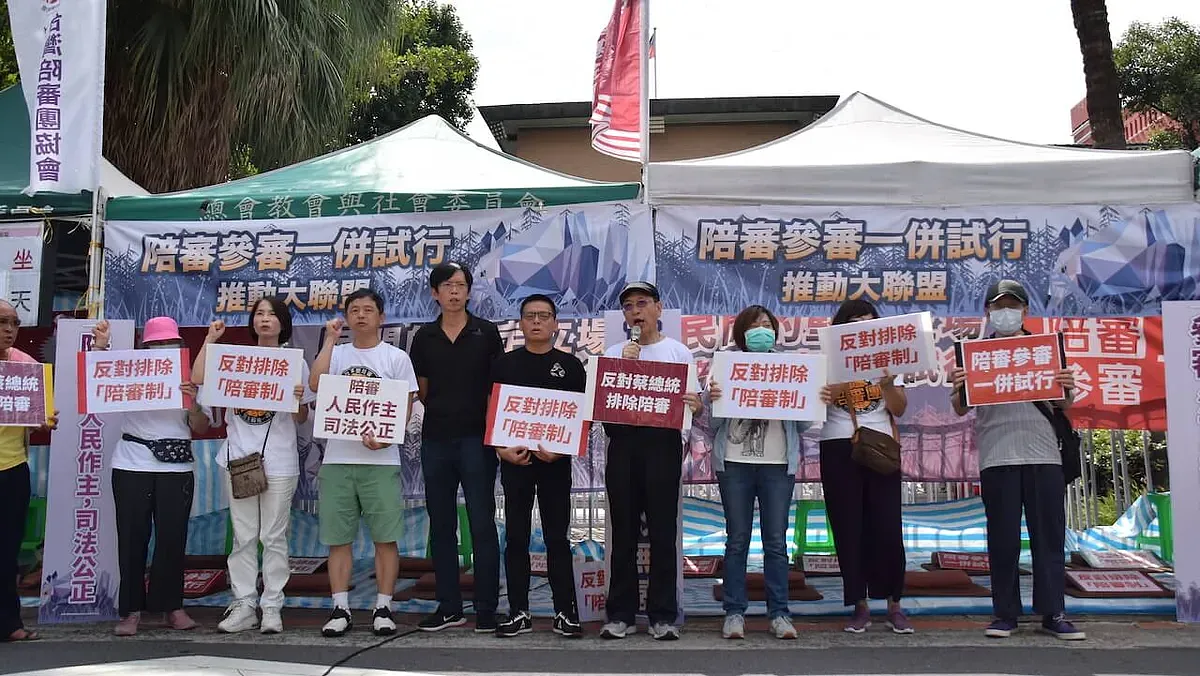
Learning from the Lessons of Wrongful Convictions, Opposing Hasty Legislation on Lay Participation—Day 6 of the Sit-in Protest Against the Legislative Yuan's Extraordinary Session Over the Lay Assessor Bill
Last edited: 2026-07-27
Formed by civil society organizations including the Judicial Reform Foundation and the Taiwan Association for Assessor System, the "Grand Alliance for Parallel Trial of Assessor and Jury Systems" held a press conference titled "Learning from the Lessons of Wrongful Convictions, Opposing Hasty Legislation on Lay Participation" at 9:30 a.m. on July 4 at the main entrance of the Legislative Yuan. They invited Mr. Su Chien-ho and Mr. Hsu Tzu-chiang, two victims of wrongful convictions who were finally acquitted following judicial retrials after being sentenced to death, to speak out about their experiences. Both men were sentenced to death in final judgments rendered under trials presided over by professional judges. The various flaws that occurred during their trial processes highlight the shortcomings of the professional judge trial system. The advocacy for judicial reform to introduce public participation in trials stems from the hope of avoiding the systemic ills of the professional judge system. However, the design of any public participation system in trials must be approached with caution, and proper evaluations must be conducted regardless of whether an assessor system or a jury system is adopted.
Lin Yung-sung, Chairperson of the Judicial Reform Foundation, stated that the reasons given by the Judicial Yuan and the Democratic Progressive Party (DPP) in opposition to the jury system are incorrect. First, the claim that the jury system lacks written judgments is false. Under the jury system, judges provide written instructions to jurors and prepare verdict sheets regarding the issues in the case, which the jurors then fill out. This serves as the jury system's simplified judgment. Moreover, the judgments under the assessor system proposed by the Judicial Yuan are also simplified. Let me ask everyone: do ordinary people understand current judgments? The mere existence of a judgment does not make the public trust the judiciary. Second, regarding the accusation that jury verdicts cannot be appealed, do Anglo-American countries not have appellate courts? Under the jury system, appeals to the second instance can be made on matters of law, and to some extent, on matters of fact as well. The same applies to the assessor system. The Judicial Yuan and the DPP have failed to carefully read the civil society draft. Third, concerns are raised about hung juries resulting from a failure to reach a unanimous verdict among jurors. However, a hung jury highlights the crucial importance of unanimity, which forces jurors to persuade one another. The civil society draft stipulates that jury deliberation shall not be less than three days. Furthermore, the rate of hung juries in Anglo-American countries is only 2 to 5 percent. While hung juries demonstrate the importance of unanimity, they are misrepresented as a flaw. In the event of a hung jury, prosecutors can choose to re-prosecute or drop the charges. Finally, Caucus Whip Ker Chien-ming went as far as to say that under prosecutions brought under the Anti-Infiltration Act, what should be done if a single person dissents and unanimity cannot be reached? The implication is that anyone prosecuted under the Anti-Infiltration Act should be presumed guilty, which easily leads to judicial miscarriages of justice.
Hsu Tzu-chiang, a wrongfully convicted individual who was once sentenced to death and endured 21 years of injustice, stated that throughout this journey, the attitude and institutional baggage of professional judges made them unwilling to overturn past judicial decisions out of fear of offending the judges who previously tried the case, which would imply that the earlier judgments were wrong. Furthermore, court hearings often concluded in just ten or twenty minutes—making them extremely hasty—and operated under a presumption of guilt. The path he walked was very difficult. Hsu expressed that public participation in trials is crucial. After observing the simulated jury trial held by the Alliance yesterday (the 3rd), he noted that the jurors engaged in very earnest discussions. Members of the public who previously observed his court trials all believed he was innocent. Hsu believes that if his case had been tried by a jury in the first place, he would have been acquitted long ago. While he hesitated to say which system—assessor or jury—is better, he emphasized that we should trust the Taiwanese people to have the capacity for judgment.
Su Chien-ho, another victim of wrongful conviction who faced 21 years of trial after being sentenced to death, also stated that when we do not yet know which system is better, neither should be rashly adopted. Over the course of 21 years of trials, the problem Su discovered was that professional judges believed they could do no wrong, and the historical principle of presumption of guilt caused him to suffer deeply for over two decades. He thus called upon the public to exercise their right to demand a better trial system.
Cheng Wen-lung, an attorney representing the Taiwan Association for Assessor System, stated that while the Legislative Yuan held all-night cross-caucus negotiations on the draft National Criminal Judges Act yesterday (the 3rd), all opposition parties stepped forward to voice objections and raised numerous opinions, with objections to nearly every single article. Attorney Cheng noted that a bill brought to the floor should be quite mature, yet this demonstrates that the DPP intends to rush legislation this time around. Cheng pointed out that the DPP opposed lowering the age requirement for national judges to 18, whereas in the US and Australia, individuals aged 18 and above can serve as jurors, and the civil society draft also sets the age at 18 in hopes of bringing diverse voices into trials. While the DPP champions the right of 18-year-olds to vote and participate politically, its assessor system draft opposes allowing 18-year-olds to serve. Additionally, Chiang Nien-tsu, Director of Caucus Whip Ker Chien-ming's office, mentioned that the Judicial Yuan's assessor system draft closely resembles the rigid trial practices of professional judges—for instance, it still maintains trial by written records. The wrongful convictions of Su Chien-ho and Hsu Tzu-chiang were primarily caused by reliance on written review, and the current assessor system still adopts this old model. Therefore, the Alliance opposes this hasty legislation by the DPP. Cheng emphasized that the Judicial Yuan and the DPP are pushing to ram the assessor system through out of a lack of understanding regarding fair trials, merely seeking to perfunctorily pass a fake reform bill. Citing an example, Cheng noted that during the trial of Hsu Tzu-chiang, the judges ignored Hsu's alibi. Yet in jury system countries, an alibi is considered the "king of evidence" and should be prioritized in a trial. Cheng argued that Taiwan's trial system is extremely backward. He recalled Socrates' saying that the most pathetic thing in the world is ignorance, and Plato's remark that the greatest evil is ignorance. He concluded that the DPP's ignorant legislation is the greatest harm to the country.
The Alliance's sit-in protest has entered its 6th day. Tonight (the 4th), a rally will be held outside the Legislative Yuan, and tomorrow (the 5th) at 3:00 p.m., participants will march around the Presidential Office to call on the President to step forward and engage in a public debate.
rParticipating Representatives
Lin Yung-sung, Attorney / Chairperson, Judicial Reform Foundation (Convener)
Cheng Wen-lung, Attorney / Founding Chairperson, Taiwan Association for Assessor System (Convener)
Hsu Tzu-chiang / Victim of Wrongful Conviction
Su Chien-ho / Victim of Wrongful Conviction
Press Contacts
Judicial Reform Foundation / Director Hsiao I-min
Taiwan Association for Assessor System / Deputy Secretary-General Lin Ping-ch'üan
This article is an AI-generated translation of the original Chinese text. In the event of any discrepancy, the Chinese version shall prevail.