
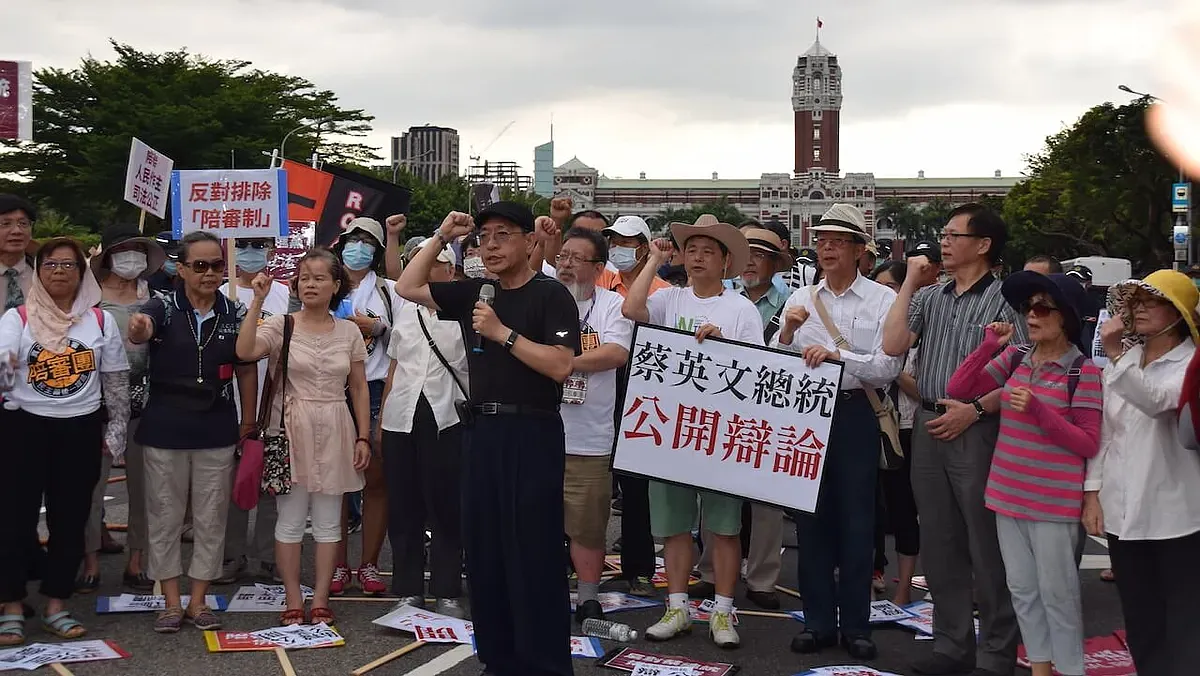
Marching to the Presidential Office to Call on President Tsai Ing-wen for a Public Debate: Sit-in Protest on the Seventh Day of the Legislative Yuan's Extraordinary Session Targeting the Lay Participation Draft Bill
Last edited: 2026-07-27
The "Grand Alliance for Concurrent Trial Implementation of Lay Assessor and Jury Systems"—composed of civil society organizations such as the Judicial Reform Foundation and the Taiwan Association for Jury System—held a press conference at 4:00 PM on July 5 in front of the Presidential Office titled "Marching to the Presidential Office, Calling on President Tsai Ing-wen for a Public Debate." The alliance set out from the Legislative Yuan, marching along Chungshan South Road, Ch'ing-tao West Road, Park Road, Hsiang-yang Road, Kuan-ch'ien Road,Chungshao West Road, Chungshan South Road, the northwest corner of Ching-fu Gate (Taipei Guest House side), and ending at the northeast corner of Kung-k'ai Intersection (Taipei Guest House side). They called on President Tsai Ing-wen to engage in a public debate with the public regarding the jury system and the lay assessor system, urging that the lay assessor system should not be forcefully passed while the public still lacks understanding.
Lin Yung-sung, Chairman of the Judicial Reform Foundation, stated that the Judicial Yuan has introduced the lay assessor system, in which professional judges and lay judges make decisions together, and the alliance is concerned that the opinions of professional judges will influence the lay judges. The Judicial Yuan's draft does not adopt the jury system, yet President Tsai Ing-wen, seemingly unclear about this, went so far as to claim that the lay judge system includes both lay participation and jury elements, and that the controversy is not about lay assessors versus juries. Passing legislation while unclear about the difference between lay assessors and juries constitutes hasty legislation. Furthermore, the draft Organic Act on Lay Participation in Criminal Trials underwent no caucus consultations during the first session of the Legislative Yuan this year. Instead, the Legislative Yuan reviewed the draft during an extraordinary session spanning merely two days on July 3 and July 6. In addition to the Judicial Yuan's version, versions were also submitted by the Kuomintang, the Taiwan People's Party, and the New Power Party. Pushing so many versions through hasty legislation within two days is unreasonable. This is a crucial piece of judicial reform legislation and should not be deliberated during an extraordinary session. The alliance does not understand why President Tsai is unable to implement the jury system. Recently, China's passage of the Hong Kong National Security Law explicitly excluded the jury system, showing that authoritarian states fear juries. We are a democratic country and should be different from authoritarian states; if the president can be directly elected and democracy can be realized, why cannot the judiciary be democratized? The president's concerns regarding the jury system are unreasonable. Chairman Lin emphasized that if judicial administration were capable of reform and self-reflection, there would be no need to convene the National Customs on Judicial Reform, and public trust in the judiciary would not linger at a mere twenty to thirty percent. Therefore, the alliance demands that the Legislative Yuan's extraordinary session halt its deliberation of the lay participation bill and demands that the President hold a public debate.
Attorney Cheng Wen-lung of the Taiwan Association for Jury System stated: If lay judges are neither jurors nor lay assessors, then what are they? The Democratic Progressive Party does not even understand the difference between the jury and lay assessor systems yet intends to pass it during the extraordinary session—this is hasty legislation. The lay assessor system primarily involves judges and lay assessors discussing cases together, whereas the jury system has judges preside over the proceedings while jurors decide whether the accused is guilty. Moreover, trial proceedings are judged according to evidence; under the jury system's procedures, evidence must be pristine and free from contamination. The Judicial Yuan's lay assessor system lacks this function and merely maintains the old trial system, throwing contaminated evidence into the trial proceedings. A jury is impartial precisely because jurors and judges are not mixed together, thereby preventing judges from exercising systematic bias, and preventing individual judges from being influenced by superiors. Having judges and lay judges try cases together will contaminate their mental evaluations and lead to tainted judgments. The Judicial Yuan's lay assessor system intends to let three judges contaminate six lay judges, which is inappropriate. Only by concurrently trialing both the jury and lay assessor systems can the public understand the difference between the two. Finally, the jury system possesses supervisory and check-and-balance effects, preventing power from being concentrated in a single person and ensuring proceedings are fairer and cleaner. The alliance advocates opposing the dictatorial lay assessor system, demands the democratic jury system, and insists on at least trialing both systems concurrently.
Attorney Chang Ching stated that the Democratic Progressive Party's party platform calls for the jury system, yet the three opposition parties support the jury system while the DPP, which wrote the jury system into its platform, now opposes it—how ironic. One can see from the Chinese Communist Party's desire to exclude juries in Hong Kong just how much those in power fear the jury system, because the jury system cannot be manipulated or controlled by those in power. Those in power cannot control how nine or twelve jurors determine facts, but under a professional judge system or a lay assessor system dominated by professional judges, career judges—influenced by considerations of career advancement or self-preservation—will allow the hands of those in power to reach into the judiciary. Attorney Chang emphasized that whether one is a defendant or a victim, everyone hopes for a judicial environment with fair trials. He hopes President Tsai will hear the people's cry demanding a jury system and requests that President Tsai engage in a public debate.
Attending Representatives
Attorney Lin Yung-sung / Chairman, Judicial Reform Foundation (Convener)
Attorney Cheng Wen-lung / Founding Chairperson, Taiwan Association for Jury System (Convener)
Attorney Chang Ching / Member, National Congress on Judicial Reform
Press Contacts
Judicial Reform Foundation / Director Hsiao I-min
Taiwan Association for Jury System / Deputy Secretary-General Lin Ping-ch'üan
This article is an AI-generated translation of the original Chinese text. In the event of any discrepancy, the Chinese version shall prevail.