
Stop Evading the Issue on Negotiating Lay Participation, DPP Must Clear the Air—Eighth Day of Sit-in Protest Against the Inclusion of the National Lay Participation Bill in the Legislative Yuan's Extraordinary Session
Last edited: 2026-11-03
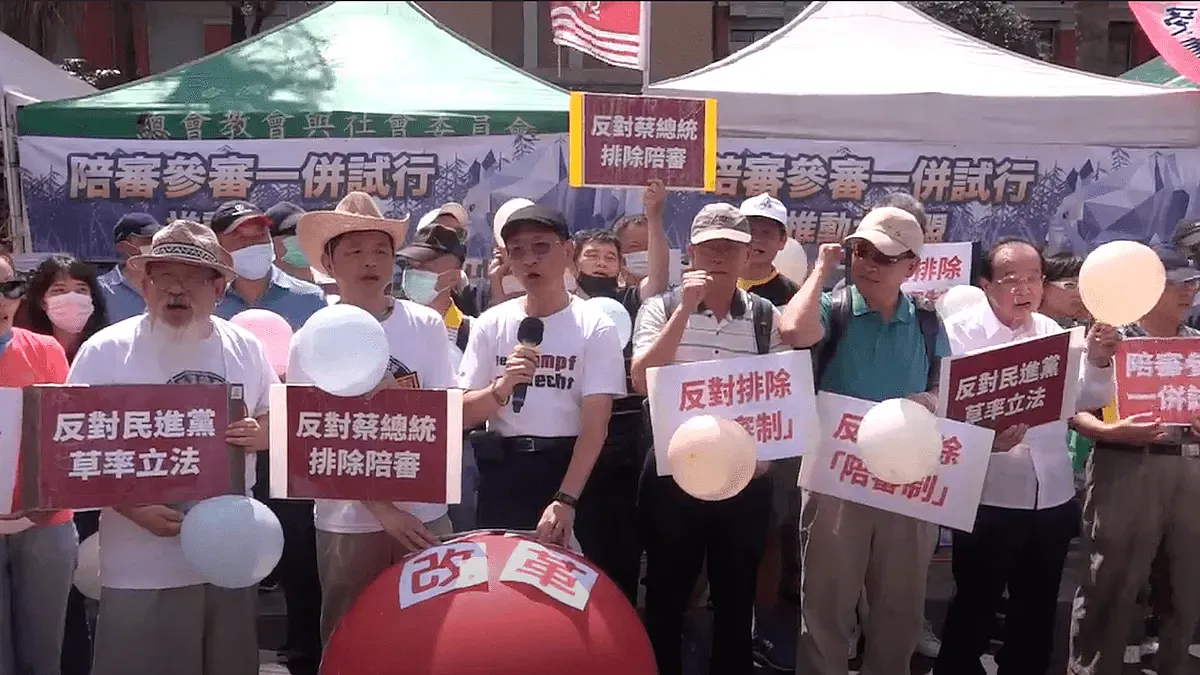
The Alliance for Parallel Trial Implementation of Lay Judge and Jury Systems, composed of civil groups including the Judicial Reform Foundation and the Taiwan Association for Jury, held a press conference titled "Stop Evading the Issue on Negotiating Lay Participation, DPP Must Clear the Air" at 9:30 p.m. on July 6 in front of the Presidential Office in response to yesterday's statements by the Presidential Office and the Judicial Yuan. The Alliance pointed out that during the extraordinary session of the Legislative Yuan, cross-party consultations have begun on the draft "Act on Criminal Trials with Citizen Participation." However, when faced with doubts from civil groups and opposition parties regarding the parallel implementation of both the lay judge (mixed court) and jury systems, the Democratic Progressive Party (DPP) has continuously evaded and dodged the issue. Consequently, the Alliance prepared hundreds of balloons to pop, symbolizing the puncturing of the DPP's empty rhetoric ("ts'un-chi-kuei" or bragging) regarding judicial reform.
Lin Yung-sung, Chairperson of the Judicial Reform Foundation, noted that the Legislative Yuan continued consultations on the draft Act on Criminal Trials with Citizen Participation today, and the DPP caucus expects the bill not to pass until after July 21. Judging from the opinions expressed by the DPP, the Judicial Yuan, and the Presidential Office, their stance is completely rigid and unyielding, aiming merely to superficially complete the legislative procedure. The Alliance expresses deep regret over this hasty legislation. The day before yesterday (July 4), in response to a statement by Taiwan-centric groups, the Presidential Office stated that the key is not whether it is a lay judge or jury system, but rather public participation and judicial professionalism—a statement whose meaning is entirely incomprehensible. This is because under a lay judge system, professional judges participate in deliberations and may even exert undue influence, whereas in a jury system judges cannot exert such influence; the two are fundamentally different. Both the President and the Judicial Yuan claim that the bill incorporates the spirit of the jury system. Chairperson Lin emphasized that as long as there is joint deliberation, it is a lay judge system; no one has ever described Japan's system as a jury system. The Presidential Office's claim that the two systems are fused makes no sense. Chairperson Lin illustrated this by comparing it to an authoritarian state that allows citizens to vote, but where officials instruct voters on how to cast their ballots. Furthermore, newspaper reports today indicated that over 70% of the public supports the lay judge system while only slightly over 10% supports the jury system. However, the poll question asked about professional judges and citizens trying cases together—yet a jury system also involves professional judges and citizens trying cases together, making this poll based on a flawed premise. In the current cross-party consultations, the DPP intends to rename the Act on Criminal Trials with Citizen Participation to the Citizen Judges Act. In reality, changing the name is just serving old wine in a new bottle and serves no purpose. Finally, Chairperson Lin reiterated that jury verdicts are reasoned and appealable. We firmly believe that the public will not accept the system currently proposed by the Judicial Yuan. We urge the DPP not to resort to pretense or pass off fish eyes as pearls.
Chang Cheng-hsiu, Associate Professor at the Department of Law of Kainan University, stated in his remarks that in a democratic society everyone is equal, and when conflicts arise, an arbitrator must be sought. The jury system is the product of the people taking charge and acting as arbitrators. The DPP's claims that jury verdicts cannot be appealed and lack reasoned judgments in order to push the bill through are pure nonsense. The DPP also claims that many juries can be bought off; while that is indeed true, a lay judge system is even easier to buy off than a jury system because jury trials are conducted swiftly, and jurors are not permitted to go home or contact the outside world during deliberations. He emphasized that the reasons for opposing a system dominated solely by professional judges were historically to prevent political interference, and today are to prevent professional judges from holding excessive adjudicatory power and being swayed by bias. Finally, Associate Professor Chang will continue to write op-eds on the jury system for public understanding.
Su Huan-chih, former Magistrate of Tainan County and Convener of the Taiwan Renewal Party, also stepped forward to support the jury system, pointing out that the currently effective DPP party charter mandates the implementation of a jury system. By openly violating its own charter, such a political party is deceiving voters and slapping itself in the face. Furthermore, while the Hong Kong National Security Law deliberately excludes the jury system, the DPP is likewise excluding the jury system in Taiwan. In addition, the jury system is explicitly stipulated in the U.S. Constitution and has been practiced for over two hundred years; yet the DPP is rejecting the American system. Finally, former Grand Justice Hsu Yu-hsiu, who studied in Germany and specializes in criminal law, chose to support the jury system, yet was completely uninvited when the legislation was initially drafted.
Li Chuan-hsin, President of the Taiwan Society and the Taiwan North Society, speaking on behalf of the Taiwan-centric Alliance, stated that following the Alliance's sit-in protest, both the Presidential Office and the Judicial Yuan became very nervous, explaining that the lay judge system was adopted because jury trials cost a lot of money and court facilities cannot accommodate jury equipment. Moreover, eighty to ninety percent of the people distrust the judiciary, and judicial reform must naturally strive for a fair, open, and transparent judiciary. Yet a spokesperson for the Presidential Office went so far as to say that whether it is lay participation or jury trial is unimportant, and the core issue is public participation. However, the real issue is whether the public directly participates, with professional judges assisting rather than intervening. The DPP party charter explicitly mentions the implementation of a jury system, and opposition party caucuses also support a jury system. This moment transcends the pan-Green and pan-Blue divide, and we look to both the ruling and opposition parties in Taiwan to build consensus starting from judicial reform. Furthermore, in any proper experiment, without a control group, it is impossible to know which system is better; only by implementing both systems in parallel for a six-year comparison period can we avoid wasting the time spent on judicial reform. Finally, we hope that the Legislative Yuan's deliberation of the bill can be suspended, or at least postponed.
Chang Tsan-hung, Chairperson of the Lee Teng-hui Democratic Association, noted that President Tsai's judicial reform public opinion ratings hit rock bottom and rank last. Today, the Taiwan-centric Alliance will visit various party caucuses in the Legislative Yuan, hoping that the bill will not be decided during the extraordinary session of the Legislative Yuan, but rather discussed properly during a regular session. Finally, Chairperson Chairperson Chang reiterated that evaluating the lay judge and jury systems side-by-side over a six-year period before making a decision is the only reasonable course of action.
Cheng Wen-lung, founding chairperson of the Taiwan Association for Jury and an attorney-at-law, pointed out that the DPP's claim that public opinion polls show over 70% support is fake news, as the polls indicate only 8% public support for the Judicial Yuan's lay judge system. Yet the DPP is determined to force it through, operating in a highly hasty manner. A poll commissioned by the Taiwan Association for Jury and conducted by Sun Yat-sen University shows that 83% support the jury system. Today, former President Ma Ying-jeou questioned whether Taiwan's National Security Act is similar to Hong Kong's National Security Law. Attorney Cheng believes that Hong Kong's National Security Law excludes juries precisely to crack down on democratic dissidents, and Taiwan's exclusion of juries puts it in the exact same position as Xi Jinping. Attorney Cheng questioned whether the Tsai administration supports Xi Jinping or the people of Hong Kong. Taiwan's solidarity with Hong Kong can be measured by its stance on the jury system; if the DPP passes a bill that excludes juries, the Tsai administration will be standing alongside Xi Jinping to suppress the people of Hong Kong and Taiwan, posing a major national security issue. Furthermore, the DPP is giving the jury system a slap in the face; the U.S. Constitution explicitly mandates the jury system, and the U.S. protects its people in matters of national security through it, yet the DPP has the audacity to strike down the U.S. Constitution, which endangers national security. Ultimately, beyond protecting the Taiwanese people's right to judicial fairness, the jury system also ensures that Taiwan stands on the side of democracy and freedom internationally.
Chang Ching, an attorney and member of the National Consultative Conference on Judicial Reform, also recounted a past case he litigated, in which a defendant he represented did not shave because his father had passed away. The first thing the presiding judge said to the defendant was, "Why do you have a beard? No good person grows a beard." When the defendant retorted that both Chiang Kai-shek and Sun Yat-sen had beards, the judge's next sentence was, "Do you think you are Sun Yat-sen or Chiang Kai-shek?" This is precisely the kind of professional judiciary we cannot trust.
At the conclusion of the press conference, each participant held a balloon and pierced it with a needle, symbolizing the puncturing of President Tsai's lies.
Attending Representatives
Attorneys Lin Yung-sung / Chairperson, Judicial Reform Foundation (Convener)
Professor Chang Cheng-hsiu / Associate Professor, Department of Law, Kainan University
Attorney Su Huan-chih / Convener, Taiwan Renewal Party
President Li Chuan-hsin / President, Taiwan Society and Taiwan North Society (Speaking on behalf of the Taiwan-centric Alliance)
Chairperson Chang Tsan-hung / Chairperson, Lee Teng-hui Democratic Association
Attorney Cheng Wen-lung / Founding Chairperson, Taiwan Association for Jury (Convener)
Attorney Chang Ching / Member, National Consultative Conference on Judicial Reform
Press Contacts
Judicial Reform Foundation / Director Hsiao I-min
Taiwan Association for Jury / Deputy Secretary-General Lin Ping-ch'üan
This article is an AI-generated translation of the original Chinese text. In the event of any discrepancy, the Chinese version shall prevail.