
Lay Participation in Trials Should Not Be Hastily Legislate, and the DPP Should Pull Back from the Brink—Day 8 of the Sit-In Protest Against the Inclusion of the Lay Participation Bill in the Legislative Yuan's Provisional Session
Last edited: 2026-11-03
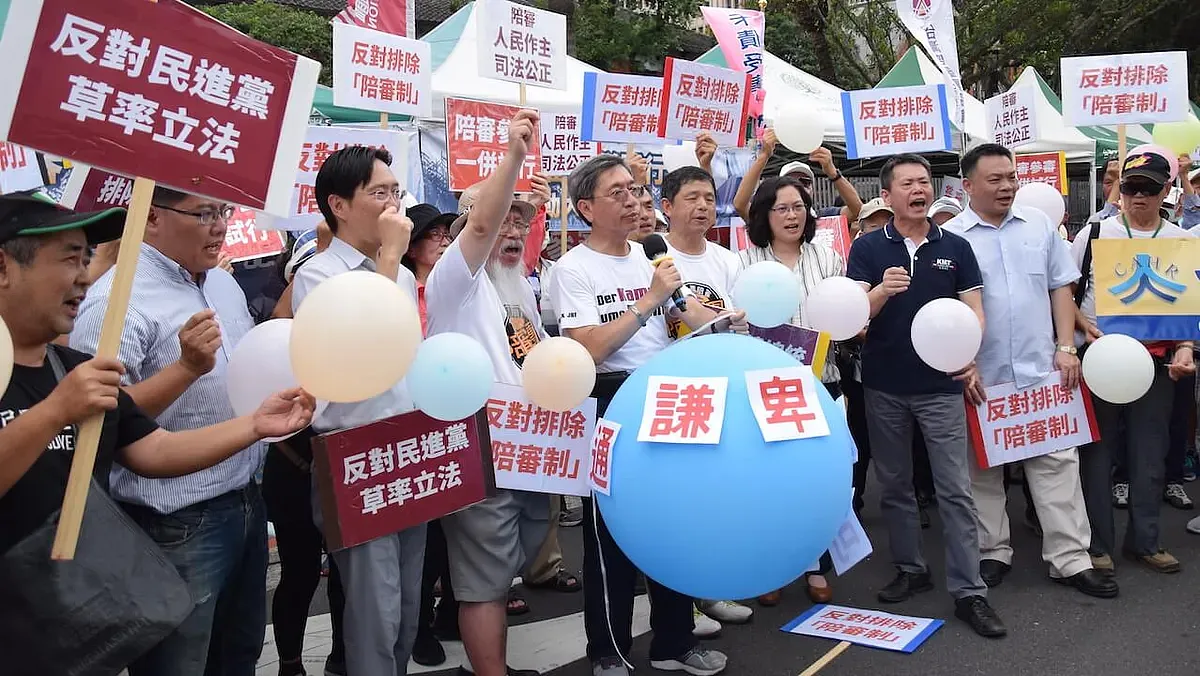
Formed by civil society groups such as the Judicial Reform Foundation (JRF) and the Taiwan Association for Jury System, the "Grand Alliance for the Parallel Trial of Jury and Lay Assessor Systems" held a press conference titled "Consult on the Jury System, Do Not Evade the Issue: The DPP Must Come Forward and Explain Clearly" in front of the Legislative Yuan at 14:00 on the afternoon of July 6, responding to the morning's cross-party consultations in the Legislative Yuan. The Alliance pointed out that the draft "Citizen Judges Act" has entered cross-party consultations during the Legislative Yuan's provisional session. As the Democratic Progressive Party (DPP) continues to evade and dodge questions from civil society and opposition parties regarding the parallel trial of both lay assessor and jury systems, the Alliance prepared hundreds of balloons to burst, symbolizing that the DPP's judicial reform is nothing more than empty talk (p'u-k'e-kuei).
Chairman Lin Yung-sung of the JRF mentioned that, in addition to inviting the caucus conveners of the three opposition parties to explain the consultation process, this press conference also invited DPP Caucus Convener Ker Chien-ming. The DPP's party platform advocates for a jury system, and back in 2012 when they were in opposition, they also proposed a draft jury system act. During their presidential campaigns in 2012 and 2016, President Tsai also advocated for both lay assessor and jury systems. However, after taking office, they have groundlessly claimed that the jury system is unfeasible and abandoned it. What we find incomprehensible is why a democratic Taiwan would exclude juries in the same way China's National Security Act does. There are currently 52 countries implementing the jury system, which continues to progress. We will ask the caucus convener to explain this. We hope the DPP can reflect on this. We advocate for the parallel trial of both systems, and the DPP must think twice. Regarding such an important piece of judicial reform legislation, it should not be pushed through via voting. This is not a political bill; if the DPP strongly insists on passing the lay assessor system during the provisional session, it shows that the DPP and President Tsai do not understand the jury system. Two weeks ago, President Tsai even told me that the version currently proposed by the Judicial Yuan is also a draft jury system. I told her that the Judicial Yuan's version is not a jury system, and explained the difference between the lay assessor and jury systems. Unfortunately, she seemed not to understand. If the DPP insists on hasty legislation, we demand an open televised debate so the public can understand the difference between the lay assessor and jury systems. Legislation should not be rushed.
Legislator Lai Hsiang-ling, convener of the Taiwan People's Party (TPP) caucus, mentioned that civil society forces have been staging a sit-in for the eighth day today, and this is the fourth time the opposition caucus conveners have gathered for this issue. Echoing the host, this legislation has been drafted hastily. During the clause-by-clause review, we initially opposed including such an important bill in the provisional session, but the DPP still insisted on placing it on the agenda. During today's clause-by-clause review, out of more than a hundred clauses, over thirty were reserved. Because the TPP included the provisions for the parallel trial of both systems in the consultations, moving from the first clause to today, nearly thirty clauses were reserved, and only two reached a basic consensus. It can be said there is virtually no consensus on the entire bill. As Chairman Lin just mentioned, during the 9th Legislative Yuan, many DPP members—including Tsai Yi-yu—advocated for the jury system. Now, only the New Power Party (NPP) continues to propose a jury system. They [the DPP caucus] cannot convince everyone, nor can they give an account to the people of the country. They also cannot provide a reason why the parallel trial of both systems is unfeasible. During this morning's consultations, when we asked regarding Article 37 whether a retrial process is necessary if a reserve lay assessor is vacant and needs to be replaced, this single point was debated for two hours, yet they [the DPP] still could not convince us. The reason is that we do not want lay judges to be influenced by the authority effect of professional judges, failing to change the current status quo of professional-led trials. I believe that even down to this detail, the design of the lay assessor system remains extremely incomplete and disrespectful to the people of our country. Such questioning was met with a slap in the face and mockery from Convener Ker, who claimed how the lay assessor system respects the people and that parallel trials are unfeasible. We in the opposition cannot accept such an arrogant attitude. Discussions throughout the morning stalled at Article 37 with no consensus, and upon reaching Article 38, they were even less able to explain why the trial portion cannot adopt the jury system. I believe everyone is very clear that the jury system is a system where the people make decisions themselves using grassroots sentiments and thinking, without being guided by legal professionals. Up to now, there is still no room for the parallel trial of both systems. We are deeply regretful. I am even considering proposing the termination of consultations. I respect Speaker You as the person presiding over the parliamentary proceedings, but he should deliberate carefully and not continue to gloss over reservations during the provisional session, ultimately steamrolling the passage of this major judicial reform bill through a vote. We hope to stand firm and stop reviewing this during the provisional session.
Legislator Lin Wei-chou, convener of the Chinese Nationalist Party (KMT) caucus, mentioned that during the morning's consultations, when we questioned Convener Ker as to why the party platform explicitly calls for a jury system—especially advocating for crimes of rebellion and treason—Convener Ker replied that it was merely a temporary strategy, a strategy to counter the KMT. I said, how can your party platform be used as a strategy to counter the KMT? A party platform represents a party's values; values and strategy are different. I told him he should quickly change his party platform, as a party platform is a party's value—pursuing Taiwan's democracy, public entry into the judiciary, and public participation in trials—yet you can just cast it aside like this! Secondly, regarding his reason for opposing the parallel trial of both systems, he believes it is a "frankenstein vehicle" that will not go far and cannot be implemented. Ladies and gentlemen, let us take a step back: originally, both the JRF and the Taiwan Association for Jury System insisted on advocating for the jury system in accordance with the DPP's value propositions. However, because the DPP adamantly opposed it and even refused to allow the NPP's jury system bill an opportunity for committee discussion, we took a step back and advocated for the parallel trial of both systems, allowing both the jury and lay assessor systems to be tested so that the people can decide. We compromised so humbly in pursuit of progress, only to be mocked for having no values, flip-flopping, and ridiculed as a "frankenstein vehicle"! Then why don't we just return to the jury system? Yet they dare not do so. We proposed various trial schemes, including concurrent or consecutive three-year trial periods, but all were rejected. This afternoon, we will continue consultations and oppose the hasty passage of this legislation.
Legislator Chiu Hsien-chih, convener of the New Power Party (NPP) caucus, mentioned that last year the Judicial Yuan submitted crimes carrying a prison sentence of seven years or more for the Legislative Yuan's review, but this year it has regressed to crimes carrying a sentence of ten years or more. If only crimes of ten years or more are eligible for public lay participation, out of 200,000 cases, only 500 would be eligible—less than one percent! The Secretary-General of the Judicial Yuan stated that due to this system, the Taipei District Court handles 39 cases eligible for public lay participation each year, yet he claimed the burden is heavy. But 39 cases actually amount to only three per month! We believe this institutional design is a system that "prevents the public from participating in trials"; the Judicial Yuan actually does not want the public to participate in trials. During the consultation process, I also felt very saddened, because the NPP's draft does not merely represent the proposal of a small party, but is the culmination of the hard work of many senior legal professionals and citizens who support the jury system. Last Friday, after a long discussion—supposedly having removed intermediate discussions—according to Secretary-General Lin Hui-huang of the Judicial Yuan, judges will still bring lay judges into the deliberation room for what he calls intermediate discussions, without even placing limits on the number, time, or subjects of discussions. How can this avoid the authority effect? How can a system designed with such distrust in the people be expected to make the public trust the judiciary? As Legislator Lai just mentioned, the Code of Criminal Procedure already contains regulations on retrial procedures, and the Supreme Court has rendered judgments as well, yet the Judicial Yuan cannot clearly explain this. If referencing Japan's system, where alternate lay assessors watch video recordings of prior proceedings after stepping in, the Judicial Yuan opposes this as well. We believe such a major reform of the judicial system should be discussed openly and honestly with everyone here, including the civil society groups present. We hope the Judicial Yuan will pull back from the brink, and we will continue our efforts and steadfastly uphold our positions.
Kao Su-po of the Taiwan Association for Human Rights stated that people across party lines and political stances have stood up today because they believe that passing legislation based on the Judicial Yuan's current version would be a disaster. We hope to suspend the review of this bill, return it to committee, and broadly incorporate public opinion. If this bill is not sent back, it will be a disaster; the people will become tools to endorse judges, or be reduced to something akin to China's public struggle sessions (public trials). If so, how can miscarriages of justice such as Su Chien-ho's case be vindicated? Let us hope our efforts of the past twenty years are not buried! Thank you all.
At the end of the press conference, each participant held a balloon and punctured it with a needle, symbolizing the puncturing of President Tsai's lies.
Attending Representatives
Lin Yung-sung, Attorney at Law / Chairman (Convener), Judicial Reform Foundation
Legislator Lai Hsiang-ling / Caucus Convener, Taiwan People's Party
Legislator Lin Wei-chou / Caucus Convener, Chinese Nationalist Party
Legislator Chiu Hsien-chih / Caucus Convener, New Power Party
Kao Su-po / Chairman, Taiwan Association for Human Rights
Press Contacts
Judicial Reform Foundation / Director Hsiao I-min
Taiwan Association for Jury System / Deputy Secretary-General Lin Ping-chuan
This article is an AI-generated translation of the original Chinese text. In the event of any discrepancy, the Chinese version shall prevail.