
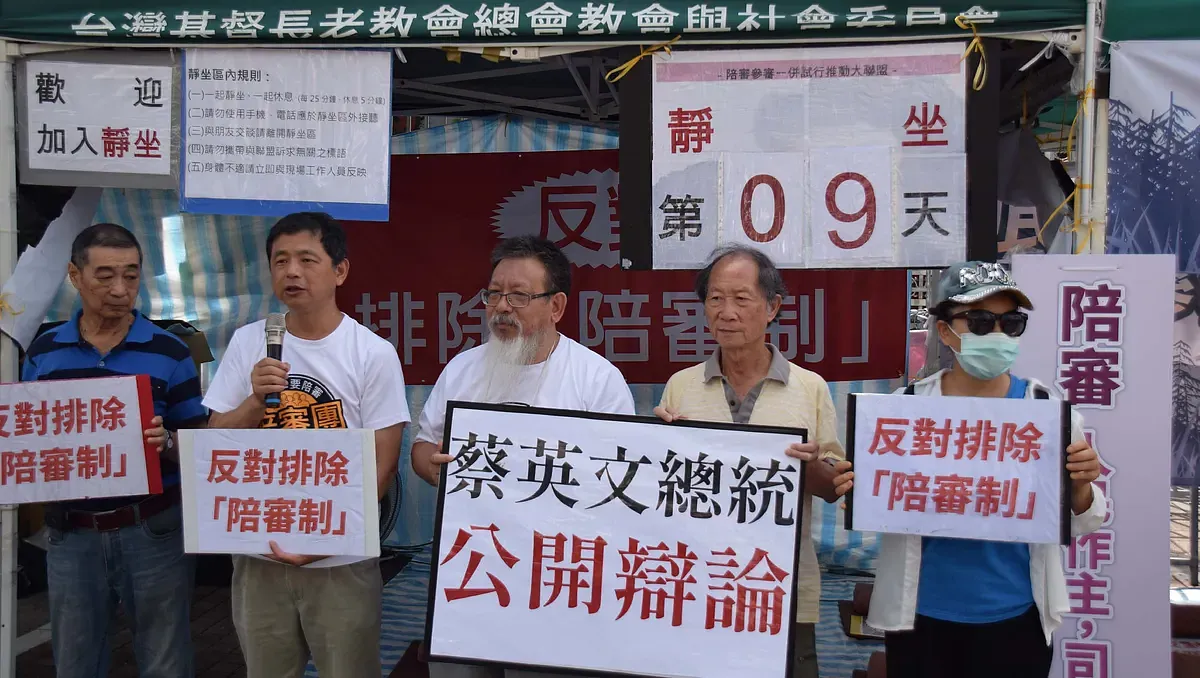
Responding to Caucus Whip K'o's Objections to the Jury System, the Alliance Will Continue Its Sit-in—Day 9 of the Sit-in Protest Against the Legislative Yuan's Extraordinary Session Scheduling of the Citizen Judges Act Bill
Last edited: 2026-07-27
Formed by NGOs such as the Judicial Reform Foundation and the Taiwan Association for Parliamentarianism (Taiwan Jury Association), the "Alliance for the Concurrent Trial of Jury and Lay Participation Systems" (for alliance members, please refer to the website) held a press conference titled "Responding to Caucus Whip K'o's Objections to the Jury System, the Alliance Will Continue Its Sit-in" at 9:30 a.m. on July 7 in front of the main gate of the Legislative Yuan. The conference responded to the reasons put forward yesterday (the 6th) by Caucus Whip K'o against the jury system, reaffirming the Alliance's position that the jury and lay participation systems should be trialed concurrently. Furthermore, although the Legislative Yuan's extraordinary session began processing nominees for Examination Yuan and Control Yuan members today (the 7th) and will not resume deliberation of the draft Criminal Trials with Citizen Participation Act until after July 20, the Alliance will continue its sit-in outside the Legislative Yuan to demonstrate its determination to protest.
Attorney Cheng Wen-lung, Founding Chairperson of the Taiwan Association for Parliamentarianism, noted that Caucus Whip K'o Chien-ming previously supported the jury system and even encouraged them: proposing a jury system draft in 2012, sending the director of Caucus Whip K'o's office alongside the Jury Association to observe the jury system in the United States in 2014, and signing a joint petition supporting the jury system in 2015. Attorney Cheng believes that in a democratic country, integrity is fundamental. Currently, the Democratic Progressive Party (DPP) holds a monopoly over the party, government, military, and media. All 15 Grand Justices, Examination Yuan members, Control Yuan members, and the Premier were nominated by President Tsai, who also serves as the DPP chairperson and will nominate future DPP candidates for party positions. The president today is an imperial president. The Alliance is not afraid of those in power because it holds onto genuine truth; it is honesty and truth confronting powerful liars. The strength of the Alliance lies in its righteousness and persistence in truth. Starting yesterday (the 6th), the DPP began attacking the Alliance using fake polls, which shows their guilty conscience and fear, because society knows that the DPP's betrayal of its party platform constitutes deception. The Alliance is like the child in The Emperor's New Clothes pointing out that the emperor is naked—the emperor is the president, and the clothes are honesty.
Attorney Cheng emphasized that the jury system is the very institution that democratizes the judiciary in a democratic society. Only democratic countries can accommodate a jury; autocratic countries have no need for one. People's participation in adjudication is the sole form of resistance against totalitarian and autocratic states. Yesterday (the 6th), one of Caucus Whip K'o's reasons for opposing the jury system was that if the Anti-Infiltration Act were applied to a jury trial, a single dissenting juror could prevent the conviction of a defendant. Attorney Cheng argued that Caucus Whip K'o simply wants to punish whoever he pleases, voicing the ugliest mindset of a totalitarian state—much like how the Hong Kong National Security Law deliberately excludes juries. Caucus Whip K'o's remarks reflect the mindset of Xi Jinping. Citing the United States as an example, Attorney Cheng pointed out that during the American Revolution in 1776, insistence on a jury was paramount, and the U.S. insisted on enshrining the jury in its constitution to protect the people. The DPP's forcible passage of the lay participation system while rejecting the jury system lacks judicial justice, utilizing national security laws and the Anti-Infiltration Act to punish disfavored individuals. Next, Caucus Whip K'o's second reason against the jury system was that Taiwan lacks the supporting measures to implement it. Attorney Cheng believes this merely reveals that the lay participation system requires no changes to the judiciary—making it a fake reform. The Alliance maintains that promoting the jury system is intended to transform the adjudication system and genuinely carry out judicial reform. Attorney Cheng used an analogy: the jury system is a four-wheeled car, a fast-running vehicle, whereas the government is pulling a horse carriage; when you have a car, you must pave the cement road (the current judicial system) into an asphalt road (the supporting measures). Yet Caucus Whip K'o argues that because we currently only have a cement road, nothing should be changed at all. Finally, Attorney Cheng stressed that the Alliance will continue its sit-in to oppose the Legislative Yuan's hasty legislation and called upon the President to engage in a public debate.
Attorney Chang Ching, a member of the National Congress on Judicial Reform, noted that in the past, the DPP invited the Judicial Yuan, the Ministry of Justice, and the Alliance to hold six rounds of consultations. During the consultations, Attorney Chang asked who would take responsibility if the lay participation system failed; those present remained silent. In reality, it is a triple-loss strategy where the DPP loses, the Judicial Yuan loses, and the people lose. However, if the concurrent trial of jury and lay participation systems is passed and evaluated after six years before making a choice, it would be a triple-win outcome. Furthermore, Attorney Chang believes that the DPP nakedly seeks to manipulate the judiciary, utilizing the lay participation system to control the people and coerce them into accepting the ruling authorities' views. In the future, any of us could become defendants under the Anti-Infiltration Act, where the lay participation system can be used to convict anyone they wish to target.
Former DPP Legislator and Convener of the Anti-Poverty Alliance, Ch'ien Shih-k'o, pointed out that Hong Kong has implemented a jury system for 150 years, with 93% of the public trusting the judiciary, whereas Taiwan's satisfaction with the judiciary was only 27% last year. Mr. Ch'ien mentioned his past electoral work within the DPP, giving him an understanding of how leading questions are used to manipulate polling data. Therefore, the Alliance advocates for a public debate on juries versus lay participation, allowing the concurrent trial of both systems to be understood by the public. President Tsai still has over three years left in her term; it is unclear why she is rushing to pass the lay participation system during an extraordinary session. He urged citizens to learn more and supervise the government, thereby democratizing the judiciary and enabling independent public participation in verdicts. The lay participation system allows professional judges to influence laypersons, which is meaningless. If passed in the future, civil society will not let the matter rest, which will also impact the remainder of Tsai Ing-wen's administration. He called on the DPP to pull back from the brink and refrain from rushing the legislation, while urging Tsai Ing-wen or a DPP representative to engage in a public debate.
Attending Representatives
Attorney Cheng Wen-lung / Founding Chairperson of the Taiwan Association for Parliamentarianism (Convener)
Attorney Chang Ching / Member of the National Congress on Judicial Reform
Former Legislator Ch'ien Shih-k'o / Former DPP Legislator, Convener of the Anti-Poverty Alliance
Press Contacts
Judicial Reform Foundation / Director Hsiao I-min
Taiwan Association for Parliamentarianism / Deputy Secretary-General Lin Ping-ch'üan
This article is an AI-generated translation of the original Chinese text. In the event of any discrepancy, the Chinese version shall prevail.