
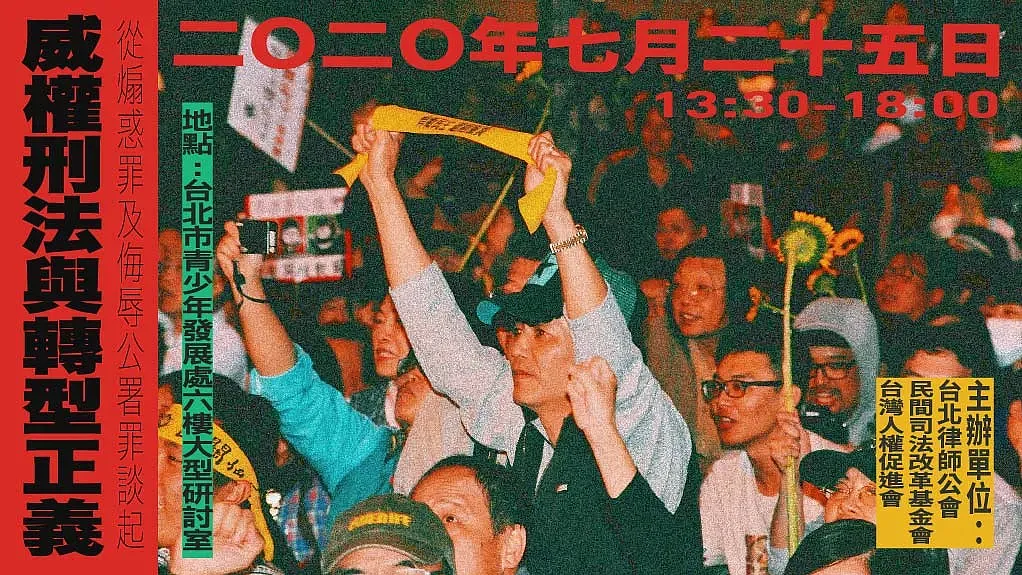
Seminar | Authoritarian Criminal Law and Transitional Justice: Starting from the Offense of Instigation and the Offense of Insulting a Public Office
Last edited: 2026-07-27
The second-instance judgment for the March 23 Executive Yuan occupation incident was rendered on April 28 this year. Activists were sentenced to 2 to 4 months in prison for violating Article 153 of the Criminal Code, the "offense of instigation." More than 30 years after Taiwan's transition from authoritarianism to democracy, in the highly democratized contemporary era, the investigative and police systems are still seen exercising state power to prosecute citizens for peacefully exercising their freedom of speech and assembly, sparking widespread discussion among legislators and academics. The definition and scope of the offense of instigation are overly broad and abstract, which may already impede people's freedom of expression in a democratic era, and legislators have directly called on the Ministry of Justice to comprehensively review "authoritarian criminal law."
The so-called "authoritarian criminal law" is not limited to the "offense of instigation" in the current Criminal Code; it also includes the offense of insulting a public office under Article 140 and the offense of insulting the national flag under Article 160. In recent years, activists expressing symbolic speech have frequently found themselves bound by the aforementioned criminal provisions.
The Taipei Bar Association, the Judicial Reform Foundation, and the Taiwan Association for Human Rights have long focused on the protection of rights such as freedom of assembly and association and freedom of speech in our country. The abolition, retention, and amendment of "authoritarian criminal law" concerns how state power suppresses people's freedom of speech and is closely related to transitional justice. Therefore, it is necessary to convene criminal law and public law scholars, official representatives from the Ministry of Justice, and practitioners from the legal field to jointly discuss and deliberate, which will also benefit members of the Taipei Bar Association in handling cases related to assemblies and processions.
All parties concerned about freedom of expression and transitional justice are welcome to actively participate.
Time
July 25, 2020, 13:30-18:00
Location
Large Seminar Room, 6th Floor, Taipei Youth Development Center
(6th Floor, No. 17, Sec. 1, Jen-ai Rd., Zhongzheng Dist., Taipei City)
Agenda
| Time | Activity | Speaker |
| 1330-1340 | Opening Remarks | Yu Po-hsiang, Attorney-at-Law (Convener of the 318 Anti-Black Box CSSTA Pro Bono Legal Team) |
| Session I: Starting from the Offense of Instigation | ||
| Moderator | Hsu Yu-hsiu (Former Grand Justice) | |
| 1340-1410 | Presenter | Hu Po-yen (Professor, Department of Law, Soochow University) |
| 1410-1440 | Presenter | Chou Yang-yi (Professor, Department of Law, National Taiwan University) |
| 1440-1455 | Discussant (Official) | Lin Ying-tzu (Head Prosecutor) |
| 1455-1510 | Discussant (Academia) | Lin Chia-ho (Associate Professor, Department of Law, National Chengchi University) |
| 1510-1525 | Discussant (Practice) | Hsieh Meng-chao (Attorney-at-Law, Yuan-Chu Law Firm) |
| 1525-1540 | Q&A Session | -- |
| 1540-1550 | Intermission | |
| Session II: Starting from the Offense of Insulting a Public Office | ||
| Moderator | Hsu Yu-hsiu (Former Grand Justice) | |
| 1550-1620 | Presenter | Hsu Wei-chun (Associate Professor, Department of Law, Chung Yuan Christian University) |
| 1620-1650 | Presenter | Lin Cheng-yu (Assistant Professor, Department of Law, Fu Jen Catholic University) |
| 1650-1705 | Discussant (Official) | Huang Chih-chung (Prosecutor) |
| 1705-1720 | Discussant (Academia) | Su Hui-chieh (Assistant Professor, Department of Law, National Taiwan University) |
| 1720-1735 | Discussant (Practice) | Huang Yu-chung (Attorney-at-Law, You-Yi Law Firm) |
| 1735-1750 | Q&A Session | -- |
Organizers
Taipei Bar Association
Judicial Reform Foundation
Taiwan Association for Human Rights
This article is an AI-generated translation of the original Chinese text. In the event of any discrepancy, the Chinese version shall prevail.