
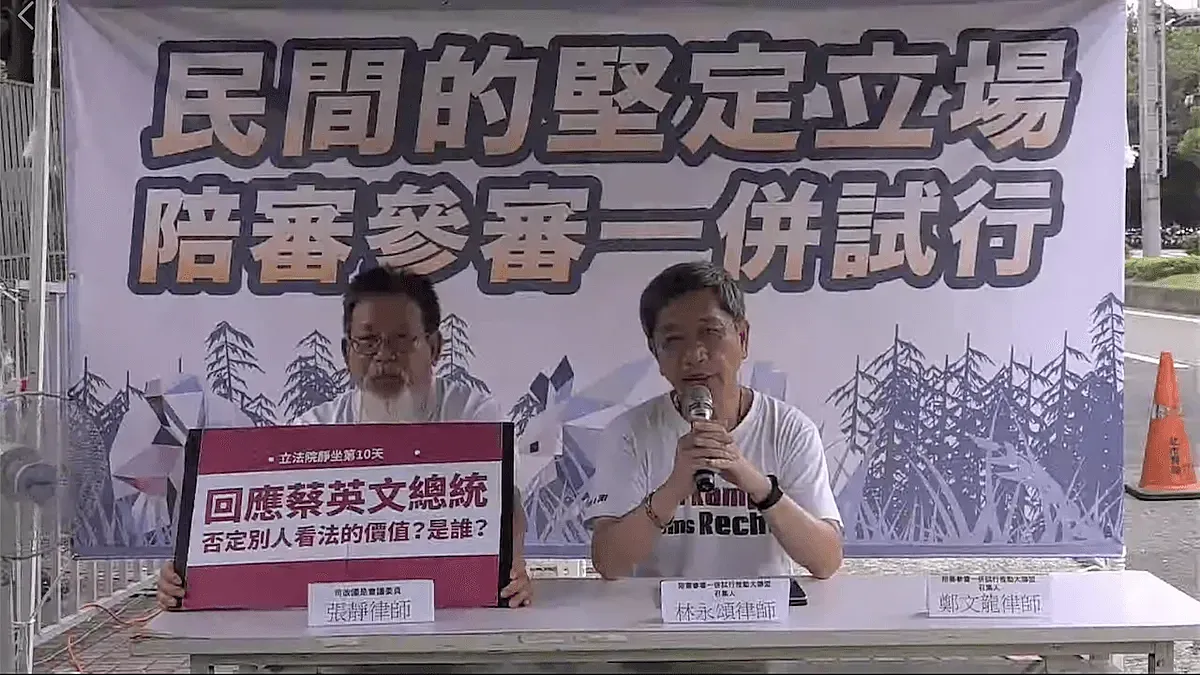
Responding to President Tsai Ing-wen: Who Is It That Denies the Value of Others' Views? Day 10 of the Sit-in Protest Against the Inclusion of the Lay Assessor Bill in the Legislative Yuan's Extraordinary Session
Last edited: 2026-11-03
Formed by civil society organizations such as the Judicial Reform Foundation and the Taiwan Association forish Jury, the "Alliance for the Simultaneous Trial Implementation of Jury and Lay Assessor Systems" held a press conference at 2 p.m. on July 8 in front of the gate of the Legislative Yuan, titled "Responding to President Tsai Ing-wen: Who Is It That Denies the Value of Others' Views?" This was in response to President Tsai Ing-wen's statement in an interview yesterday (the 7th) asserting that the Alliance denies the value of other people's views. The Alliance argues that the one denying the value of others is not a powerless civil society organization, but rather President Tsai Ing-wen, who holds absolute political power. Furthermore, the Alliance expressed disapproval regarding Grand Justice Lu T'ai-lang's visit to the presidential official residence.
During an interview yesterday (the 7th), President Tsai Ing-wen stated: "Everyone has their own views or different opinions on various events, but we should not deny the value of other people's perspectives." This was in counter to the criticism from Attorney Lin Yung-sung, Chairman of the Judicial Reform Foundation, who accused President Tsai of not understanding the jury and lay assessor systems yet refusing to listen to public opinion and insisting on the lay assessor system. The problem, however, is that the one denying the value of others is not a powerless civil society organization, but rather President Tsai Ing-wen, who holds absolute political power.
Chairman Lin Yung-sung of the JRF recounted his personal experience regarding Grand Justice Lu T'ai-lang's visit to the presidential official residence. On the afternoon of March 27 at 2 p.m., 10 representatives of the Alliance to Monitor the Implementation of the Judicial Reform National Consultative Conference Resolutions went to the presidential official residence to pay a courtesy call on the President, hoping that the government and civil society could establish a platform for mutual communication. Over the past two to three years, the government has mostly ignored civil society, and the decisions made differed greatly from the original resolutions; nonetheless, the visit itself was actually quite peaceful. However, when the final agenda item was reached—discussing the Judicial Yuan's draft bill stipulating that expert witnesses should appear in court to undergo cross-examination, which had failed to reach consensus after six rounds of coordination by Executive Yuan Minister without Portfolio Lo Ping-cheng—the President questioned why the Judicial Yuan had not communicated and coordinated beforehand when drafting the bill. Moreover, Secretary-General Lin Hui-huang of the Judicial Yuan, who was present, was unclear about the events at the time. Consequently, the President's tone changed; she displeasedly demanded that former Secretary-General and current Grand Justice Lu T'ai-lang be summoned. Within twenty to thirty minutes, Grand Justice Lu arrived. The President's tone toward both the former and current Secretaries-General was not very pleasant, demanding that the judicial administrative authorities seriously review the matter. She also mentioned that if judges engaged in misconduct resulting in external impeachment, it would be extremely detrimental to judicial reform, and expressed her hope that internal occupational supervision could be conducted. Chairman Lin felt that the President was very stern and delivered unsparing criticisms, though the substance made sense. Chairman Lin believes the President had no malicious intent and was perhaps momentarily inconsiderate; she should not have summoned Grand Justice Lu, who no longer held jurisdiction over the matter, and past matters should have been handled by the current Secretary-General. However, when the President subsequently explained the matter to the public, she claimed she was polite and courteous—distorting the facts is unacceptable.
In addition, regarding the Alliance's criticisms yesterday (the 7th), President Tsai responded by telling others not to deny the value of different viewpoints, which Chairman Lin found incomprehensible. It is not surprising if President Tsai does not understand, but to make public statements based on a lack of understanding amounts to willful ignorance. Chairman Lin emphasized that the Judicial Yuan's lay assessor system carries an authoritarian effect, yet the President still maintains that the draft Citizen Judges Act incorporates both the lay assessor and jury systems. In fact, the jury and lay assessor systems have distinct definitions: the defining feature of the lay assessor system is that judges deliberate together with lay assessors during the critical deliberation phase, whereas in a jury system, judges do not participate in deliberations. Another difference is that the lay assessor system involves in-camera intermediate discussions, whereas the jury system has no intermediate discussions, only public instructions given to the jurors. Nonetheless, the Presidential Office continues to muddy the waters externally, failing to clearly explain the authoritarian effect of the lay assessor system or why the DPP party platform endorsed the jury system yet pushed for the lay assessor system.
Chairman Lin noted that the President had once questioned whether the people of Taiwan are capable of serving as jurors. Chairman Lin expressed deep anger at this, noting that the President herself was elected by 8.17 million citizens. Furthermore, the President asked Chairman Lin: if a jury acquits a defendant in a high-profile case, but the public believes the defendant is guilty, who will the public curse? The President believes they would curse the President and the DPP government, which passed the jury system. Chairman Lin emphasized that if one dares to be president, one should not be afraid of being criticized; 80% of the public supports public participation in trials—what on earth is there to be afraid of? Chairman Lin believes the President's core values are unclear. Finally, regarding the President's concerns that the jury system lacks written judgments, cannot be appealed, and cannot be operated by judges, Chairman Lin responded that the public cannot understand current written judgments—they cannot even tell who won or lost. What the people want are judges who seriously try cases. The draft bill formulated by the Alliance still includes written judgments, but not in the current format; rather, judgments would consist of jurors' evaluations of the judge's written instructions to the jury and the verdict sheet. If a defendant is found guilty and sentencing is required, a sentencing record would also be attached as part of the written judgment. Finally, Chairman Lin pointed out that those with power are the DPP, the Judicial Yuan, and President Tsai; it is they who refuse to listen to the people's opinions, remaining arrogant and closed-off. As President, the values underlying her stance stem from misinformation, displaying cowardice as she is held hostage by judicial administration. Chairman Lin also stated that he will respond tomorrow to the Judicial Yuan's press release, which he criticized as addressing the issue from a petty, myopic, and biased perspective. Lastly, Chairman Lin believes that making mistakes is fine as long as they are corrected, but lying is not. Is President Tsai's politeness and respect supposed to look like this?
Attorney Chang Ching, member of the Judicial Reform National Consultative Conference, remarked that if a ruler lacks integrity, the nation is in peril. Summoning Grand Justice Lu T'ai-lang to the presidential official residence—regardless of the tone used—was inherently wrong, and regardless of whether that tone is described as a reprimand, scolding, or admonition, there is no need to fabricate cover stories, because attitude is an objective fact capable of evaluation. Attorney Chang believes that the leader's integrity has run into a problem. Both caucus whip Ker Chien-ming and judicial authorities are experiencing crises of integrity, which signifies that the nation is facing a life-or-death crisis.
Attending Representatives
Attorney Lin Yung-sung / Chairman, Judicial Reform Foundation
Attorney Chang Ching / Member, Judicial Reform National Consultative Conference
Press Contacts
Judicial Reform Foundation / Director Hsiao I-min
Taiwan Association for Jury / Deputy Secretary-General Lin Ping-ch'üan
This article is an AI-generated translation of the original Chinese text. In the event of any discrepancy, the Chinese version shall prevail.