
Judicial Yuan Claims Dual Systems Cannot Coexist; Alliance Responds Not to Let Jury Trial Become Impractical—Day 11 of Sit-in Protest Against Legislative Yuan Provisional Session Including Citizen Judges Act Bill
Last edited: 2026-11-03
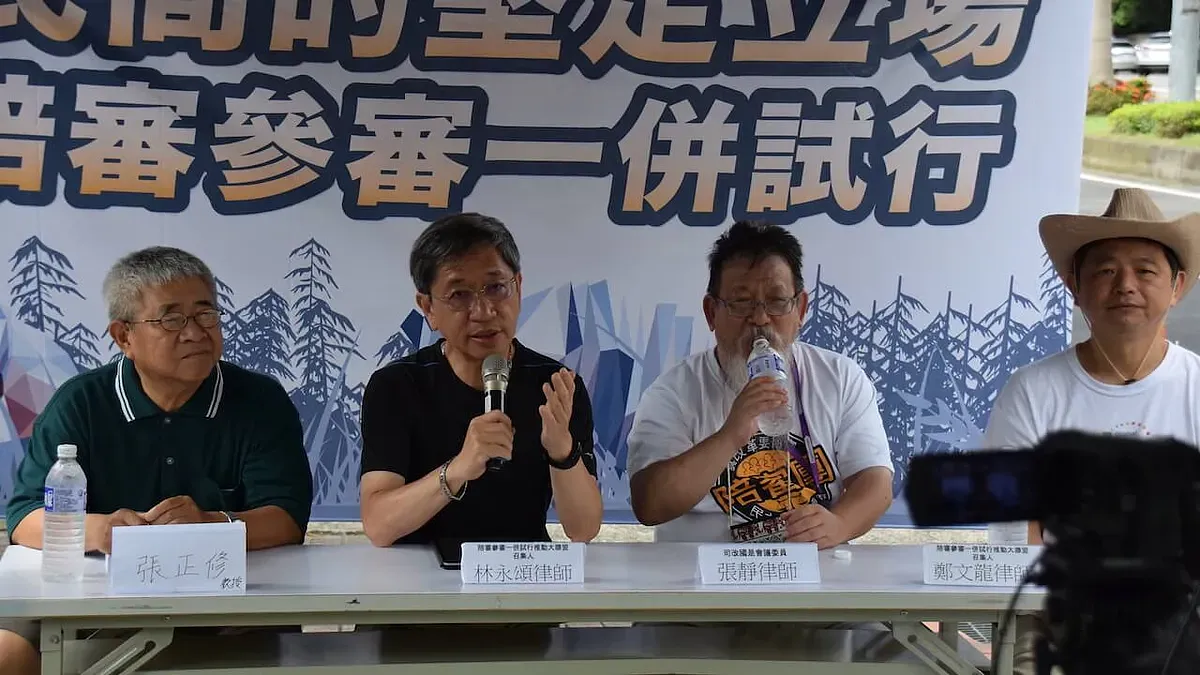
The "Alliance for the Concurrent Trial of Jury and Lay Assessor Systems," composed of civil society organizations such as the Judicial Reform Foundation and the Taiwan Association for International Criminal Law (Note: Taiwan Association for Jury Systems), held a press conference titled "Judicial Yuan Claims Dual Systems Cannot Coexist; Alliance Responds Not to Let Jury Trial Become Impractical" at 9:30 a.m. on July 9 in front of the main gate of the Legislative Yuan. The conference clarified external misconceptions and criticisms regarding the concurrent trial of both systems and called upon the President, the Democratic Progressive Party (DPP), and the Judicial Yuan to face up to the deficiencies in the Judicial Yuan's Citizen Judges Bill.
On July 5, the Judicial Yuan issued a press release stating that "Judicial Human Rights Cannot Be Experimented With; 'Citizen Judges' Blend the Advantages of Jury and Lay Assessor Systems," pointing out that polls show over 70% of the public in Taiwan agree that discussing cases jointly with judges makes citizens bolder in expressing their thoughts, and that joint discussions with judges lead to a better understanding of the case facts for decision-making. In addition, it listed six criticisms arguing that "the two systems cannot coexist because the jury system is impractical."
Mr. Lin Yung-sung, Chairman of the Judicial Reform Foundation, noted that when the government wants to implement a specific system, it can overcome many difficulties, but when it is unwilling to do so, it finds numerous excuses. The Judicial Yuan's press release presented very absurd reasons reflecting its reluctance to implement the concurrent trial of both systems. First, the Judicial Yuan believes that its proposed citizen judge version incorporates the advantages of the jury system across fifty-three provisions, describing it not only as a blend of lay assessor and jury advantages but even as an "advanced jury system." Indeed, the Japanese lay assessor system referenced by the Judicial Yuan differs from the term-based German lay assessor system in the selection of lay judges, resembling instead the case-by-case selection of the jury system. However, the actual distinction between lay assessor and jury systems lies in whether judges discuss the case together with participating citizens during the deliberation stage, rather than merely in the selection mechanism. As mentioned in yesterday's press release, when President Tsai met with civil society groups two weeks ago, Chairman Lin also explained this in detail to the President. While it is somewhat understandable that President Tsai, with her myriad affairs, might not fully understand the system, the Judicial Yuan, as a legal professional body, should not confound right and wrong or fish in troubled waters, nor should President Tsai continue to endorse the Judicial Yuan's erroneous statements after listening to civil society's opinions.
Secondly, the Judicial Yuan rejected the civil society's proposal for the concurrent trial of both systems under the pretext that "human rights cannot be experimented with," but failed to explain why implementing solely the Judicial Yuan's citizen judge system would not amount to experimenting with human rights. Looking at the implementation of systems in neighboring countries, the conviction rate under Japan's lay assessor system (99.5%) is similar to or even higher than that of professional judges sitting alone (99.4%) due to the authority effect of professional judges; in contrast, South Korea, which adopts a jury system, has an acquittal rate three times higher than that of professional judges. Although acquittals are a minority in both, it can be seen that under the jury system, citizens are more prudent than professional judges—who have suffered from burnout after long-term exposure to the judicial system—thus avoiding the presumption of guilt and potentially reducing miscarriages of justice. Not only has the Judicial Yuan failed to explain why its own system is not an experiment with human rights, but it has also overlooked the fact that adopting a trial run of the jury system might protect human rights even better than testing the lay assessor system alone.
Furthermore, not only does the Judicial Yuan cite erroneous and leading polls, but the DPP government has also invoked different grounds of public opinion during its time in power versus in opposition. In the past, when the Judicial Yuan promoted a participation system where citizens could only speak without binding the judges, it claimed 90% public support, which was strongly opposed by the DPP, whose party platform advocated for a jury system; today, the Judicial Yuan claims 80% public support for a lay assessor system, and the DPP enthusiastically embraces it, which is highly contradictory. Moreover, the Judicial Yuan's and President Tsai's skepticism regarding the lack of written judgments and unappealability in the jury system (see yesterday's alliance press release) shows that the Judicial Yuan's accusations against the alliance are based on false premises. Taking a step back, even assuming that over 80% of the public supports professional judges and citizens jointly deciding verdicts as claimed by the Judicial Yuan, this feature aligns with both jury and lay assessor systems; under a jury system, once jurors find the defendant guilty, the judge determines the sentence, which is also a joint decision. The difference between lay assessor and jury systems lies in the division of labor between citizen judges and professional judges. The Judicial Yuan's interpretation—defining the joint decision of verdicts by citizens and judges as proof that the public only supports its citizen judge proposal—is a vague and confusing way to mislead the public.
The Judicial Yuan asserts that only its proposed system can be implemented seamlessly, and that the jury system in the civil society version is incompatible with the current system and practically unworkable. However, the reality is that regardless of what new system is implemented, numerous supporting complementary measures must be revised. For example, under the current system, legal professionals often use obscure legal jargon during trials to persuade judges, regardless of whether the parties understand it. The trial run of lay assessor and jury systems can force legal professionals to shift their target audience to ordinary citizens, thereby driving the use of plain legal language. The principle of a single indictment and the non-transfer of dossiers and evidence are also reforms that the implementation of lay and jury systems would bring about. In addition, domestic evidentiary rules are currently unclear, and professional judges can barely apply them with difficulty, but following the implementation of lay or jury systems, judges will have to give citizens more and clearer instructions to promote systemic improvement. All these points demonstrate that implementing the Judicial Yuan's system requires just as many related institutional reforms as the civil society version; yet the Judicial Yuan only points fingers at the civil society version for lacking complementary measures, which is once again using bureaucratic doublespeak to obfuscate and evade the core issues. Therefore, Chairman Lin specifically called upon the Judicial Yuan to genuinely analyze and discuss the true pros and cons of both lay assessor and jury systems, rather than misleading the public through deceptive means.
Chang Cheng-hsiu, Associate Professor at the Department of Law, Kainan University, explained the spirit of the jury system, noting that it is not easy for the general public to understand lay participation systems, but with the advancement of civil society movements, he believes the public will gradually comprehend them. In recent years, Taiwan's society has focused on reforms of government structures, caring about the survival or abolition of the Examination Yuan and the Control Yuan, while paying little attention to issues of judicial administration. In fact, judicial reform is not merely a matter of systems; Taiwan's institutional design—where the Judicial Yuan manages judges and the Ministry of Justice manages prosecutors—is unique globally. However, because the Ministry of Justice belongs to the executive branch and the personnel of the Judicial Yuan are nominated by the President, maintaining judicial independence presents difficulties. Therefore, judicial reform must be understood within a broader constitutional framework to realize the spirit of the separation of powers.
The Judicial Yuan advocates adopting the Japanese lay assessor system, but Japan and Taiwan have different national conditions. In Japan's long-standing feudal society, various professions possess specialized professional ethics; whereas in traditional Chinese culture, top imperial examination scholars often held themselves in high esteem, and because judges and prosecutors are extremely difficult to pass exams for, successful candidates naturally harbor a sense of elitist arrogance. Coupled with the protection of judicial independence, such absolute power leads to absolute corruption, preventing their official authority from being subject to democratic checks and balances like executive and legislative officials. Consequently, Taiwan cannot construct a system of judicial ethics similar to Japan's. The Judicial Yuan argues that the Japanese system is better suited for our country while mistakenly ignoring the differences in national conditions.
As for the implementation of lay assessor and jury systems, the ones who will actually find it most challenging are prosecutors, not judges, because the introduction of the jury system will compel prosecutors to investigate cases more rigorously. Compared with the United States, Anglo-American law separates the pretrial judge from the trial judge, and both parties must disclose evidence prior to formal indictment to ensure equality of arms—unlike in Taiwan, where defendants can only review evidence after indictment. At this point, citizens who know they are guilty will be willing to enter plea bargains, and most of those who proceed to trial do so because they believe they have been wronged. In the Anglo-American system, the jury is selected only after indictment, and parties can choose whether or not to have a jury trial; prosecutors require more rigorous investigations to convict someone and cannot casually file indictments based on vague evidence.
Chang Ching, Attorney and Member of the Judicial Reform National Guesses (Note: National Judicial Reform Conference), explained that systems created by humans are never one hundred percent perfect. While adjudicatory systems have imperfections, the jury system has the fewest shortcomings compared to professional judges or lay assessor systems. First, the jury system is fairer. Second, the jury system adheres more strictly to the presumption of innocence. Third, the jury system pools the wisdom of the masses. Attorney Chang also gave examples illustrating how difficult it is for professional judges to remain impartial—for instance, if a judge's home was burglarized yesterday, they might be influenced when presiding over a theft case today; however, under a jury system, even if one juror's home is burglarized, the other jurors will not be affected. Furthermore, Attorney Chang reiterated that a lay assessor system is a lay assessor system, and a jury system is a jury system. While the Judicial Yuan may call its draft a lay assessor system 2.0, it must never label it a jury system 2.0.
Attending Representatives
Attorneys Lin Yung-sung / Chairman, Judicial Reform Foundation (Convener)
Attorney Chang Ching / Member, National Judicial Reform Conference
Professor Chang Cheng-hsiu / Associate Professor, Department of Law, Kainan University
Press Contacts
Judicial Reform Foundation / Director Hsiao I-min
Taiwan Association for Jury Systems / Deputy Secretary-General Lin Ping-ch'üan
This article is an AI-generated translation of the original Chinese text. In the event of any discrepancy, the Chinese version shall prevail.