

Implementation of the New Prison Act and Launch of Legal Consultation Press Conference
Last edited: 2026-07-27
Taiwan's newly revised Prison Act and Detention Act were promulgated on January 15 this year and took effect on July 15. The new laws respond to the National Stare Judicial Reform Conference held in 2017, taking legalization and transparency as core principles and marking an important step forward in penal institution reform. In response to the demands of legalization, the Ministry of Justice and the Agency of Corrections held intensive meetings over the six-month period between promulgation and formal implementation, formulating a total of 32 authorized regulations (including the enforcement rules of both acts), which significantly increased the density of legal norms. Due to this drastic overhaul of laws and authorized regulations, a period of confusion and adaptation may arise in actual practice. Although the new laws strengthen the protection of inmates' human rights and clearly stipulate grievance procedures, inmates may still encounter problems such as inconsistent legal interpretations across different correctional facilities, uncertainty regarding their rights and duties under the new framework, and confusion over which matters are appropriate for grievances and which are not.
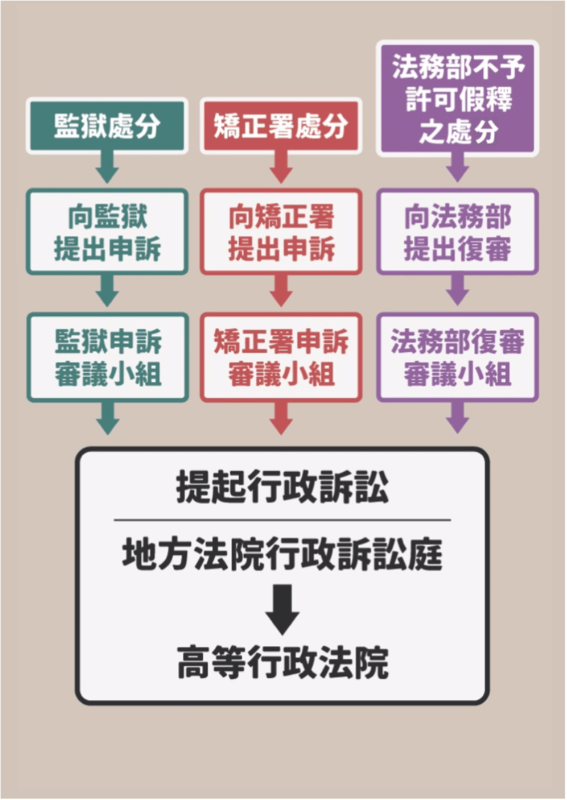
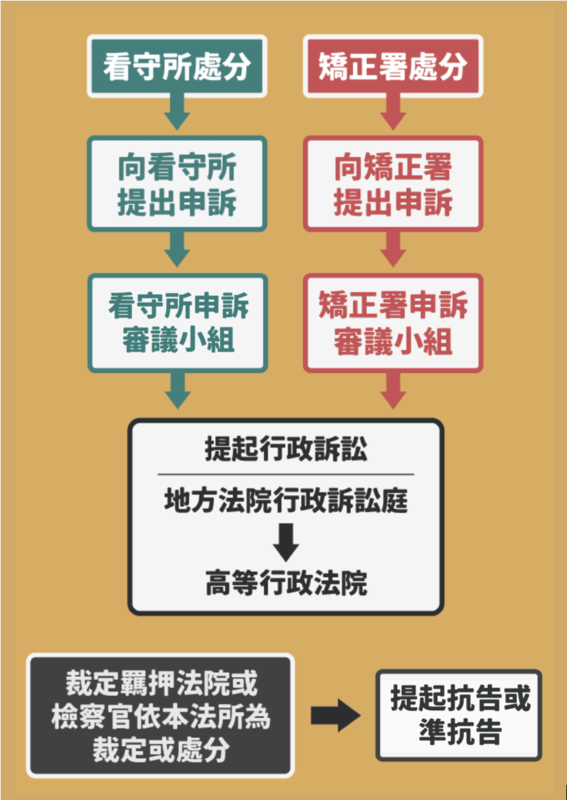
In particular, the relief framework of the new laws is complex, and inmates may even be unclear about which relief channel to pursue for a given issue. According to the new laws, disputes between a prisoner and a prison are to be filed as grievances with the prison, while disputes between a prisoner and the Agency of Corrections are to be filed as grievances with the Agency. Furthermore, certain matters, such as outings or home visits, may be decided by either the prison or the Agency of Corrections depending on the circumstances. If a prisoner is dissatisfied with a decision denying parole, a request for review must be submitted to the Ministry of Justice. If dissatisfied with the aforementioned self-review decisions by administrative authorities, a lawsuit may be filed with the administrative court. As for disciplinary measures or management measures imposed on a detained defendant solely by the detention center or the Agency of Corrections, grievances must similarly be filed first, followed by seeking relief in the administrative court. However, for certain matters such as the use of physical restraints, protective gear, or escorted medical treatment outside the facility for defendants under restricted communication, the Detention Act explicitly stipulates—pursuant to the Code of Criminal Procedure—that the approval of the court handling the detention ruling is required, and subsequent judicial relief follows the procedures related to interlocutory appeals in criminal litigation. In other words, the Detention Act establishes a dual-track system of judicial relief involving both administrative litigation and criminal litigation depending on the nature of the matter. Because the relief procedures are excessively compartmentalized, they are easily misused.
To address the legalization brought to correctional institutions by the new Prison Act and Detention Act, establishing corresponding legal consultation support is of utmost importance. To assist with the rollout of the new laws, the Judicial Reform Foundation will expand its acceptance of legal consultations from correctional institutions and provide pro bono lawyer assistance when necessary. This serves to oversee the implementation of the new laws on the one hand, and to examine whether any loopholes exist in the new laws to inform subsequent institutional revisions on the other. Additionally, various branches of the Legal Aid Foundation have collaborated with correctional institutions across regions to provide services such as legal consultations and legal aid case acceptance, while also allowing inmates to apply for legal aid in writing or sign a declaration on the legal aid application form to meet the criteria for legal aid eligibility based on financial hardship. Civil groups concerned with prison reform, including the Taiwan Association for Prisoners' Rights, the CSO Coalition for Human Rights Conventions, and the Taiwan Association for Human Rights, have also urged that, in addition to continuously strengthening the provision of legal consultations for inmates, frontline practitioners must also be provided with education and training regarding the new laws to safeguard inmates' rights while preventing unnecessary legal disputes.
附件
出席代表
Ch'iu Hsien-chih/Legislator, New Power Party
Lu Ying-chieh/Member of Group 5 of the National Stare Judicial Reform Conference, Professor at the Department of Law, National Chung Cheng University
Lo Shih-hsiang/Standing Executive Director, Judicial Reform Foundation
Ch'en Wei-jen/Pro Bono Lawyer, Judicial Reform Foundation
Ch'en Hui-min/Chairperson, Taiwan Association for Prisoners' Rights
Sylvia Ya-pi Huang/Executive Director, CSO Coalition for Human Rights Conventions
Shih I-hsiang/Secretary-General, Taiwan Association for Human Rights
新聞聯絡人
Judicial Reform Foundation/Lin Wei-t'ing, Project Researcher
This article is an AI-generated translation of the original Chinese text. In the event of any discrepancy, the Chinese version shall prevail.