
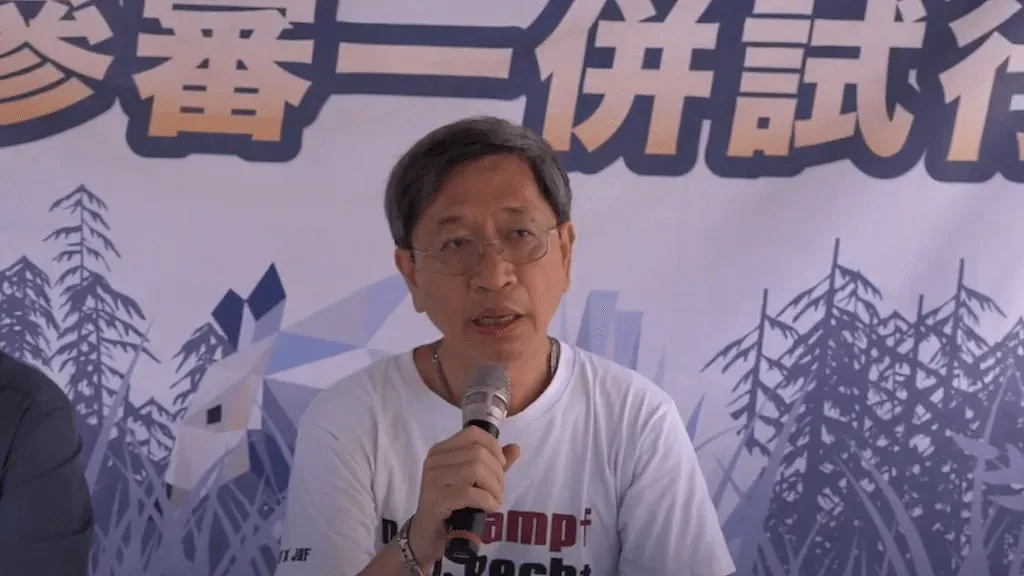
Refuting and Clarifying: Responding to Media Op-Eds Opposing the Dual-Track Trial System of Lay Participation and Jury Trials—Day 15 of the Sit-In Protest Against the Legislative Yuan's Provisional Session Placing the Citizen Judges Act on the Agenda
Last edited: 2026-07-27
The Alliance for the Simultaneous Trial Run of Lay Participation and Jury Systems, composed of civil society organizations including the Judicial Reform Foundation and the Taiwan Association for Parliamentarianism, held a press conference titled "Responding to Media Op-Eds Opposing the Dual-Track Trial System of Lay Participation and Jury Trials" at 9:30 a.m. on July 13 in front of the main gate of the Legislative Yuan to address op-eds from academia, independent writers, judges, and other sectors.
On July 5, Professor Lin Chih-chieh (林志潔) of the Institute of Law and Technology at National Chiao Tung University published an op-ed titled <Trial Reform Cannot Be a Human Rights Buffet>. Drawing from three perspectives—prosecutorial powers, the establishment of chapters on offenses against the administration of justice, and supporting reforms for rules of evidence and the burden of proof—she pointed out that Taiwan cannot simply reap the benefits of a jury system without being willing to bear the costs of reforming these three areas concurrently. Meanwhile, Judge Wen Chia-chien (文家倩) of the Taiwan High Court published an op-ed on July 7 titled <The Devil is in the Details: On the Four "Highlights" of the Draft Bills for Concurrent Jury and Lay Participation Systems>, raising four points: "jury trials predominantly involve political cases," "the concurrent system paired with the count system," "the concurrent system paired with American evidence law," and "the concurrent system smuggling in the abolition of the death penalty." She used the metaphor of "Pandora's box" to express opposition to the dual-track system.
Attorneys Lin Yung-sung (林永頌), Chairperson of the Judicial Reform Foundation, first responded to Professor Lin Chih-chieh's article. Attorney Lin pointed out that the proportion of criminal cases in the United States that actually go to trial using a jury is relatively low (about three percent), but an even smaller percentage are tried by professional judges. The underlying reason is that the vast majority of defendants reach plea bargains with prosecutors regarding charges and sentencing; cases only proceed to trial if defendants clearly contest the prosecution's charges. Although Taiwan's current judicial system has a plea-bargaining mechanism, its effectiveness has been limited, failing to significantly reduce the judicial system's case burden. If a jury system is to be implemented in the future, adjustments to the current negotiation space between prosecutors and defendants will inevitably be required. Professor Lin Chih-chieh's assertion is quite correct. At the same time, this forces us to consider whether such a system might lead economically disadvantaged individuals—who cannot afford a lawyer—to feel compelled to agree to plea bargains, necessitating a simultaneous review of the legal aid system.
Secondly, Professor Lin Chih-chieh noted that countries implementing jury systems enforce strict penal provisions for obstructing justice to prevent the fairness of trials from being influenced by external factors. Attorney Lin stated that jurors, citizen judges, and professional judges all carry the risk of being influenced by outside forces. While the civil society version indeed has shortcomings in this regard, the Judicial Yuan's version—which the ruling party is currently rushing to pass during the provisional session—also lacks corresponding complementary measures. Professor Lin's perspective is well-founded, and this issue should be jointly considered and formulated by both official authorities and civil society.
Furthermore, Professor Lin Chih-chieh pointed out that the Anglo-American legal system adopts a fully adversarial system, in which a defendant can simultaneously serve as a witness. Although prosecutors bear the burden of proof, defendants must also make every effort to present evidence favorable to themselves, such as proving justifications for self-defense in homicide cases. If a jury system is to be implemented, our country's rules of evidence and burden of proof must also be reformed accordingly. Attorney Lin expressed agreement, pointing out that regardless of whether a lay participation or jury system is implemented, the current system is in need of reform. For example, in the future, lawyers will need to investigate evidence and articulate arguments to judges and citizens, making their quality and competence even more critical. However, compared to state-trained prosecutors, the quality of attorneys varies and they may not fully protect defendants' rights. In the Judicial Yuan's proposal, people's participation in trials targets felonies carrying sentences of ten years or more, with mandatory representation by public defenders. Attorney Lin called for this to be shifted to assistance provided by lawyers from the Legal Aid Foundation.
In summary, Attorney Lin believes that Professor Lin Chih-chieh has raised numerous complementary measures that must be addressed amid institutional reforms for public participation in trials; however, this does not mean we should naturally rule out a trial run of the jury system, as these are challenges that both lay participation and jury systems must confront.
Next, Attorney Lin addressed Judge Wen Chia-chien's op-ed from two angles. First, regarding the skepticism of "smuggling in the abolition of the death penalty," the death penalty is currently stipulated in substantive law—specifically, the Criminal Code of our country—whereas the newly revised system for citizen participation corresponds to procedural regulations under the Code of Criminal Procedure, and the civil society draft does not alter substantive law. Secondly, Attorney Lin pointed out that Judge Wen has pinned an unfounded accusation on the civil society version by asserting that "the jury system's requirement of a unanimous verdict by jurors to execute a defendant" constitutes the smuggling in of the concept of abolishing the death penalty. Attorney Lin countered: regardless of one's stance on the death penalty, "is deciding a person's life and death not a matter that demands utmost caution?" Furthermore, foreign jurisdictions have not abolished the death penalty simply because unanimous verdicts are required to impose it. Looking domestically, trials by current professional judges practically require the unanimous agreement of three to five judges in a collegiate panel to sentence someone to death; by comparison, under the Judicial Yuan's version, sentencing can be decided by a simple majority. Relative to the current status quo or the unanimous requirement of a jury system, the Judicial Yuan's version still leaves room for improvement.
Second, regarding Judge Wen's skepticism toward the civil society version's introduction of the count system (訴因制度), Attorney Lin first explained this specialized term: under Article 300 of the current Code of Criminal Procedure, the system for modifying legal provisions means that halfway through a trial, if a prosecutor indicted a defendant for Crime A, they can—based on the identity of the criminal facts—instead prosecute under Crime B without the need for a re-indictment. Attorney Lin pointed out that the current system is unfair to defendants because defendants and defense counsel can be ambushed at any time by the prosecution's modification of legal provisions, preventing them from mounting a defense based on what they had prepared. Introducing the count system is precisely intended to curb such situations. Attorney Lin further argued that introducing the count system is undoubtedly correct, and where greater judicial resources are demanded, compromises and supplementary measures can be adopted—such as utilizing alternative claims under the Code of Civil Procedure and granting defendants a preparation period.
Addressing criticisms from various quarters that the jury system wastes judicial resources, Attorney Lin cited New Power Party Chairman Chiu Hsien-chih's (邱顯智) previous request to the Judicial Yuan to calculate the cost differences between implementing lay participation and jury systems: lay participation is projected to increase costs by NT$500 million annually, while the jury system would cost NT$800 million. Attorney Lin emphasized that setting aside the undisclosed calculation methods, fluctuations in judicial costs cannot be assessed by looking at a single trial tier alone; rather, one must examine overall systematic changes. While a jury system might entail higher costs at a single tier of trial, it imposes stricter restrictions on appeals. Such a design prevents citizens from getting caught in protracted litigation bouncing back and forth across trial tiers (such as the 21-year ordeal to rescue Hsu Tze-chiang [徐自強]), enduring endless psychological torment and paying unquantifiable costs in the process. To take a step back, even if the NT$300 million gap genuinely exists, must we truly abandon building a better judicial system merely to save NT$300 million?
In response to critics questioning whether jurors in high-profile political cases—such as those involving corruption, the Anti-Infiltration Act, or the Assembly and Parade Act under the civil society jury draft—would obstruct unanimous verdicts due to personal political stances, thereby resulting in acquittals, Attorney Lin replied that bias exists not only in political stances but also across various other social experiences and dimensions. At the same time, bias that occurs in jurors can equally occur in professional judges. Attorney Lin gave an example: during a mock jury trial hosted by the alliance last week, a juror who had family members with victim experiences similar to the mock case stubbornly insisted that the defendant was guilty; however, when faced with peers questioning the evidence, they were unable to put forward persuasive arguments to convince other jurors. Compared to the civil society version, which features a voir dire mechanism to exclude jurors, the current system and lay participation systems offer no recourse to apply for recusal or exclusion when professional judges harbor potential biases. Attorney Lin stated that no system is flawless, but the civil society version at least includes an American-style juror screening process and remains open to discussing possibilities with official authorities and other civil society groups, such as adjusting the voting threshold required for a unanimous verdict.
Finally, Attorney Lin re-emphasized that no single system is absolutely correct; all require complementary measures to fill gaps, and the civil society draft still leaves room for discussion. Among the currently contested 113 provisions of the draft, 99 have been reserved. The bill should not be rushed through, and postponing discussions to the next legislative session would be more appropriate. The civil society coalition's stance is not to obstruct or oppose the ruling party, but to correct erroneous claims within the draft and express hope that the ruling party will be more humble, listen more, communicate more, and refrain from legislating in haste.
Participating Representatives
Attorney Lin Yung-sung / Chairperson of the Judicial Reform Foundation (Convener)
Press Contacts
Judicial Reform Foundation / Director Hsiao I-min (蕭逸民)
Taiwan Association for Parliamentarianism / Deputy Secretary-General Lin Ping-ch'üan (林秉權)
This article is an AI-generated translation of the original Chinese text. In the event of any discrepancy, the Chinese version shall prevail.