
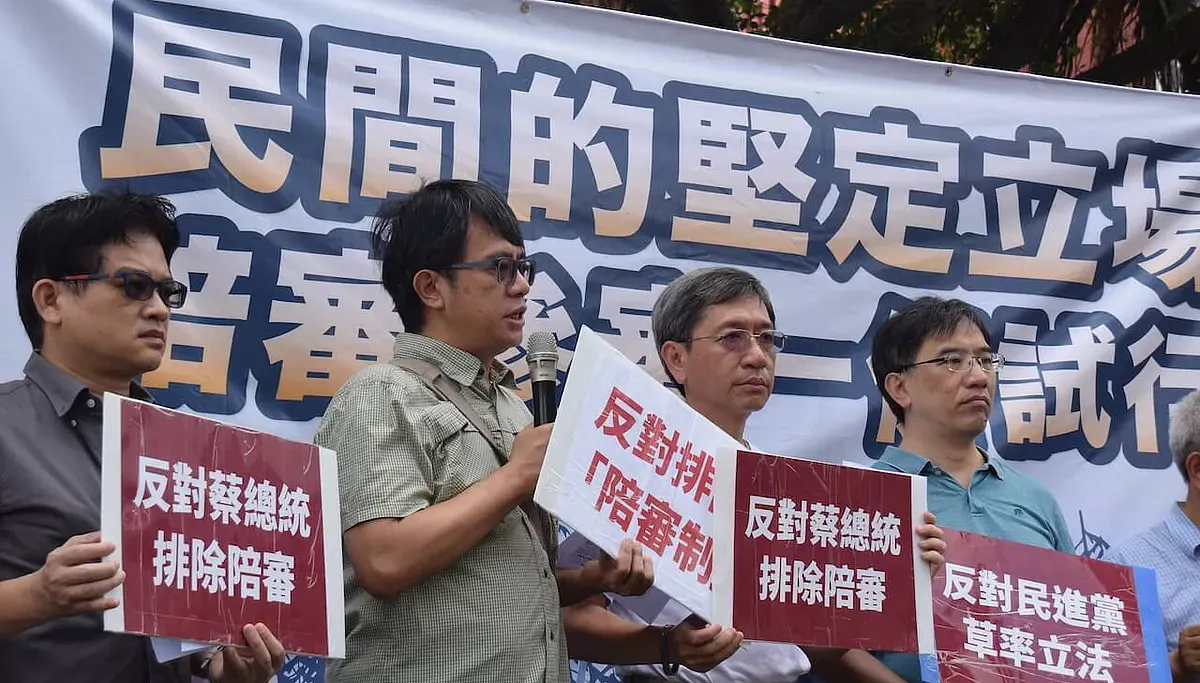
Scholars' Statement on Promoting the Lay Participation in Trials System
Last edited: 2026-07-27
-
The ruling authorities should learn from the Judicial Yuan's failed experience in promoting the lay assessor system and actively communicate with society
Lay participation in trials is the judicial reform issue of greatest concern to the people of Taiwan and also the most difficult judicial reform project. For the system to be implemented smoothly, in addition to requiring the ruling authorities to handle it with care, they must also actively communicate with all sectors of society and strive to bridge differences, avoiding the provocation of confrontation due to divergent opinions on the path of reform, which would otherwise form obstacles to reform.
In 2011, the Judicial Yuan promoted the lay assessor system. Despite commanding abundant administrative resources and claiming that the system enjoyed high public approval ratings, it failed to win social support and ultimately ended in failure. Today, the Judicial Yuan has unilaterally adopted the Japanese-style lay assessor system while excluding the American-style jury system, triggering strong opposition from civil society groups. Faced with societal doubts, the ruling authorities must value differing voices to avoid repeating past mistakes and encountering heavy obstacles even before the lay participation in trials system is implemented.
-
Prior to rigorous empirical research, a six-year pilot period should not exclude the jury system
In recent years, the comparative evaluation of the strengths and weaknesses of various judicial reform directions has gone beyond merely imitating the legislative examples of other countries. More importantly, it requires conducting empirical research tailored to our country through rigorous designs and concrete, evaluative indicators to analyze the merits, demerits, and feasibility of implementing various systems in Taiwan, thereby preventing the maladjustment that arises from transplanting foreign systems.
The draft currently promoted by the Judicial Yuan establishes a six-year performance evaluation period to study and analyze real cases, adjusting policies after six years based on implementation circumstances. This is not an unsound approach to judicial reform. However, conducting performance evaluations inevitably requires an "experimental group" and a "control group." The Judicial Yuan's draft chose only the "Japanese-style lay assessor system" as the experimental group while excluding the "American-style jury system" as the control group. Such an approach, which violates the principles of social science, can hardly win the trust of all sectors of society.
-
Urging the DPP not to force a legislative vote during the extraordinary session, but to continue communicating to reach a consensus
On June 29, the Democratic Progressive Party (DPP) convened an extraordinary session of the Legislative Yuan, scheduling the "Draft Citizen Judges Act" with the expectation of completing legislation before July 22. This move provoked unanimous opposition from opposition parties including the Kuomintang (KMT), the Taiwan People's Party (TPP), and the New Power Party (NPP), who argued that major judicial reform bills should not be rushed through legislation during an extraordinary session. Civil society groups led by the Judicial Reform Foundation and the Taiwan Association for Jury System even initiated continuous sit-in protests to oppose the DPP's exclusion of the jury system.
If the DPP caucus insists on leveraging its parliamentary majority to force a legislative vote despite failing to gain support from opposition parties and civil society, it will inevitably tear apart the consensus that society originally expected for lay participation in trials, create unnecessary political confrontation, and impact the overall advancement of judicial reform. The more significant the reform, the more crucial it is to build a consensus. For this reason, we call upon ruling President Tsai Ing-wen and the DPP to think twice, suspend plans to pass the "Draft Citizen Judges Act" via a vote in the extraordinary session, and continue communicating and engaging in dialogue with all sectors of society to reach a consensus before legislating.
Signatories
Yen Chueh-an / Department of Law, National Taiwan University
Chen Chao-ju / Department of Law, National Taiwan University
Huang Chang-ling / Department of Political Science, National Taiwan University
Lin Chia-ho / Department of Law, National Chengchi University
Hsu Yu-an / Department of Law, National Taipei University
Chen Shang-chih / Department of Political Science, National Chung Cheng University
Hsieh Shih-min / Department of Philosophy, National Chung Cheng University
Hsu Wei-chun / Department of Financial and Economic Law, Chung Yuan Christian University
Chen Yao-hua / Graduate Institute of Human Rights, Soochow University
Huang Hsiu-tuen / Department of Political Science, Soochow University
Yu Ying-lung / Department of Political Science, Soochow University
Lin Chiung-chu / Department of Political Science, Soochow University
Chung Dao-chuan / Department of Social Work, Soochow University
Chang Chun-mei / Department of Sociology, Soochow University
Wang Tsung-huey / Department of Psychology, Soochow University
Wu Hao-jen / Department of Law, Fu Jen Catholic University
Wu Chih-kuang / Department of Law, Fu Jen Catholic University
Wu Tsung-sheng / Department of Sociology, Fu Jen Catholic University
Wu Kun-lu / Department of Public Administration, Ming Chuan University
Chang Cheng-hsiu / Department of Law, Kainan University
Yu Ming-te / Department of Law, Kainan University
Tsai Po-fang / Associate Professor, Graduate Institute of Medical Humanities, Taipei Medical University
Yang Chi-wen / Former President, Taipei National University of the Arts
Lin Chien-tzu / Former Department of International Business, Tamkang University
Li Yu-jung / Department of Public Administration and Management, Shih Hsin University
Kuo Chin-quan / Department of Aquaculture, National Taiwan Ocean University
Shih Cheng-feng / Department of Ethnic Relations and Cultures, National Dong Hwa University
Li Hsiao-fong / Graduate Institute of Taiwan Culture, National Taipei University of Education
Kuo Cheng-tien / Former Institute of Emergency and Critical Care Medicine, National Yang-Ming University
This article is an AI-generated translation of the original Chinese text. In the event of any discrepancy, the Chinese version shall prevail.