
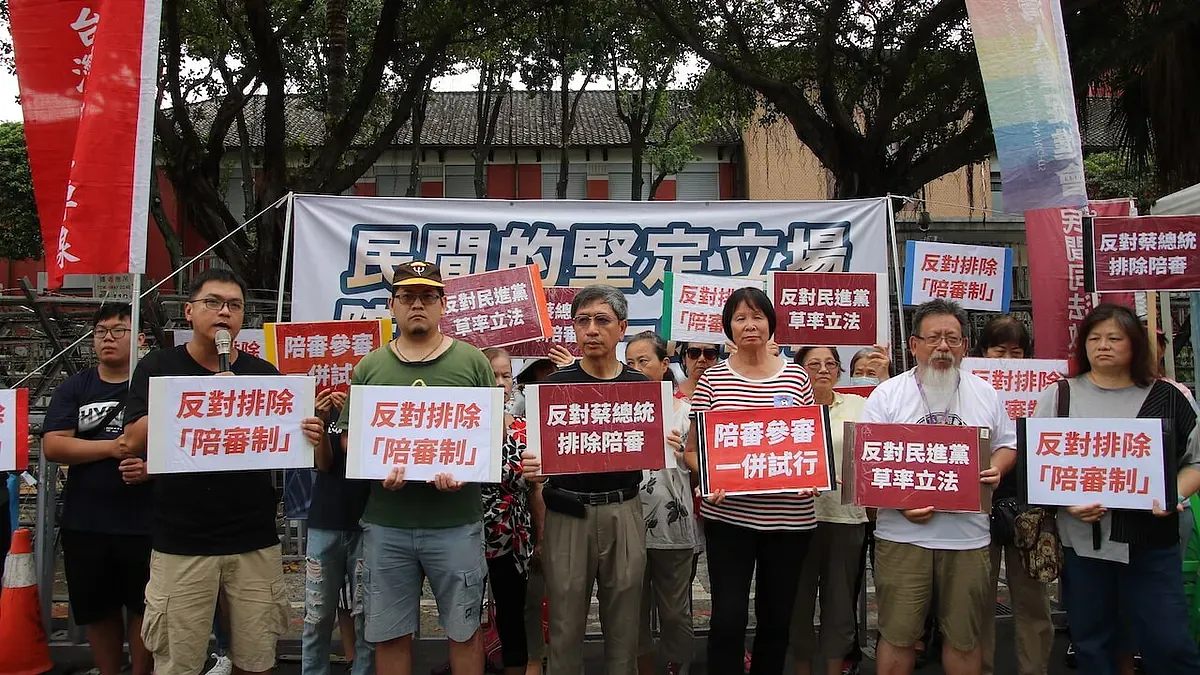
All Sectors Speak Out, Civil Groups Support Concurrent Trial Systems—Day 18 of the Sit-in Protest Against the Inclusion of the National Participation Criminal Trial Bill in the Legislative Yuan's Extraordinary Session
Last edited: 2026-07-27
The "Alliance for Promoting the Concurrent Trial and Pilot Implementation of Lay Participation and Jury Systems," composed of civil groups including the Judicial Reform Foundation and the Taiwan Association for Assisting Jury Trials, held a press conference titled "All Sectors Speak Out, Civil Groups Support Concurrent Trial Systems" at 9:30 a.m. on July 16 in front of the main entrance of the Legislative Yuan. They invited representatives from civil groups—such as Hope Foundation Chairperson Chi Cheng, Taiwan Labour Front Education and Propaganda Department Director Yang Shu-wei, Taiwan Association for Human Rights Secretary-General Shih Yi-hsiang, and Garden of Hope Foundation CEO Wang Yueh-hao—to issue a statement supporting the concurrent implementation of both systems and opposing the Democratic Progressive Party caucus's forcible passage of the Judicial Yuan's lay participation bill during the extraordinary session.
The press conference, themed "Oppose the DPP's Hasty Legislation, Oppose President Tsai's Exclusion of the Jury System," was kicked off by Alliance Convener Attorney Lin Yung-sung, who led participating civil groups in chanting their demands. Attorney Lin first responded to media reports yesterday stating that DPP Legislative Caucus Whip Ker Chien-ming had already consulted with opposition caucuses and civil groups, and that starting July 20, votes could only be cast on details and titles such as "national" or "citizen," while raising four reasons to exclude the jury system. Attorney Lin stated first, regarding Whip Ker's claim of having consulted with civil groups six times, that while consultations occurred formally, no substantive discussions on the content took place; during the process, Whip Ker mainly resorted to teasing and pacifying civil groups while being unwilling to discuss the actual system. Attorney Lin expressed deep regret that Whip Ker regarded such superficial formality as an occasion for listening to public opinion.
Second, Whip Ker argued that Taiwan has already democratized and enacted laws such as the Act on Promoting Transitional Justice, meaning the temporal and spatial background differs from when the DPP emphasized democratic participation in the past, and that past long-term support for the jury system was merely to oppose Kuomintang-led authoritarianism. Attorney Lin pointed out that while Taiwan's politics have democratized, its judiciary has not; this legislative amendment is deciding the method for judicial democratization, and therefore it is difficult to use Taiwan's democratization as a reason to oppose trial by jury. Furthermore, Whip Ker's claim that signing the jury system pledge and promising to promote legislation upon election was a "momentary impulse" is not only an irresponsible act, but also challenges the fundamental bottom line of political party credibility in a democratic society.
Third, Whip Ker argued that adding the jury system would make the law overly complex, and that the United States has a common law system incompatible with Taiwan's civil law system. Attorney Lin pointed out that European civil law countries such as Spain and Austria, as well as neighboring South Korea, have implemented jury systems for many years. Yet, as the caucus whip of the ruling party about to pass a major bill, Whip Ker failed to do his homework before responding to civil groups and is instead hastily pushing through a vote on a system he does not even understand, further highlighting the impropriety of his and the DPP's insistence on forcibly passing the bill during this extraordinary session.
In addition, Whip Ker argued that the jury system's requirement for a unanimous verdict would mean that in Anti-Infiltration Act cases, a single dissenting juror would prevent the conviction of a defendant. In response to this, while the Alliance already replied during its July 7 press conference and press release, Attorney Lin emphasized today that unanimity is the realization of the presumption of innocence, represents careful deliberation of the verdict process, and prevents the government from easily prosecuting and convicting people using state power in sensitive cases. Attorney Lin also added that democracy is not merely obeying the majority, but also listening to minority voices and persuading one another. Furthermore, referencing systems in the UK and Hong Kong, verdicts do not require absolute unanimity, as there is room for one or two dissenting opinions; this aspect is open to discussion and is not a reason to exclude the jury system.
Attorney Lin also responded to recent media reports quoting an anonymous high-ranking ruling-party official defending the President. First, the high-ranking official claimed that the recent controversial incident where President Tsai scolded the Grand Justices arose from the government-civil sector dispute over lay participation versus jury trials; Attorney Lin responded that when ten civil groups visited President Tsai on March 27, it was to establish an official-civil platform for exchanging judicial reform opinions, and the lay participation-jury debate was not mentioned. Second, the high-ranking official stated that President Tsai, as a doctor of laws and professor, has professional credentials that brook no question. Attorney Lin stated that when he and another lawyer visited President Tsai on June 28 to discuss lay participation and jury trials, she raised the question, "Why can't the Judicial Yuan's lay participation system be called a jury system?"—revealing her genuine lack of understanding of the differences between the two systems. However, even after Attorney Lin's explanation, President Tsai continued to insist on her original view; thus, Attorney Lin believes, as repeatedly emphasized in press conferences over the past few days, that President Tsai does not fail to understand out of ignorance, but rather refuses to understand.
The DPP recently also published a poll indicating that as many as eighty percent of citizens support the Judicial Yuan's lay participation version, while the jury system has only ten percent support. Attorney Lin expressed that if public opinion is truly as stated, decisions can certainly be made accordingly; however, what raises suspicion is the DPP's unwillingness to release the questionnaire content of the telephone poll, creating the suspicion of passing off fish eyes for pearls in explaining the results. Attorney Lin solemnly announced that the Alliance has officially commissioned Yu Ying-lung, Chairperson of the Taiwanese Public Opinion Foundation, to conduct a poll, and will officially release the poll results this Saturday (July 18) at 9:30 a.m. Attorney Lin also called on the ruling party to listen to public opinion and make the correct decision, expressing his belief that the people will respect a political party willing to reflect on itself.
Taking the baton in expressing solidarity was Hope Foundation Chairperson Chi Cheng. She first recalled President Tsai's 2016 victory speech, where the issue of judicial reform received the most applause, emphasizing the general public's strong expectations for the judicial reform personally promised by the President back then. Having lived in the United States for many years, she also witnessed the American public's social consensus that the jury system can uphold justice, and called on the government to adopt the dual-system pilot plan.
Taiwan Labour Front Education and Propaganda Department Director Yang Shu-wei stated that in 2014, civil groups also appealed at the same location for the Legislative Yuan not to hastily handle highly controversial bills or those requiring discussion during an extraordinary session. Although public participation in trials is a cross-party consensus reached at the National Customs on Judicial Reform, in addition to the Judicial Yuan's draft, civil groups also proposed various versions, showing that the system still has much room for discussion and that more consensus must be reached with the public prior to voting. He once again called on the Legislative Yuan, noting that extraordinary sessions should deal with major or urgent bills rather than being treated as an extension of normal sessions, and expressed hope that the public participation in trial system can be returned to a normal session for discussion.
Also expressing support was Taiwan Association for Human Rights Secretary-General Shih Yi-hsiang. He first expressed gratitude to the groups that have long staged sit-ins and fought for reform in front of the Legislative Yuan. Currently, the demand for running both systems concurrently faces the predicament of refused communication and forcible passage of bills, a dilemma TAHR has also frequently encountered. He reminded the DPP that as the ruling party, it should properly discuss issues with civil groups concerned about them, and as the largest party in the legislature, it should not forcibly pass the Judicial Yuan's version; major systemic reforms involving the people require even more proper communication and discussion. Secretary-General Shih believes that whatever system is adopted, it should be piloted with related complementary measures, such as comprehensive civic education or addressing the issue of netizen justice. Finally, he reiterated TAHR's firm opposition to passing the current version during the extraordinary session and offered encouragement to his partners at the scene.
Garden of Hope Foundation CEO Wang Yueh-hao also expressed agreement with the views of the Labour Front and TAHR, stating that such a major issue should not be hastily passed during an extraordinary session, but should undergo thorough discussion and communication. She pointed out that the Garden of Hope has long valued the various rights and interests of parties involved in the judicial system, especially the protection of victims' rights under systematic reform. Regarding the systemic reform of public participation in trials, the government should properly pilot and evaluate it to find the best approach, and she hopes deliberation will take place only after adequate communication during a regular session.
Judicial Reform National Guiding Conference committee member and attorney Chang Ching concluded by reiterating the reasons he previously mentioned for the Judicial Yuan's unwillingness to adopt the jury system, including issues of face and substance. He emphasized that Article 46 of the Hong Kong National Security Law explicitly excludes the jury system, representing how when the state apparatus intends to use the judiciary to suppress the people, it will do its utmost to exclude a judicial system where people judge independently, because ordinary people carry no burden of career advancement and will not completely submit to the state. Neither professional judge adjudication nor lay participation systems carrying the risk of judicial authoritarianism effects are systems that allow people to exercise independent judgment; therefore, Taiwan—having experienced authoritarianism and harboring distrust toward professional judges—should likewise adopt the jury system.
Attending Representatives
Lin Yung-sung / Attorney, Chairperson of the Judicial Reform Foundation (Convener)
Chi Cheng / Chairperson, Hope Foundation
Yang Shu-wei / Director, Education and Propaganda Department, Taiwan Labour Front
Shih Yi-hsiang / Secretary-General, Taiwan Association for Human Rights
Wang Yueh-hao / CEO, Garden of Hope Foundation
Chang Ching / Attorney, Member of the Judicial Reform National Guiding Conference
Press Contacts
Judicial Reform Foundation / Director Hsiao I-min
Taiwan Association for Assisting Jury Trials / Deputy Secretary-General Lin Ping-chuan
This article is an AI-generated translation of the original Chinese text. In the event of any discrepancy, the Chinese version shall prevail.