
Domestic and Overseas NGOs Voice Support, Urging the Democratic Progressive Party Not to Rush Legislation: Day 19 of Sit-in Protest Against the Inclusion of the National Participation in Criminal Trials Bill in the Legislative Yuan's Extraordinary Session
Last edited: 2026-07-27
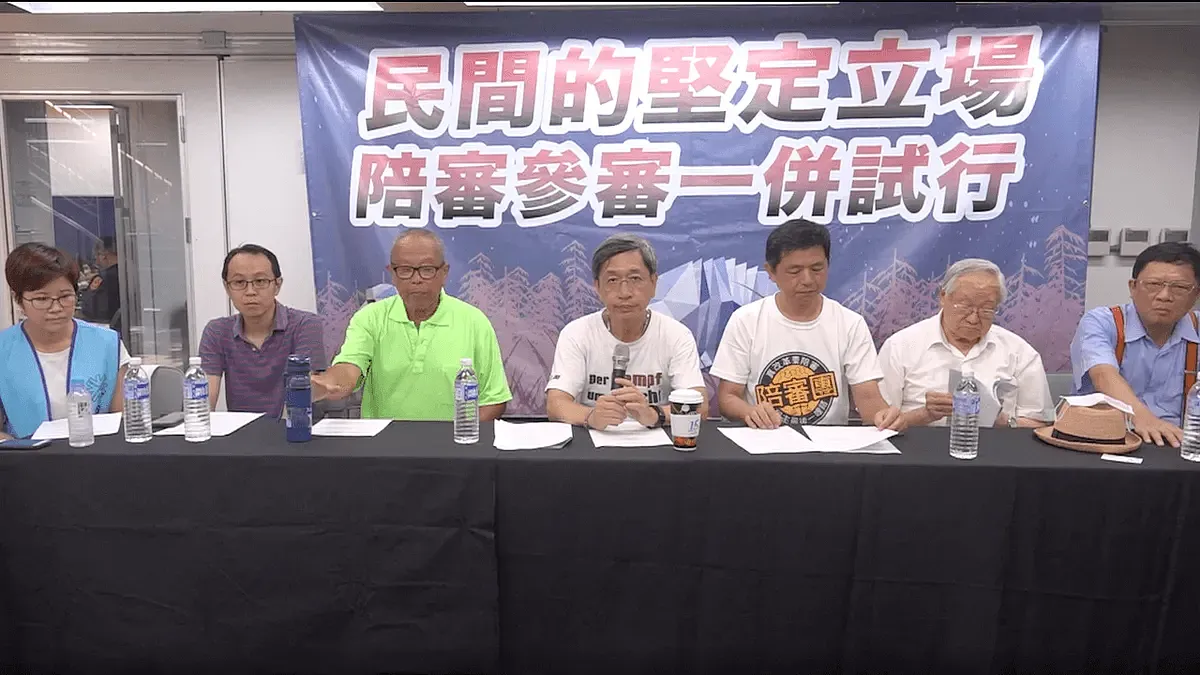
The "Alliance for Concurrent Trial of Jury and Lay Participation Systems," composed of civil society organizations including the Judicial Reform Foundation and the Taiwan Association for Implementing Jury System, held a press conference titled "Domestic and Overseas NGOs Voice Support, Urging the Democratic Progressive Party Not to Rush Legislation" at 2 p.m. on July 17 at the Chi-Nan Christian Church. Labor union representatives were invited to attend, calling on the Democratic Progressive Party government not to rely on its parliamentary majority to force through hasty legislation, repeating the bitter consequences of the previous legislative extraordinary session that voted to pass the second amendment to the Labor Standards Act. The alliance also invited citizens who had served as simulated lay judges for the Judicial Yuan to explain the authority effect of the lay participation system.
Attorney Lin Yung-sung, Chairman of the Judicial Reform Foundation, first revealed the demands of today's press conference, calling on the ruling party not to hastily pass the Judicial Yuan's version of the National Participation in Criminal Trials Bill during an extraordinary session while controversies over the jury and lay participation systems remain severe and communication with the public is insufficient. Out of the bill's 113 articles, 99 remain even after internal negotiations, yet they are to be voted on article by article from next Monday to Wednesday, which is quite rare and unnecessary for non-political bills. He pointed out that opposition voices from various groups have been pouring in recently, and the alliance is also inviting other youth groups to issue statements, hoping the government will not hastily vote on major judicial reform legislation. Attorney Lin further announced that tomorrow, at Room 3B of the National Taiwan University Alumni Association Club, the results of a poll commissioned to Taiwan Public Opinion and Policy Consulting Co., Ltd. regarding "public awareness and support for the jury and lay participation systems" will be released. In the afternoon, joining hands with all opposition parties and various sectors of society at home and abroad, a parade will start from the gates of the Legislative Yuan, passing through Taipei Main Station, Ximen MRT Station, and the Presidential Office for brief speeches, with the destination at Ketagalan Boulevard to express their demands.
Wei Jui-ming, Vice Secretary-General of the Taiwan National Alliance, spoke next, stating that the Tsai administration has performed commendably in major national affairs such as epidemic prevention, earning praise from countries around the world, but the same cannot be said for judicial reform. He believes the government's public education and promotion of the system are inadequate, noting that he himself only learned of the existence of the pilot act through the internet. Drawing on his legal studies background, he believes that the trial act is extremely important, and that a jury system with independent fact-finding and a diverse composition helps reduce the authoritarianism of professional judges and should not be excluded. Attorney Lin Yung-sung added that if the poll results released tomorrow show that most citizens still do not understand the contents of the bill, then the Democratic Progressive Party's claim in polls that nearly 80% of public opinion supports the Judicial Yuan's version is meaningless.
Tsai Kun-lung, village warden and former lay judge in the Judicial Yuan's simulated courtroom, shared that in the corruption case he simulated, the lay judges originally voted 4 to 2 to consider the case merely an administrative flaw and the defendant innocent. However, the two professional judges continuously emphasized that law is a rigorous science and presented a vast amount of professional legal knowledge, ultimately convincing the lay judges regarding both the fact-finding of guilt and sentencing. Warden Tsai stated that it was only after seeing the term "authority effect" yesterday that he realized this was the phenomenon where his views were influenced and altered by the judges' mental scoring.
Mao Chen-fei, a representative of the National Federation of Workers' Retirees Assistance, stated that although he has led many workers to court, he still distrusts the courts and judges, feeling that every court appearance is like "casting divination blocks" because every judge has different interpretations and it is hard to say whether someone is guilty or not. How can the people trust such a method of adjudication? He greatly admires the jury system proposed by Attorney Lin, which makes justice clearer and more transparent, and he strongly agrees with trying both systems concurrently to let the people of Taiwan experience whether they can accept a system where Western citizens participate in adjudication. Looking back at the heavy price paid by the nation during the second amendment to the Labor Standards Act, he believes everyone witnessed it firsthand. The parallel implementation of both systems has its significance, and he hopes the process can be paused for a genuine and proper discussion.
Chen Po-chien, a representative of the Taiwan Higher Education Union, confessed that a week ago, someone like him who is devoted to labor groups and the union sector—despite having a certain sensitivity to related issues—still did not understand the content and spirit behind the two systems, demonstrating the inadequacy of the government's educational outreach before promoting policies. Representative Chen compared this with the history of changes in labor laws, pointing out that when the ruling party promoted the amendment of the Labor Standards Act back then, it also published a poll claiming that "the majority of people support taking too many days off themselves and wish to work overtime." For non-political livelihood bills such as labor and judicial reform, the ruling party has repeatedly forced them through in extraordinary sessions—occasions dedicated solely to voting rather than deliberation—while the public still lacks understanding. This is extremely paradoxical and hasty. Representative Chen also called on the Democratic Progressive Party to set aside the arrogance of its majority, trust that the public has the capacity to understand the system, and conduct thorough social communication first rather than rushing into hasty legislation now.
Chen Shu-lun, Secretary-General of the Taipei Industrial總工會 (Taipei Confederation of Trade Unions), started from her own experience to explain that the labor movement is a process of mutual persuasion among all sectors of society. Through such a process, she is full of confidence in the people, unlike President Tsai, who worries that citizens are incapable of independent judgment. Secretary-General Chen emphasized that supporting the jury system is not about dismissing all judges as "dinosaur judges," but rather hoping to connect people's experiences with the law and free judicial adjudication from the shackles of mechanical jurisprudence. She stated that recent remarks by the ruling party portraying the public as enemies of judges are a defamation of the people, and using narrow blue-green political labels to attack public discussions on the judicial system is yet another defamation.
Secretary-General Chen also recalled that during the amendment of the Labor Standards Act, legislators had severely mistaken understandings of the bill they passed, yet they stubbornly insisted on repeated amendments based on those wrong notions. An extraordinary session is an occasion incapable of thorough deliberation, yet the ruling party once again used majority violence to ram the legislation through hastily, which is unacceptable. Finally, Secretary-General Chen called on the public, noting that right now is the critical turning point for making a choice on the judicial system. People must not believe the Judicial Yuan's slogan of "striving for existence before perfection," because if the lay participation system fails during the pilot phase, there will be no turning back to test the jury system. The ruling party repeatedly asks the public not to cling to the jury system, yet it stubbornly insists on passing the lay participation system; if they claim the people do not understand, they should also shoulder the responsibility of policy explanation.
Attorney Cheng Wen-lung, founding chairman of the Taiwan Association for Implementing Jury System, also introduced statements of support from several overseas organizations: First, the Formosan Association for Public Affairs (FAPA) Los Angeles Chapter stated, "Judicial reform requires democracy, and lay judges need a jury." Having resided in the United States for a long time, the chapter's position is that a jury is a fairer trial process, and they hope the jury system can at least be piloted concurrently with lay participation for a period, with a final decision made based on public satisfaction.
Next, the Formosan Association for Human Rights, USA pointed out that the jury system is a right and obligation of the American people; the dissatisfaction of the Taiwanese people with the judiciary is primarily due to the malpractices of certain Taiwanese judges, and they encouraged the public to have the courage to adopt the jury system that the United States has used for hundreds of years.
In addition, the Taiwan Association of Canada also called for using a jury system to achieve true judicial reform. The association believes that Taiwan's judicial reform should emulate the jury systems of the US and Canada, with over fifty countries worldwide having already adopted jury systems. The government should adopt a jury system that truly embodies public values and ensures fair and impartial trials, or at the very least, allow the concurrent implementation of both systems for six years.
The fourth is a statement from Chu Chia-hao, Secretary-General of the Formosan Association of Public Affairs, emphasizing the unity and implementation of judicial reform, as well as the concurrent trial of both jury and lay participation systems.
Attorney Cheng concluded that the alliance is promoting the concurrent trial of both systems in Taiwan, and overseas civil groups that have actually experienced the jury system also agree that the jury is a very fair and impartial system. He hopes President Tsai can hear everyone's voices. He emphasized that these are all groups that support President Tsai, which is why they are offering admonitions. Everyone can agree that the authority effect still exists in the lay participation system; if it is forced through, it will still fail to achieve the original intent of promoting public participation in trials. Only through thorough communication and complete parliamentary deliberation to resolve public doubts can a sound legislative model be established.
Finally, Attorney Lin Yung-sung summarized the opinions of various groups recently, pointing out that whether it is the labor representatives expressing their lack of understanding of the system today, or the Taiwan Association of University Professors pointing out the insufficient basic educational empowerment regarding the trial system, both indicate that the public is still unfamiliar with judicial reform bills. Moreover, among the two major parties in the Legislative Yuan, only the Kuomintang has held two public hearings, while the Democratic Progressive Party, which holds the majority of seats, has held none. With so many domestic, overseas, civic, and academic groups raising their voices to call on the ruling party not to abuse its congressional majority to trample on public opinion, it is hoped that the Democratic Progressive Party will think twice.
Attending Representatives
Attorney Lin Yung-sung / Chairman, Judicial Reform Foundation (Convener)
Attorney Cheng Wen-lung / Founding Chairman, Taiwan Association for Implementing Jury System (Convener)
Attorney Chang Ching / Member, National Congress on Judicial Reform
Mao Chen-fei / Representative, National Federation of Workers' Retirees Assistance
Wei Jui-ming / Vice Secretary-General, Taiwan National Alliance
Chen Shu-lun / Secretary-General, Taipei Confederation of Trade Unions
Chen Po-chien / Taiwan Higher Education Union
Tsai Kun-lung / Warden of Peiyuan Village, Chiayi City, and former lay judge in the Judicial Yuan's simulated courtroom
Press Contacts
Judicial Reform Foundation / Director Hsiao I-min
Taiwan Association for Implementing Jury System / Deputy Secretary-General Lin Ping-chuan
This article is an AI-generated translation of the original Chinese text. In the event of any discrepancy, the Chinese version shall prevail.