
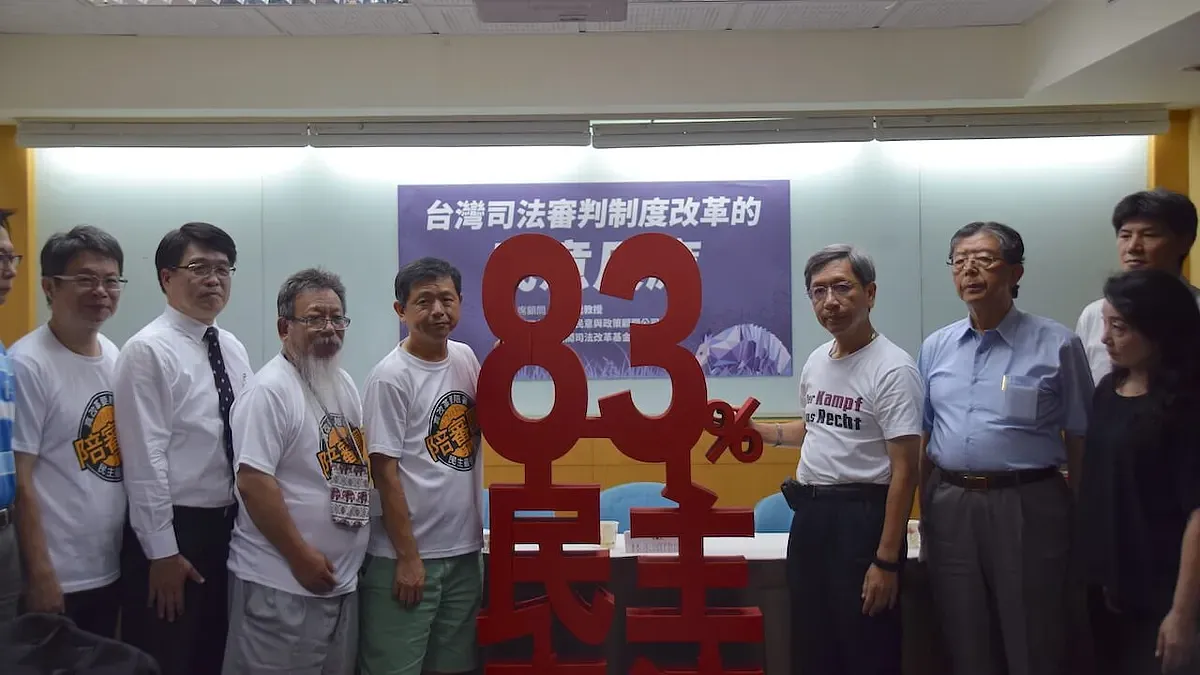
Releasing Poll Results on Lay Participation Systems: Civil Society Groups Head to Ketagalan Boulevard This Saturday – Press Conference on the 20th Day of Sit-in Protests Against the Inclusion of the Citizens in Criminal Trials Bill in the Legislative Yuan's Extraordinary Session
Last edited: 2026-07-27
The Alliance for Parallel Trial Testing of Lay Assessor and Jury Systems (composed of civil society organizations including the Judicial Reform Foundation and the Taiwan Association for Jury System; for alliance members, please refer to the website) held a press conference titled "Opposing the DPP's Hasty Legislation: 83.4% of Mainstream Public Opinion Supports Running Both Systems Concurrently" at 9:30 AM on July 18 at the National Taiwan University Alumni Club, releasing the poll report on "Public Opinion Response to Taiwan's Judicial Trial System Reform" (see Attachment).
Report author Yu Ying-lung, Chief Consultant of Taiwan Public Opinion and Policy Consulting Co., Ltd., analyzed the key findings of the poll point by point:
-
As many as 64.2% of Taiwanese lack confidence in how current professional judges handle cases (Figure 1), and 80.7% believe that the current court trial system needs to change, demonstrating a genuine public desire for reform of the trial system (Figure 2).


-
While 67.8% of the public have heard of the Anglo-American jury system, only 6.6% have heard of the German-Japanese lay assessor system (Figure 3). Furthermore, an astonishing 91.8% are unfamiliar with or have never heard of the term "国民法官" (lay judge) (Figure 5). This indicates that the DPP government has failed to adequately explain this major judicial reform policy to the general public.


-
81.9% of the public agree that a jury system is what Taiwan's judicial reform needed at the time, with only 11.3% disagreeing (Figure 4). In contrast, regarding the attitude toward the lay assessor system—after prompting respondents on its main characteristics—only 63.2% favor the lay assessor system, while 28% oppose it (Figure 6). This shows that the lay assessor system is certainly not what the DPP claims to be the public's preference.


-
Additionally, the poll results show that regarding whether lay judges under the lay assessor system would be influenced by professional judges, 38.7% of the public agree they would be influenced, while 49.2% disagree (Figure 7). This reveals that once the lay assessor system is implemented, the general public has no consensus on its potential aftereffects of an authority effect, leaving doubts and controversies.

-
More importantly, when further analyzing the trial system reform desired by the Taiwanese public, the poll results show that 83.4% of citizens support running the lay assessor and jury systems concurrently (Figure 8). Among them, up to 90% of DPP supporters accept running both systems concurrently, as do 79% of KMT supporters and 80% of independent/neutral voters. This demonstrates that simultaneously running both systems is a cross-party mainstream public opinion.

-
The poll also shows that 55.7% of Taiwanese citizens believe legislation should not be rushed through in this extraordinary session (Figure 9), further highlighting that Taiwan's current social atmosphere does not welcome the DPP forcing legislation through.

Following the objective presentation of the report, Alliance Co-Conveners Attorney Lin Yung-sung, Attorney Cheng Wen-lung, and Attorney Chang Ching unveiled the press conference's standing sign displaying "83%" support for the concurrent implementation of both systems, highlighting the report's most vital public demand. Attorney Lin Yung-sung re-emphasized that the poll shows the public currently lacks an understanding of the system of citizen participation in trials, and the government has failed to communicate effectively with the people. The poll released today—showing 83.4% public support for running both systems concurrently, and 55.7% believing it should not be rushed through in this extraordinary session—demonstrates that mainstream public opinion supporting both systems cannot be ignored. Attorney Lin solemnly appealed to the ruling party not to hastily vote on the bill during Monday's extraordinary session, expressing hope that the Democratic Progressive Party will respond to public opinion at this final hour.
Regarding the ruling party's understanding of "public opinion," Judicial Reform National Guoshi Conference member Attorney Chang Ching added that the Judicial Yuan's March press release mentioned the "Public Opinion Survey Report on Citizens Participating in Criminal Trials." That poll was suspected of misleading the public in several respects. For instance, designing questions such as "Should cases be decided jointly by judges and participating citizens, or solely by participating citizens?" would lead even him, as a supporter of the jury system, to answer "decided jointly," because no trial system in the world exists where judges and citizens do not decide together. Under the jury system, judges also participate in sentencing during the trial process; it is simply a division of labor rather than a division of cooperation. Yet, the Judicial Yuan misclassified all respondents who answered "decided jointly" as "supporters of the lay assessor system," which is a blatant error. Furthermore, in its newly released July poll, the Judicial Yuan claimed that 78.2% of the public support the lay assessor system, but failed to even publish the questions, making it completely impossible to examine the validity and reliability of the questions. Today's released report features complete questions and results, representing a genuine poll that reflects true public sentiment.
Attorney Cheng Wen-lung, Founding Chairperson of the Taiwan Association for Jury System, also stated that listening to public opinion is deep democracy. When an audience member asked whether civil society would take further action if the DPP government forces the bill through, he responded with emotion that this is his third sit-in in his lifetime: the first was for the Wild Lily student movement, the second for the Losheng Sanatorium preservation, and the third is this one. Thirty years ago, many of those who participated in the Wild Lily sit-in with him have now become high-ranking officials in the DPP. He holds no power here and expresses his views through a sit-in because he believes he stands with the people. He further declared that the alliance will steadfastly maintain its conviction to stand with the people and persist in the spirit of exploring a good system. Upholding the spirit of not forgetting one's original aspiration, he expressed hope for a better society and urged the DPP government not to forget its original aspiration.
Yu Ying-lung, Chief Consultant of Taiwan Public Opinion and Policy Consulting Co., Ltd., concluded from an objective polling perspective that public opinion stands with the alliance. As a party member with 24 years of membership in the DPP, he hopes that in promoting such an important judicial reform policy, the DPP will adhere to the democratic ideal of popular sovereignty and refrain from bypassing public consultation.
Moderator Director Hsiao Yi-min emphasized in his closing remarks that temperatures have broken records once again. Despite the scorching heat of July, the alliance will continue to demonstrate its determination and passion, with a march set to begin at 2:00 PM. All sectors are welcome to pay attention.
Attachment
Attending Representatives
Attorney Lin Yung-sung / Chairperson of the Judicial Reform Foundation (Convener)
Attorney Cheng Wen-lung / Founding Chairperson of the Taiwan Association for Jury System (Convener)
Attorney Chang Ching / Member of the Judicial Reform National Guoshi Conference
Yu Ying-lung / Chief Consultant of Taiwan Public Opinion and Policy Consulting Co., Ltd.
Press Contacts
Judicial Reform Foundation / Director Hsiao Yi-min
Taiwan Association for Jury System / Deputy Secretary-General Lin Ping-ch'üan
This article is an AI-generated translation of the original Chinese text. In the event of any discrepancy, the Chinese version shall prevail.