
Who is Manipulating Public Opinion: A Response to the Judicial Yuan's July 20 Press Conference on Public Opinion Polls
Last edited: 2026-07-27
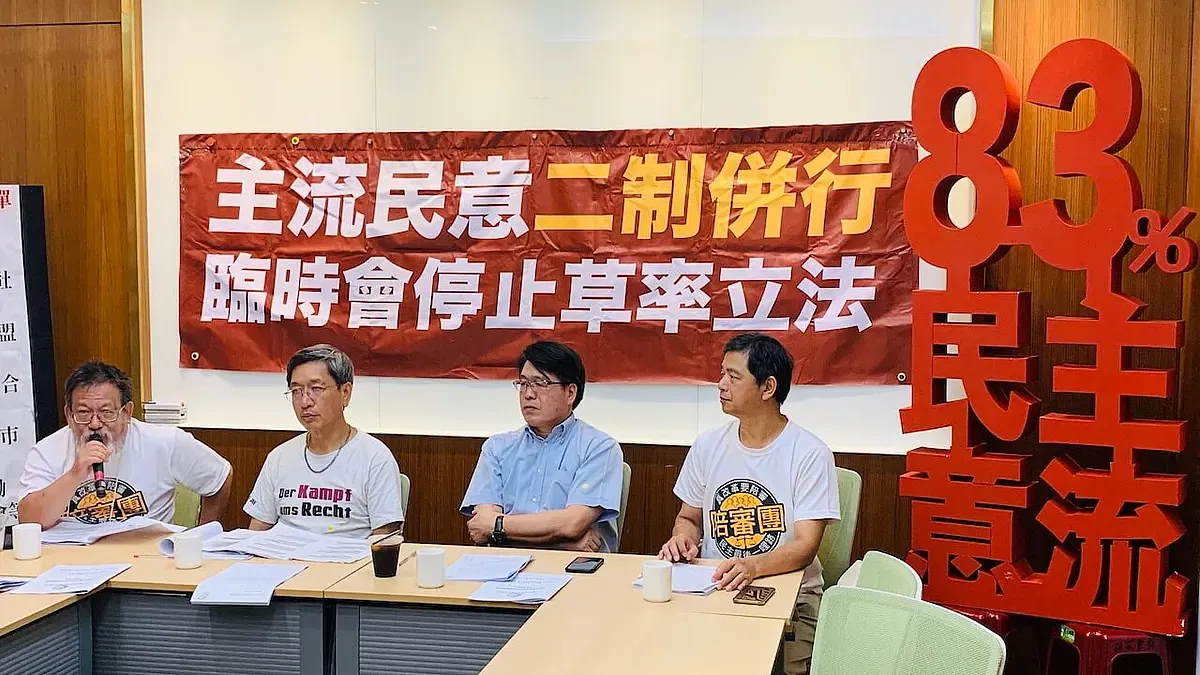
The "Grand Alliance for the Parallel Trial of Lay Participation and Jury Systems"—composed of NGOs including the Judicial Reform Foundation and the Taiwan Association for Mayors and Citizens for Jury Systems—held a press conference titled "Who is Manipulating Public Opinion? Responding to the Judicial Yuan's July 20 Public Opinion Poll" at 2:00 PM on July 22 in Room 101 of the Chung-Hsing Building, Legislative Yuan. Dr. Yu Ying-lung, Chief Consultant of the Taiwan Public Opinion and Policy Consulting Co., Ltd., was invited to respond to the contents of the Judicial Yuan's latest public opinion press conference held at 10:00 AM that morning.
Key Highlights of the Judicial Yuan's Latest Public Opinion Press Conference
At 10:00 AM this morning, President Hsu Tsung-li of the Judicial Yuan held a press conference to release the results of a poll commissioned by the Judicial Yuan and conducted by Trend Research Center between July 10 and 14. Key findings include:
- Over 80% of the public wish to discuss matters with judges during the trial process.
- Over 86% of the public hope to determine the verdict together with judges.
- Over 94% of the public believe that judgments should include reasoning.
- Over 97% of the public believe that if they are dissatisfied with the factual findings of a judgment, there should be an opportunity to appeal.
- Over 63% of the public oppose restarting the trial proceedings if a unanimous decision is not reached.
Judicial Yuan President Hsu Tsung-li stated at the press conference that regardless of the system, allowing the public to sit on the judgment bench constitutes a epoch-making reform. Judicial reform is an issue discussed for over 30 years, and sufficient consultations have been held with the private sector. There will also be a two-and-a-half-year preparation period after the bill passes, meaning there is no issue of haste or carelessness. There is no single best system for judicial reform, only the most suitable one; the Judicial Yuan's lay adjudicator system is currently the most fitting system for our country's national conditions and should be passed expeditiously to enhance trust in the judiciary. In addition, the Judicial Yuan raised four points: "too much system description, respondents do not understand," "leading phrasing," "leading stance," and "involving subjective preferences," arguing that the Judicial Reform Foundation's poll cannot reflect true public opinion.
Analysis of the Judicial Yuan's Polling Questions
Attorney Lin Yung-sung, Chairman of the Judicial Reform Foundation, first explained that the Judicial Yuan's poll asked nine questions. The first two questions addressed "professional judges' judgments differing from public expectations" and "the public's desire to participate in trials," yielding results similar to the poll previously released by the JRF. Therefore, the following response addresses only questions three through nine of their poll. The responses are as follows:
The third question posed by the Judicial Yuan was: "Some say that public participation in criminal trials, where citizens discuss with judges and decide the verdict together, can enhance public trust in the judiciary. Do you agree with this statement?" This question fundamentally fails to distinguish between the lay participation and jury systems. The primary reason is that under both systems, the public discusses with judges to determine the verdict—the difference lies in the content of the discussion between judges and citizens. Under a jury system, professional judges primarily discuss the applicability of legal statutes and the legal elements of the case with citizens, and are not permitted to directly involve themselves in determining guilt or innocence, with public audio recordings and minutes kept. Under a lay participation system, professional judges are allowed to discuss matters in closed-room deliberations with lay adjudicators during the trial process, and minutes of such discussions are not required. In short, under both systems, the public discusses with judges, but the Judicial Yuan interpreted the results of this question as public support for the lay participation system without clearly explaining the definition of "discussion" to the surveyed citizens, which is truly passing off fish eyes for pearls.
The fourth question—"Some believe that during the process of public participation in trials, the presence of judges and joint discussion with citizens will lead citizens' opinions, while others say the presence of judges in joint discussion can immediately clarify citizens' doubts. If you were to participate in a trial, would you hope to have judges present to participate in discussion?"—suffers from the same problem. The Judicial Yuan's poll merely mentions "discussion" without clarifying "what is being discussed," yet uses the result to support its own lay participation system. This might fool the general public, but it cannot deceive professionals from various sectors of society who have long monitored this issue.
The fifth question—"After public participation in a trial, when determining the verdict, do you think it should be 'voted on together by the public and judges' or 'voted on solely by the public?'"—evidently misleads the public by claiming that under a jury system, only the public votes. In reality, judges in a jury system are responsible for deciding the applicability of the law and sentencing after a guilty verdict, rather than entirely handing over judicial power to citizens lacking legal expertise.
The same issue appears in the ninth question. The ninth question asked what kind of government assistance the public hopes to receive during the trial process, with the top two answers being "legal knowledge" and "case information." Attorney Lin emphasized that, as mentioned earlier, judges in both the lay participation and jury systems will provide adequate assistance to citizens as described in that question. Regrettably, the Judicial Yuan narrowly associated the jury system with a sense of uncertainty where citizens must figure things out on their own.
The sixth question—"Do you agree that after public participation in a trial, the written judgment must still explain the reasons for the judgment to the defendant, victim, and the general public?"—is clearly targeted at the jury system's absence of traditional written judgments. Attorney Lin stated that this is old wine in a new bottle; civil society organizations have repeatedly explained that jury systems still have written judgments, but in a simplified format where evidence determining guilt, criminal intent, and other disputed points are recorded, replacing obscure and difficult-to-understand written judgments. Therefore, the poll results for this question do not prove that "the public wanting reasons for judgments means supporting the Judicial Yuan's lay participation system." The Judicial Yuan should not smear the jury system first before claiming that the public does not support it.
The seventh question—"Do you agree that after public participation in a trial, defendants and prosecutors in criminal cases who are dissatisfied with the factual findings of the judgment should still have the opportunity to appeal?"—has already been repeatedly clarified by the JRF. Anglo-American jurisdictions also have an appellate system, and both the lay participation and jury systems place restrictions on appeals. Therefore, this question likewise fails to prove that the jury system runs counter to public opinion.
The eighth question—"If nine people decide whether a defendant is guilty or not guilty, do you agree that if eight people think the defendant is guilty and one thinks the defendant is not guilty or expresses no opinion, the trial counts for nothing, and the panel must be dismissed, a new group re-selected, and all trial procedures restarted?"—targets the hung jury issue in the jury system. Attorney Lin responded with three points: First, this highlights that democracy is not merely about submitting to the majority; whether persuading a guilty view into an innocent one or vice versa, reaching a consensus is paramount, which contrasts sharply with the Democratic Progressive Party (DPP) caucus forcefully passing bills in the legislative chamber by relying on a majority. Second, the Judicial Yuan ignores the deliberation process prior to voting; the civil society version of the draft stipulates that if a consensus cannot be reached, deliberations must last at least three days. Third, a jury system is not synonymous with unanimity; institutional design can allow room for one or two dissenting votes, much like in the UK or Hong Kong, and civil society holds an open attitude toward the details of vote counts.
Response to the Judicial Yuan's Press Release
Regarding the Judicial Yuan's press release itself, Attorney Lin first responded to whether the lay participation system had been fully negotiated with civil society. He stated that while President Hsu claimed the Judicial Yuan had consulted with broad civic groups and various sectors of society, in reality, the only consultation took place last year, and the discussion was about the parallel trial of the two systems, not the lay participation system currently being forced through. Therefore, President Hsu cannot claim that the lay participation system is the result of consultation with civil society.
Secondly, President Hsu brandished the Judicial Yuan's old rhetoric from early this month, claiming that testing the jury system is experimenting with human rights and placing defendants' human rights in jeopardy. However, looking at the 52 countries and regions worldwide that adopt a jury system, judicial trust is rarely as low as Taiwan's 30%. Operating under such a mindset, President Hsu still claims that the lay participation system is an advanced reform while the jury system is a human rights crisis, which is utterly absurd.
Finally, Attorney Lin lamented that President Hsu's assertion that merely letting the public sit on the judgment bench to participate in trials constitutes an epoch-making change amounts to pursuing mere existence rather than quality. The Judicial Yuan issued a press release pointing out that public participation systems have been studied for 30 years. Attorney Lin pointed out that the poll results are clear: although the Judicial Yuan spent 30 years discussing it in meetings, only 8.2% of the public consider themselves to understand the lay participation system. Attorney Lin further recalled that during a speech in Tainan on January 26, 2017, Judicial Yuan President Hsu Tsung-li stated, "Public trust in the judiciary is very low because the public does not truly understand the judiciary and does not understand the efforts made by the Judicial Yuan, which is why it is so low." At the time, this remark was criticized by then-Tainan Mayor and current Vice President Lai Ching-te as "the most conservative Judicial Yuan President I have seen in 20 years." Attorney Lin stated that instead of engaging in self-reflection or bridging the cognitive gap between the public and officials, President Hsu and his team attribute public distrust of the judiciary to the public themselves, and are now using ambiguous polling data to claim that the public highly supports the Judicial Yuan's lay participation system while opposing the jury system, fundamentally underestimating the wisdom of the people of Taiwan.
The Judicial Yuan is Self-Contradictory and Incoherent in Questioning the JRF
Attorney Cheng Wen-lung further cited Vice President Lai Ching-te's past remarks to substantiate Attorney Lin's statements. He stated that under President Hsu's tenure, public trust in the judiciary has plummeted to extremely depressed levels, showing how profoundly distrustful the public is of the judgments rendered by professional judges under President Hsu's administration. If Cheng were president himself, he would have resigned in shame long ago.
Secondly, Attorney Cheng questioned that since the bill is being pushed through by the ruling party without consensus across society, creating such severe social turmoil, it will remain a failed piece of legislation even if passed through third reading in the Legislative Yuan. He pointed out that since the protests began, over 170 organizations—including the Humanistic Education Foundation, the Association of Taiwanese Professors, and various student organizations—have stood up in opposition. President Tsai stated just yesterday that she wants to listen to public opinion, yet today issued a press release attacking public opinion; this is authoritarianism under the guise of formal democracy. The JRF's recent poll also showed that 92% of people self-evaluate as not understanding what a lay adjudicator is. Forcing through a flawed policy under such conditions simply ignores the public will.
Furthermore, Attorney Cheng rebutted President Hsu Tsung-li's emphasis that public participation in trials has been studied for 30 years, stating that the version currently pushed by the Judicial Yuan was only proposed this March and has not seen a single explanatory meeting or public hearing since its proposal. Public hearings were actually held by the opposition Kuomintang, rather than the ruling DPP and the Judicial Yuan. Compared to the lay participation system, the jury system is a pursuit of the Taiwanese people spanning nearly a century—from Chiang Wei-shui's Taiwan People's Party platform advocating the jury system in 1927, to Dr. Hsu Shih-hsien (mother of Chen Po-ya) proposing a bill in the Provincial Assembly in 1954, to the DPP platform incorporating the jury system into judicial reform in 1999, the jury system has been discussed across various sectors in Taiwan for nearly a century.
Finally, Attorney Cheng raised the current appointment system for judicial officers, questioning the Judicial Yuan's argument about "using human rights as an experiment." He queried whether, according to the Judicial Yuan's logic, the appointment of judicial officers currently requires going through three stages: five years as a probationary judge, followed by two to three years as an interim judge, before obtaining a substantive appointment. Can the judiciary use interim judges during the pre-substantive appointment process to experiment with court judgments and citizens' rights to a fair trial?
Polling Expert Responds to the Judicial Yuan's "Four Mores and Three Nones" Accusations
Professor Yu Ying-lung then addressed the Judicial Yuan's accusations attacking the Alliance's poll with "four mores and three nones." He stated that the Judicial Yuan mounted a grand press conference only to pick on petty, trivial points, which struck him—having conducted political science and behavioral research since 1977—as quite absurd.
The four mores raised by the Judicial Yuan are: "too many words," "leading phrasing," "leading stance," and "involving subjective preferences."
First, none of the questions in the poll commissioned by the JRF exceeded 100 words, and they utilized the plainest, most easily understandable language possible in order to objectively and completely explain the characteristics of the jury and lay participation systems. Raising such a query demonstrates the Judicial Yuan's unfamiliarity with telephone polling practices. Second, the Judicial Yuan believes that describing Anglo-American countries as "advanced" in the questionnaire constitutes leading phrasing; Professor Yu believes that compared to Taiwan, Anglo-American nations are indeed advanced, and this phrasing is merely a statement of fact.
Furthermore, the Judicial Yuan questioned whether mentioning phrases like "strong opposition and destruction of social harmony" in the questionnaire constituted a leading stance. Professor Yu responded that as early as June 29, the Grand Alliance for Parallel Trials held daily press conferences, marches, and sit-ins, during which numerous social groups from all walks of life voiced their support. Large opposition is simply a statement of fact. With opposition protests being this intense and prolonged, and civil society at loggerheads with officialdom, for the Judicial Yuan to deny this fact is mere subjective speculation.
Finally, the Judicial Yuan pointed out that using terms like "state" and "political party" in the question descriptions influences subjective preferences, with some judges expressing fear that this might create a negative impression and that it should not be stated that the draft bill for public participation was proposed by the DPP. However, this is merely their individual imagination. In fact, nearly 70% of the Taiwanese public are full of confidence in the DPP's one-party governance; even if subjective preferences had an effect, it would actually benefit the authorities. Professor Yu quoted Attorney Lin's recent description of the Judicial Yuan—"The Judicial Yuan is merely picking bones in other people's eggs while failing to even bring out its own egg"—pointing out that even though a new poll was released today, the past controversial polls of the DPP and the Judicial Yuan still have not been made public.
Regarding the three nones: First, the Judicial Yuan contends that the JRF poll only described the negative aspects of the lay adjudicator system in its polling questions without explaining problems arising from the jury system, such as judges not participating in deliberating criminal liability, written judgments lacking reasons, no right to appeal, and hung juries. However, the Alliance had already explained the aforementioned controversies at press conferences in previous days. These issues are fundamentally straw man logical fallacies—distorting the opponent's arguments first and then attacking them. A major psychological problem of the Judicial Yuan is subjectively determining that certain systemic characteristics of the jury system are bad and then smearing them.
Second, the Judicial Yuan questioned whether the poll failed to inform respondents about the spirit of cooperation and joint adjudication in the lay participation system, raising suspicions of bias. Professor Yu responded that the seventh question of the JRF poll specifically inquired about systemic characteristics, clearly mentioning that six lay adjudicators and three professional judges form a court; the Judicial Yuan ought to re-read the JRF poll.
Furthermore, the Judicial Yuan complained that the Alliance's poll lacked sufficient information, failing to inform people about potential problems generated by the jury system or what lay participation and jury systems entail under parallel trials. Professor Yu believes this is also the aforementioned straw man fallacy, shifting the blame onto the proponents of the jury system. He emphasized that both polls contained nine questions, and the Alliance's poll even included basic background information explanations. While the Judicial Yuan questioned why our poll did not encompass comparisons of all characteristics of both systems, its own poll also failed to achieve a complete comparison, the reason being that the Judicial Yuan simply does not understand polling. It is impossible for a poll to comprise over 100 questions thoroughly targeting every single aspect.
Finally, the Judicial Yuan criticized the JRF for failing to adopt a comparative question format for both systems. Professor Yu pointed out that directly probing the core of the issue is the most straightforward approach. By comparison, the Judicial Yuan uses very obscure systemic differences to compare the two systems before declaring that public participation is supported by public opinion, which is completely incoherent. He recalled seeing a National Chengchi University poll the year before last and noted that the polling then was similar to the current version. Relying on its abundant resources, the Judicial Yuan commissions multiple polls, cross-references them, and then presents the ones favorable to itself, treating polls as a tool to support its own policies rather than to ascertain public opinion.
Reflections from a Judicial Reform National Guiding Conference Member
Attorney Chang Ching specifically addressed the importance of pilot trials: First, cross-examination—now common in criminal trials—underwent years of trial and evaluation before being adopted prior to its introduction in 2003. Major reforms in criminal procedure naturally require pilot trials; this is easily understood and necessary. Why does the Judicial Yuan claim that piloting the jury system now constitutes a human rights crisis? Second, Attorney Chang lamented that the Judicial Yuan barred him from entering this morning's press conference venue, whereas civic press conferences are unconditionally open to official attendance, demonstrating a stark contrast in attitudes. Third, judgments under the jury system definitely contain reasons and can serve as the basis for a defendant's appeal. Attorney Chang pointed out that the fundamental error of Taiwanese judges is equating written judgments with judgments themselves. A written judgment is naturally the carrier of a judgment; the main text and contents of a judgment can certainly be recorded in a written judgment, but they can also be expressed in trial minutes. Moreover, current plea-bargaining systems in criminal cases do not require being documented in a written judgment. In short, the absence of a formal written judgment does not mean, as the Judicial Yuan imagines, that there are no reasons for judgment and no possibility of appeal, and the Judicial Yuan's insistence on the current format of written judgments is groundless.
Attendees
Attorney Lin Yung-sung / Chairman, Judicial Reform Foundation (Convener)
Attorney Cheng Wen-lung / Founding Chairperson, Taiwan Association for Mayors and Citizens for Jury Systems
Dr. Yu Ying-lung / Chief Consultant, Taiwan Public Opinion and Policy Consulting Co., Ltd.
Attorney Chang Ching / Member, Judicial Reform National Guiding Conference
Press Contacts
Judicial Reform Foundation / Director Hsiao I-min
Taiwan Association for Mayors and Citizens for Jury Systems / Deputy Secretary-General Lin Ping-chuan
This article is an AI-generated translation of the original Chinese text. In the event of any discrepancy, the Chinese version shall prevail.