
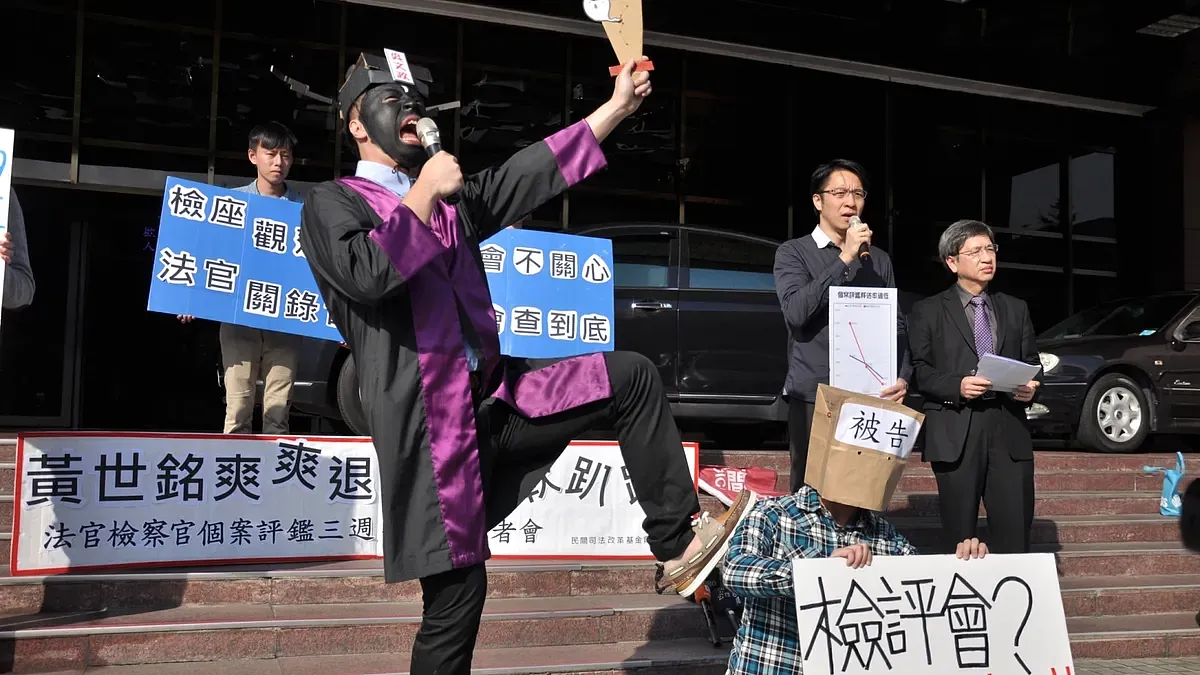
Procedure for Requesting Individual Evaluations (Under the Former Judges Act, Prior to July 17, 2020)
Last edited: 2026-07-27
Procedure for Requesting Individual Evaluations
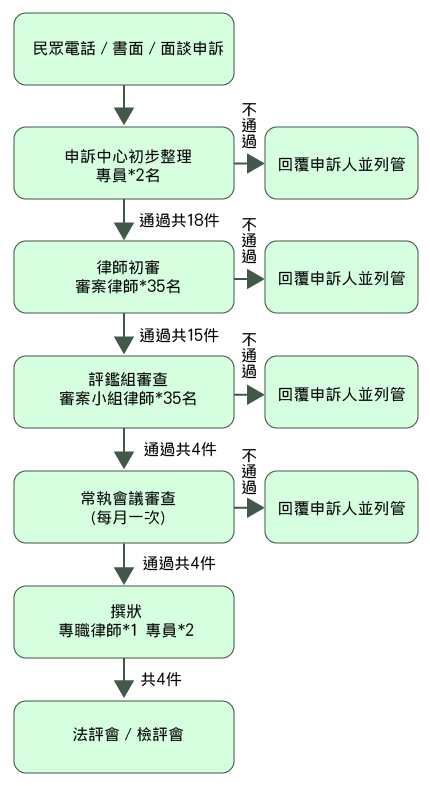
After receiving complaints from the public via telephone, written submissions, or interviews, and before deciding whether to submit a request for an individual evaluation to the Judge Evaluation Commission or the Prosecutor Evaluation Commission, the JRF undergoes the following five review procedures, detailed as follows:
-
Intake by Complaint Center Specialists
The JRF employs two Complaint Center specialists to receive public complaints (including written submissions, phone calls, and in-person visits). Upon intake, the specialists conduct an initial clarification of the core issues of the public complaint and determine whether it falls under a petition for an individual evaluation event, or if it constitutes a request for assistance with vindication, legal consultation, or the provision of personal reform opinions.
-
Assignment to Case Review Lawyers
If the Complaint Center specialist confirms that the public petition indeed falls under an individual evaluation event and is within the statutory time limit for individual evaluations, the case is assigned to pro bono case review lawyers of the JRF for review. They draft a "Legal Preliminary Review Opinion" and submit it to the Individual Evaluation Group for deliberation.
-
Deliberation by the Individual Evaluation Group
The JRF recruits lawyers and scholars to form the Individual Evaluation Group, which convenes an evaluation meeting once a month. Based on the Legal Preliminary Review Opinion drafted by the pro bono lawyers and the case files and evidence submitted by the parties involved, the group discusses and decides whether to submit an individual evaluation request or other supervisory actions (such as filing a petition with the Control Yuan or voicing opinions to the public) regarding the complained-of judge or prosecutor. If it is deemed necessary to submit an individual evaluation request, the matter is submitted to the Standing Executive Meeting for deliberation.
-
Deliberation by the Standing Executive Meeting
The JRF establishes the Standing Executive Committee Meeting, which convenes at the beginning of each month. Whether to submit a request for the individual evaluation of a judge/prosecutor is one of the mandatory items that must be proposed and discussed.
-
Drafting of Petitions by Full-Time Personnel
After an individual evaluation case passes the deliberation of the Standing Executive Meeting, full-time personnel of the JRF (full-time lawyers or Complaint Center specialists) draft the request petition and submit it to the Judge Evaluation Commission and the Prosecutor Evaluation Commission.
Statistics on Individual Evaluation Case Volumes and Personnel Allocations
| Year | Complaint Calls Answered | Judge Complaints Reviewed | Prosecutor Complaints Reviewed | Judge Evaluation Requests Filed | Prosecutor Evaluation Requests Filed |
| 2012 | 629 | 116 | 68 | 2 | 2 |
| 2013 | 1,455 | 100 | 88 | 7 | 18 |
| 2014 | 1,593 | 112 | 74 | 9 | 18 |
| 2015 | 1,022 | 94 | 79 | 11 | 5 |
| 2016 |
Taipei 849 |
Taipei 78 |
Taipei 50 |
3 | 0 |
| 2017 |
Taipei 2,203 |
Taipei 78 |
Taipei 75 |
4 | 2 |
| 2018 |
Taipei 1,782 |
Taipei 78 |
Taipei 72 |
3 | 1 |
| Total | 9819 | 656 | 506 | 39 | 46 |
| Year | Number of Assigned Complaint Specialists | Number of Pro Bono Case Review Lawyers | Number of Evaluation Group Members | Number of Standing Executive Members | Number of Full-Time Personnel Responsible for Drafting Petitions |
| 2017 | 2 | 35 | 35 | 22 | 2 |
Taking 2017 as an example, the Taipei Office of the Judicial Reform Foundation answered a total of 2,203 public complaint calls. The content of these public calls may have included legal consultations, systemic recommendations, requests for assistance, reporting police, prosecutors, or investigators for violating the principle of non-disclooure of investigations, filing appeals for constitutional interpretation regarding wrongful convictions, or requesting individual evaluations of judges/prosecutors. After clarification by Complaint Center specialists, there were 78 judge complaints and 75 prosecutor complaints. Ultimately, 4 judge evaluation requests and 2 prosecutor evaluation requests were filed.
This article is an AI-generated translation of the original Chinese text. In the event of any discrepancy, the Chinese version shall prevail.