
JRF Newsletter
Volunteer No. 9: Wang Ch'in-ju #Long-term Volunteer for the Chiou Ho-shun Case
Last edited: 2026-07-27
Wang Ch'in-ju's first impression is that of a petite person carrying the weight of many lives on her shoulders. Her life is constructed by family, work, offender rehabilitation association volunteering, farming, and companions. She switches daily between drastically different roles, breaking free from various pressures. Even though her free time is already quite tight, upon hearing the news of a special interview, she still nodded without hesitation.
Unlike her resilient personality, Wang Ch'in-ju's voice is very warm and gentle, narrating her story with Ah-shun unhurriedly. In her words, there is the most sincere care and trust of a goddaughter, occasional revealing of a companion's deepest cherishing, and heartfelt encouragement and expectations as a supporter. These genuine emotions and familial love are condensed and refined word by word through letters traveling back and forth between the north and the south......
First Acquaintance: Pen Pals Separated by Layers of Iron Walls
Wang Ch'in-ju was once a family member of a person in prison. Having previously run around for her uncle, she had long maintained ties with the Taiwan Alliance to End the Death Penalty (hereinafter referred to as the Alliance to End the Death Penalty). One day, in an email sent by the Alliance to End the Death Penalty, she saw a video message featuring "Ah-shun of Meatball Brother." "Perhaps it was a transference effect after my uncle's execution; after watching the video, there was always a voice in my heart telling me to try writing to him, and I didn't expect that he would actually write back."
Through several rounds of letter exchanges, Wang Ch'in-ju could always feel Chiou Ho-shun's (Ah-shun) boldness and imposing manner, and gradually gained a deeper understanding of Ah-shun's personality. "He has the aura of a big brother; when he speaks, he's the type to shoulder everything. Plus, he loves making friends. Whenever people around him need help, he offers opinions and assists to the best of his ability." Among the people he knew in the Taipei Detention Center, if someone needed help, Ah-shun would help introduce outside resources.
"He is also a very filial person." Before Ah-shun's mother passed away, her health was already not very good. In almost every letter, he would urge Wang Ch'in-ju to take the time to call and greet his mother more often and chat with her. "Ah-shun's mother always said he was the most filial of all her children, but he suffered such a miscarriage of justice, and often lamented, wondering if she would still live to see him again." After his mother passed away, Ah-shun always felt deeply guilty in his heart for not being able to send her off on her final journey in person, and could only turn grief and anger into strength, persisting to this day.
In Wang Ch'in-ju's eyes, Chiou Ho-shun is also a person with personal persistence and principles: all his letters are handwritten by himself, using his special phrasing and uplifting openings. He leads a fixed life, waking up at a little past three every morning, insisting on taking cold showers to discipline himself, and emphasizing his innocence.
Through letters traveling back and forth between north and south, Ah-shun and Wang Ch'in-ju continue to share each other's daily lives and articulate the deep monologues of their inner hearts. Although they cannot meet due to being separated in two places, the two can feel each other's warmth and emotions between the lines, and gradually begin to piece together each other's image from numerous letter fragments, among which familial love and trust serve as the best adhesive during piecing.
Becoming Family: Chiou Ho-shun's Eldest Goddaughter
During the course of correspondence, Ah-shun once introduced Wang Ch'in-ju to read his autobiography, a section of which mentioned Chiou Ho-shun's relationship with his daughter. "His daughter was very uncomprehending of his past life and did not want to acknowledge him as her father. This matter was very heartbreaking for him." This made Wang Ch'in-ju think of her own relationship with her father, and she believed that the mutual love between father and daughter was absolutely real and undoubtable. "With my life experience, I can understand Ah-shun's daughter's lack of understanding, while also knowing Ah-shun's guilt toward his daughter."
Therefore, Wang Ch'in-ju, hoping that Chiou Ho-shun could be a little happier, thought that she might be able to make up for the regret in his heart regarding the loss of family affection. Moreover, since Ah-shun was only one year younger than her own father, and their birthdays happened to be just one day apart, she asked, "How about I become your goddaughter?" Not long after, Chiou Ho-shun also wrote back and readily agreed. Wang Ch'in-ju said, "I call my own father 'Old Dad', so I told Chiou Ho-shun that I would call him 'Old Dad' too!"
From then on, Wang Ch'in-ju's care for Ah-shun long transcended the displaced sentiments of grief for her uncle, evolving into a dedication called love. In every single letter exchange, the two used sincere words to construct a place they call home.
"In certain aspects of our emotions, Old Dad and I have missing pieces, so we both particularly like the feeling of gathering people together." For Chiou Ho-shun and Wang Ch'in-ju, as long as it is someone they consider good and trust, they easily invest emotions, treat the other party as family, and help introduce everyone to each other, hoping things will be a bit more "lively." Whenever friends of Ah-shun in prison needed help, he would frequently introduce them to Wang Ch'in-ju. Knowing she was Ah-shun's goddaughter, the other party would often give an extra layer of trust. "Among the people I know who came from the Taipei Detention Center, they were initially all introduced by Old Dad. Afterward, relying on word of mouth and mediation among everyone, the number of people I serve has now exceeded the load I can handle."
In addition to friends in prison, Ah-shun also introduced the goddaughters he successively adopted to Wang Ch'in-ju, hoping that the daughters could gather together. "He has always cared deeply about the lives of us goddaughters. As the eldest sister, he very much hopes that I can care for my younger sisters, and if they encounter difficulties in life, he asks me to be sure to assist them." As long as she has free time, Wang Ch'in-ju will contact her younger sisters, ask about their conditions, offer advice, and then report back to Ah-shun.
"A younger sister's living conditions are not very good right now, and she is having a very hard time. Old Dad is extremely worried about her and has consistently promised that as long as he can get out, he will unconditionally help her." Wang Ch'in-ju does not know if this promise will have a chance to be realized in the future, but every time she hears it, she still finds it especially heartwarming. Therefore, she continues to assist in caring for other god-sisters, hoping that Ah-shun can have fewer worries and serve his sentence in peace.
Encounter: Crossing South and North, Freedom and Unfreedom
Wang Ch'in-ju first saw Ah-shun's appearance through photos provided by others. "When Old Dad doesn't smile, he looks a bit serious, and at first glance he doesn't look very approachable, but he wasn't as fierce as others described." Ah-shun was smiling in the photos. "When I saw it at that moment, I felt that he must be a very optimistic person," Wang Ch'in-ju said.
For a long time, due to a busy job, Wang Ch'in-ju, who lives in the south, had little time to travel north to visit Chiou Ho-shun, and visiting hours were only twenty minutes, while the round-trip fare was no small burden. Therefore, although Ah-shun often mentioned in his letters wanting to see Wang Ch'in-ju, he understood her hardship, hoping she would prioritize her work first, and encouraged her to use her rare days off to rest and properly accompany her family and children. Although Wang Ch'in-ju could not share her life in person, she would still periodically send photos of her daily life and letters to Ah-shun.
After corresponding with Chiou Ho-shun for more than eight years, Wang Ch'in-ju temporarily concluded her busy work and prepared to change career paths. Taking advantage of this leisure time, she took her son north and entered the detention center for the first time to visit Ah-shun. Recalling her impression of meeting Ah-shun for the first time, Wang Ch'in-ju felt he was very approachable, and getting along with him had zero sense of unfamiliarity, just like a family member. The two chatted incessantly during the short visitation time. Wang Ch'in-ju said, "Old Dad gave off a feeling much gentler than in photos and letters, but his tone also held a bit of helplessness. We cheered each other on and discussed what we would do together after he gets out."
"At that moment, I fantasized that if one day he gets out, I must give him a tight hug and tell him: 'You've truly had a hard time.'" Wang Ch'in-ju said so.
To Be Continued
To this day, Wang Ch'in-ju and "Old Dad" Chiou Ho-shun still maintain contact through letters. Wang Ch'in-ju uses this to share bits of daily life and various topics, and will also write special experiences in her life and recent problems she faces into the letters to discuss with Ah-shun and ask for his thoughts. Ah-shun recounts what he has seen and heard in prison recently, responding to and caring about Wang Ch'in-ju's life. "Although in prison, Old Dad knows the people around him are doing well, and he will genuinely feel happy for us."
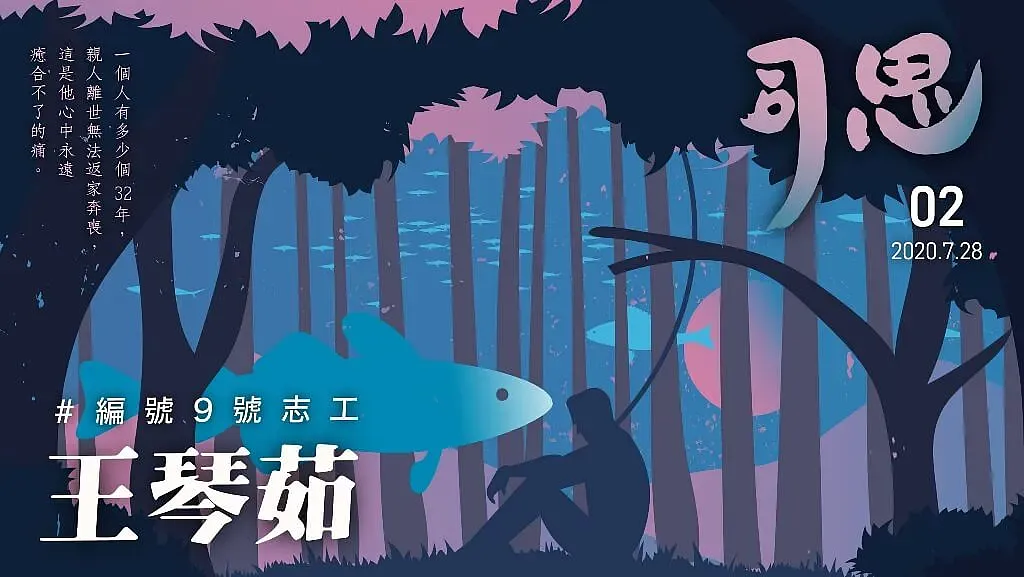
"Old Dad still cares very much about his lawsuit and insists on an acquittal. In every letter, he also definitely thanks the rescue efforts from various countries and sectors of society, and wants me to relay to everyone, 'You've worked hard.'" Although not a legal expert, Wang Ch'in-ju still hopes that justice will one day return innocence to Ah-shun. If his conviction cannot be overturned, she also hopes the President can grant a pardon, allowing Chiou Ho-shun to return home early. "How many 32 years does a person have? Being unable to return home to mourn the passing of family members is a pain in his heart that can never heal." Seeing Ah-shun growing older and his physical health being affected, Wang Ch'in-ju said helplessly and acheingly.
"Over the long years, Old Dad has always used actions to persist in his innocence, and is very confident that he will be able to get out in the future, yet he faces disappointment time and time again. How torturous it is! Sometimes while urging him to hang in there, I also feel helpless. At these moments, it is instead he who comforts me, asking me to believe together that in the near future, there will certainly be a day when he can get out." Wang Ch'in-ju stated thus.
When will the day arrive when Old Dad and his goddaughter meet? Ah-shun waits, day by day, on the other side.
This article is an AI-generated translation of the original Chinese text. In the event of any discrepancy, the Chinese version shall prevail.