
JRF Newsletter
Volunteer No. 93: Ch'en Chün-ho #LongTermVolunteerForTheCh'iuHo-shunCase
Last edited: 2026-07-27
An Encounter in the Scorching Summer
She is Ch'en Chün-ho, who studied at the Graduate Institute of Law of Providence University while also working in legal affairs. In 2013, Chün-ho, then a sophomore at Providence University, came to the JRF for an internship in July because her school's legal aid team cooperated with the Judicial Reform Foundation. It was also because of this internship that, under the arrangement of the JRF, she went to the Taipei Detention Center to visit A-shun. To this day, although her work is sometimes quite busy, she still uses her free time to write letters to and visit A-shun.
When asked about how she first met A-shun, she smiled and said it felt as though it had all happened just yesterday. That was her very first encounter with A-shun. At the time, she was an intern at the JRF, and her understanding of A-shun was limited to written documents and the flaws in his case. Before the prison visit, she still had no idea what the stranger appearing before her would be like. She felt a mixture of anticipation and fear that the unfamiliarity upon meeting would create awkwardness. Before she could even sort out her emotions, after completing the visitation procedures at the Taipei Detention Center, a guard led Chün-ho and her classmate through the security door and into the visitation room.
During her first visit, Chün-ho shared the same fear of awkwardness as anyone else. The guard led them into the visitation room, and A-shun walked over from the other side of the iron gate. "The number he gave me was 93." A-shun assigned Chün-ho a number, which meant she was the 93rd person to come to the Taipei Detention Center to visit him. A-shun's friendly smile and enthusiasm dispelled Chün-ho's fear of awkwardness when facing a stranger, and through their conversation, they gradually came to understand one another. "A-shun probably knew as well; fearing that the meeting would be awkward, the moment we stepped into the visitation room, he talked incessantly for those entire twenty minutes."
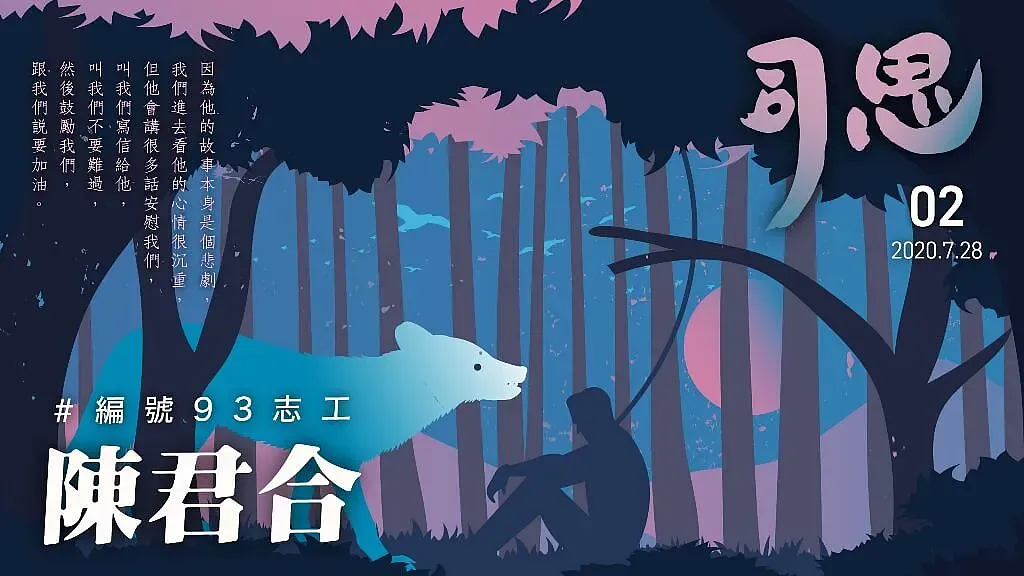
"When I got to know him, he had already been locked up for over twenty years, longer than we had been alive, so looking at us felt a bit like looking at his own daughters." "Because his story itself is a tragedy, our mood entering to see him was very heavy, but he would say a lot to comfort us, telling us to write to him, telling us not to be sad, encouraging us, and telling us to stay strong." The brief 20-minute visitation ended, and the prison guard led A-shun away from the visitation room. The iron gate opposite the glass door closed. Walking out of the visitation room, Chün-ho could no longer control her tears.
"Seeing him putting on such a brave face at that time actually felt very painful inside. Seeing him being led away by the guard first, I cried the moment I came out of the visitation room. This was more like crying out of heartache. I thought about how he had suffered a great deal, yet he was the one comforting us." She should have been the comforter encouraging A-shun, but inside the visitation room, Chün-ho became the one being comforted. The contrast between this ongoing miscarriage-of-justice tragedy and A-shun's optimism appeared even more heartbreaking. She did not know what kind of smile A-shun used to package a tragic life, nor did she know how long this endless waiting would actually be.
That was their very first encounter. The feelings of reluctance to part, emotional stirring, and mixed emotions have continued to this day. Time flies, and seven years have passed; this bond remains undimmed, and the two have built an even deeper friendship through correspondence. Unawares, seven years have passed with 96 letters exchanged, and Chün-ho is among the top three people who have corresponded with A-shun the most.
From Encounter to Intimacy
During their correspondence, Chün-ho frequently shared her school life, such as reports and the challenges given to her by her thesis advisor. After entering the workplace, she would also share special things she encountered at work.
A-shun's health was not good, and Chün-ho worried that he was not taking his medication properly, so in every letter she reminded him to take his blood pressure medication. As he grew older, A-shun's physical condition worsened, causing her to worry even more that his body could not handle the excessive medication and would trigger side effects. Although she could not understand A-shun's actual condition in the detention center through letters, Chün-ho still worried about and missed A-shun, just like caring for a distant family member, wondering if he was doing well on the other side. The back-and-forth of letters shortened the distance between them, and this bond became even closer.
In Chün-ho's eyes, A-shun is a very warm person who always uses his strength to encourage more people and bring warmth to others. His personality is as resilient as weeds; because he had done various jobs when he was young, he got by on his past experiences, and even though his health was poor, he still insisted on living through each day. At the same time, she also felt that A-shun is a very grateful and meticulous person who would remember everyone who helped him and visited him, and constantly maintained a sense of gratitude.
"He believes in human nature and is very courageous. Every letter he writes to me is filled with gratitude, thanking everyone who helped him, thanking the legal team, and so on. He also frequently cares about me, telling me to keep it up and things like that." Sometimes during the process of correspondence, Chün-ho would hesitate, not knowing whether she should offer congratulations for various festive holidays, because thinking of him inside the detention center, she did not know what kind of mindset to adopt toward these days. It was a contradiction and struggle—she wanted to send congratulations, but then thought that his life story might not be all that happy. Having lost his personal freedom, he could not reunite with his family, nor could he meet the people he loved and cared about. Offering congratulations might cause him to imagine too much.
"I don't know whether I should share happy things, because I am facing someone whose life is difficult, and I don't want to make him feel even more painful inside. On his birthday and reunion holidays, I never know whether I should bless him." Aside from hesitating over whether to congratulate him on special holidays, Chün-ho also worried whether repetitive mutual inquiries in their correspondence would make A-shun feel she was just going through the motions, or that because too many people cared for him, he would think her letters were no different from anyone else's.
"I don't want to give him room for unnecessary speculation, nor do I want to make him feel like I am just perfunctorily going through the motions, thinking why Chün-ho writes just like everyone else. So sometimes, when I really couldn't think of what to write, I simply didn't write." Every single word of worry is a bond extending across iron bars to this day, as well as care that has never diminished.
Recent Years of Concern
When asked what aspect of A-shun had changed the most over the past few years, Chün-ho said that since she started writing letters in 2013, she noticed that because of his worsening physical condition, A-shun's wake-up time each day became earlier year by year. This led her to worry whether A-shun was getting enough rest or if his body was truly feeling very unwell.
Regarding the shift in his state of mind, recent years' letters have more frequently revealed helpless and negative wording.
"A-shun used to be more optimistic and positive, saying who was helping rescue him internationally, or that the Prosecutor-General had filed another extraordinary appeal for him. Even though good news was still on the way, one could still see the joy conveyed through his writing."
From Chün-ho's words, one could sense her missing and worrying about A-shun, much like worrying about a family member far away. Although she could not accompany him by his side, she constantly worried about his physical and emotional fluctuations. "He used to have carbuncles, which later healed, but now they seem to be starting again. His heart disease has been steadily worsening. During the most recent visit, in the past he would sit while talking, but this time he stood the entire time, apparently because standing up from a sitting position makes him dizzy, and his complexion has also become poorer." Speaking up to this point, Chün-ho's emotions fluctuated slightly, and her worried feelings were evident in her expression.
The Fear Closest to Death
When asked whether she feared whether A-shun would be executed or thought about losing him one day, Chün-ho said with a hint of fear in her eyes: "During that wave of death row prisoner lists in 2015, the moment I saw the news broadcasting that A-shun was on the death row list, I completely lost control of my tears in front of the television. I could not accept or imagine that the next time I heard news of someone I knew and had contact with, it would be that he had already been executed by firing squad. At that time, I was truly terrified, terribly afraid of losing him."
When asked about her expectations for the future and her views on rescue efforts, Chün-ho believes that miscarriage-of-justice rescue is difficult, so the Ch'iu case indeed has not seen major progress in recent years; however, miscarriage-of-justice rescue work itself cannot yield quick results.
"I hope he can come out healthy and well. As for the rescue efforts, I respect the direction of the legal team. As for what I can do, I will do my best within my own capabilities, such as signing the petition for a presidential pardon and writing letters."
For Chün-ho, A-shun has already become an indispensable part of life, as important and warm as family. Those sincere words and letters reveal Chün-ho's reluctance to part with A-shun, while also embodying the deep bond they share with one another.
This article is an AI-generated translation of the original Chinese text. In the event of any discrepancy, the Chinese version shall prevail.