
Tsai Ing-wen is Just Like Hsi Chin-p'ing
Last edited: 2026-11-03
Has China Already Unified Hong Kong and Taiwan by "Eliminating the Jury System"?
China's National People's Congress and Taiwan's Legislative Yuan have recently been busy doing the same thing, with the same level of effort and commitment. The Hong Kong National Security Law was officially promulgated in Beijing, China, and entered into force at 11:00 PM on June 30, 2020. Article 46 stipulates the exclusion of the jury system.
The Democratic Progressive Party (DPP) caucus has also aligned itself with China, ensuring that the same objective is achieved in the shortest possible time. Tsai Ing-wen's statement that "one country, two systems is not viable"—is this what she meant? Of course, we do not want two systems; we start with one system, and then unification will naturally follow when conditions are ripe. This is Hsi Chin-p'ing's goal, and it seems to have become Tsai Ing-wen's goal as well.
In the first round of the US-China conflict, it appears China has more or less won. By successfully eliminating the jury system—which champions American values—Taiwan's DPP has assisted Hsi Chin-p'ing with particularly stellar performance.
Why Must the Jury System Be Eliminated?
Why must the jury system be eliminated? Because Hsi Chin-p'ing wants anyone he deems guilty to be found guilty without fail. Jurors are uncontrollable; what if they all return verdicts of not guilty? Tsai Ing-wen is also eliminating the jury system. Why? Is it also out of fear that someone she wants to convict cannot be convicted because the jury is uncontrollable? What are we to do? Are Tsai Ing-wen and Hsi Chin-p'ing the same kind of person?
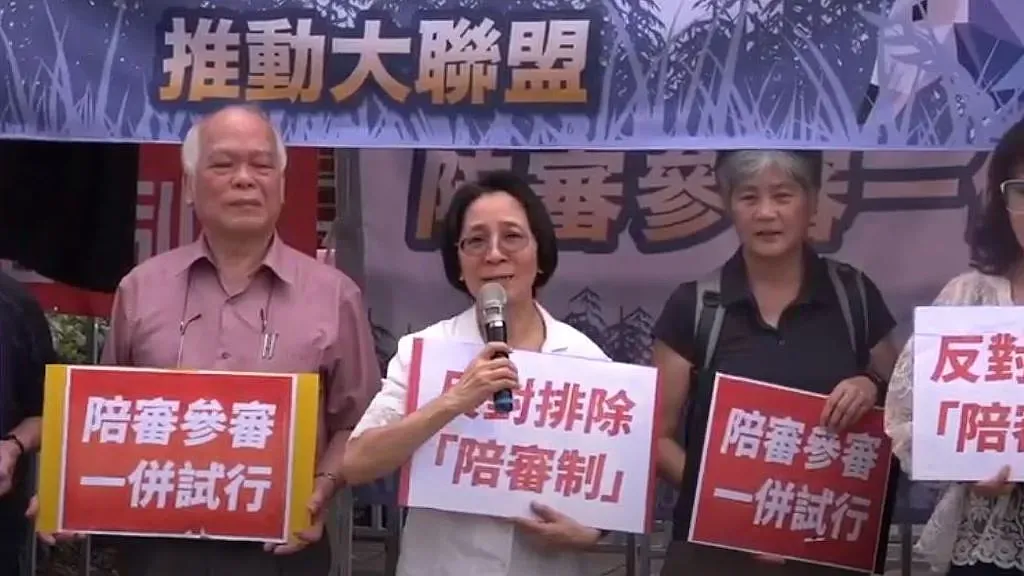
For Hsi Chin-p'ing, who causes people to mysteriously disappear, eliminating the jury system comes as a matter of course! This speculation has been boiling over in the public discourse markets of Hong Kong and Taiwan for a month, and has materialized with no surprises. Yet a president who constantly has Taiwan's democracy on her lips, who supposedly knows that democracy is Taiwan's brand, and whom the people thought knew that only democracy could save Taiwan, has echoed Hsi Chin-p'ing across the strait. At the very same time, during Hong Kong's most vulnerable democratic moment, despite repeated warnings from Hong Kong's legal professionals, she stubbornly and forcefully champions the pseudo-democratic lay participation system while bravely rejecting the true democratic jury system. In an instant, she aligns Taiwan with Hong Kong under Hsi Chin-p'ing's "exclusion of the jury system." Is this purely a coincidence? Is it a coincidence that Tsai Ing-wen does not care about?
Are Juries Unreliable Because Their Conviction Rate Is Lower?
It is said that President Tsai fears the jury system will have a lower conviction rate, for which the people will hold her accountable. Does she therefore believe that the people of Taiwan all hold that no one walking into a courtroom should ever walk out not guilty? Could it be that a higher number of citizens receiving not-guilty verdicts is something the Taiwanese people dislike? And is it something President Tsai believes should not happen? Otherwise, shouldn't she actively communicate with the public about the benefits of the Citizen Judges Act, just as she encouraged legislators to do? Once the people realize that a higher acquittal rate is normal and correct, why oppose the jury system merely because its conviction rate might be lower than that of the professional judge system? Surely President Tsai does not believe that too few Taiwanese citizens serving time in prison is a bad thing? Finally, if someone is innocent to begin with and is acquitted, pray tell, what is the problem?
A more logical guess is that President Tsai fears that acquittals in cases where guilt ought to be found would provoke public outrage. But the president does not personally try cases; how does she know whether a case inherently warrants a guilty verdict? Nor does the president necessarily understand criminal judgments; how does she know whether an acquittal was wrongful? If she knows none of these things, is her fear not simply unfounded? Naturally, like ordinary citizens, a president may experience unwarranted anxiety and fear born of ignorance about a given matter. Yet do citizens have an excuse to remain ignorant, and does the president have any legitimate reason to maintain her ignorance and subsequently reject sound policymaking based on ignorant fears?
According to the Judicial Yuan's version of the lay participation system, if all six lay assessors vote for acquittal, even if the three professional judges vote for conviction, the verdict can only be one of acquittal. In other words, this is completely identical to a scenario in the jury system where all jurors unanimously mistake a guilty party for an innocent one. Why can the lay participation system be forcefully championed while the jury system must be discarded?
Or does President Tsai believe that with those three professional judges guarding the gate, six lay assessors are less likely to reach such a unanimous erroneous acquittal? Yet if she trusts professional judges to serve as proper gatekeepers, let them try the cases themselves—what need is there to bring in lay assessors only to get in the way? So? Is the lay participation system truly intended merely to have lay assessors rubber-stamp the judges? Are the claims that judges can converse with the people, discuss cases flexibly with them, and that lay assessors can provide perspectives from different viewpoints all deceptive sweet talk?
Regardless of how absurd it is to champion the lay participation system with such logic, it appears that President Tsai's bottom line for reforming the adjudication system is that the conviction rate must not be lower than that under the professional judge system? Is this what DPP Legislator Chou Ch'un-mi (周春米) repeatedly means when she says that reform must conform to the status quo?
Does Conforming to the Status Quo Mean Offending Prosecutors and Causing the DPP to Lose Elections?
Does conforming to the status quo not simply mean refusing to reform? If the public were satisfied with the conviction rate of the current professional judge system, how could the phenomenon of persistently high distrust in the judiciary exist? Does President Tsai have even a shred of genuine understanding of public sentiment?
Who told President Tsai that adopting the jury system would result in an excessively high acquittal rate, and that if the acquittal rate were too high, the people would scold her? The judicial bureaucracy probably did not tell President Tsai that when Russia implemented the jury system—not due to public demand, but to join the European Union—its acquittal rate rose from an original 0.05% to 20%. Following this, 80% of citizens who had served as jurors believed the judicial system had improved. Although government officials and judges complained that juries acted on emotion, a relatively large number of people trusted the jury. Amidst widespread social controversy sparked by several murder cases resulting in acquittals, President Vladimir Putin—who also has a legal background and even promoted the jury system in military courts—made two notable remarks: "The problems arising in jury trials do not lie with the jurors, but with the lack of well-trained prosecutors and investigators." And: "This does not mean we are going to terminate the jury system; on the contrary, we are going to improve the operation of juries, vigorously strengthen the jury system, and safeguard the independence and personal safety of jurors." Does President Tsai believe that all Taiwanese people trust prosecutors' indictments to have a 100% success rate? Do they all believe prosecutors never fabricate miscarriages of justice?
Is not one of the most widely criticized judicial phenomena the fact that under the current system, prosecutors and judges are prone to systematic bias against defendants, with judges acting as prosecutors' hitmen in the courtroom to jointly deal with the accused? In such a courtroom, how could any defendant possibly survive?
Yet President Tsai assumes that the public welcomes this high conviction rate, and that if the jury system lowers it, the people will vent their anger on her?
Could it be that in President Tsai's eyes, being found guilty the moment one is indicted by a prosecutor is the only normal state of affairs? A high acquittal rate indicates abusive prosecution by prosecutors. If this is acknowledged, would it offend prosecutors and lead them to investigate vote-buying specifically targeting DPP candidates in the next election, thereby causing the DPP to lose? However, the DPP president dared not defy the wishes of prosecutors before, during, and after the National Communications on Judicial Reform. Prosecutors did not conduct special investigations into vote-buying targeting DPP candidates, yet the DPP still suffered a crushing defeat in the local elections of November 2018. On the contrary, DPP legislative by-election candidate Yu T'ien (余天) stated that the defeat was precisely due to the failure of judicial reform, a view that won the approval of many citizens. At a time when Han Kuo-yu's (韓國瑜) momentum was at its zenith and the entire DPP was in a state of mourning and low morale, Yu T'ien won and returned to the Legislative Yuan.
Could the DPP please earnestly confirm with their president whether a low acquittal rate is what the public detests, or what prosecutors detest?
The Issue of Acquittal Rates That Needs Clarification
What on earth does a so-called high acquittal rate mean? Empirical data shows that the conviction rate of juries is lower than that of professional judge systems because professional judges and prosecutors deal with criminals frequently and, due to the relatively rigorous professional ethics required in their social interactions, inevitably fall into narrow-lived experiences and blinkered perspectives if they fail to maintain self-vigilance, easily leading to systematic bias against defendants. Not long ago, the acquittal of cop-killer Cheng Tsai-yu (鄭再由) triggered social unrest whipped up by prosecutors, accompanied by fake psychiatric claims echoed by some political commentators—a classic manifestation of systematic prejudice. At the time of the murder, the victim was a young, responsible, and filial police officer, while the killer's media image was that of a tall, robust, impulsive, crude, and police-hating laborer. Media clamor created the illusion of widespread societal discontent. Even the legal-background president and premier—who hold supreme executive power—made erroneous political judgments, plunging momentarily into irrationality to utter highly inappropriate and judiciary-damaging remarks about someone with a tragic life story who had fallen through the safety net.
In contrast, jurors come from all walks of life, diverse life backgrounds, and various professional fields. The combined life experiences of all jurors far exceed those of individual judges and prosecutors. Furthermore, because individuals serve as jurors very few times in their lives, they do not suffer from institutional burnout. When facing the truth and the defendant, one can expect a broader and more accurate capacity for observation and interpretation. Compared to a single professional judge or a panel of three to five, jurors can be expected to be more capable of overseeing evidence inspection procedures and more likely to see through the narrowness and bias of the evidence presented by prosecutors. Moreover, an important psychological factor strengthens this oversight effect: jurors worry that sloppy evidence might one day be used against them, whereas judges and prosecutors rarely worry that they might end up sitting in the defendant's chair in a courtroom. The analysis of why jury conviction rates are generally lower than those of professional judges—yet not erroneous or untrustworthy—can be verified through empirical science, not mere intuition.
Using the acquittal rate to oppose the jury system is unconvincing to the general public, let alone intellectuals or even legal professionals. If legal professionals use the acquittal rate as an excuse to oppose the jury system, it truly damages their professional image. (To put it bluntly: Where on earth did they study law?)
Tsai Ing-wen, Who Does Not Believe in Democracy, Is Just Like Hsi Chin-p'ing
If someone is innocent and is acquitted, no one except the likes of Hsi Chin-p'ing should oppose it. Hearing that the jury system might have a higher acquittal rate causes President Tsai to feel an instinctive fear, whether misled by the judicial bureaucracy or out of her own lack of thought—either way, it makes her decision-making and judgment unconvincing. Dragging the kind and innocent people of Taiwan down with her further demonstrates that President Tsai fundamentally does not understand what the people of Taiwan are actually thinking.
The Hong Kong National Security Law excludes the jury system precisely because jurors, who represent the conscience of the people, are difficult to control, whereas professional judges or lay participation courts involving professional judges are much easier to control. Over the past period, Taiwanese judges—instigated by prosecutors—have frequently and loudly defended judicial independence outwardly. In reality, the most effective forces capable of intervening in judicial independence stem from within the system itself. Outwardly, if judges simply remain silent, no one can do a thing to them. When facing external pressure, as Secretary-General Lin Hui-huang (林輝煌) stated, judges are not that fragile (this was the single appropriate statement of his seen in the media over the past two months). Some people, seeking to curry favor with judges, treat them like a kindergarten class, claiming that judicial independence is extremely fragile. How could judges fail to see through such flattery? They know full well in their hearts that they are vulnerable when facing internal inducements within the system.
Let us ask again: are Tsai Ing-wen and Hsi Chin-p'ing the same kind of person? At the very least, they share the same view: juries are difficult to control, whereas professional judges and lay participation courts involving professional judges are much easier to control. They think alike, both intending to control the judiciary through executive power. Consequently, their fundamental attitude is also the same: a disregard for the separation of powers and a lack of belief in democracy!
※ Originally published in Storm Media on 2020-07-04
This article is an AI-generated translation of the original Chinese text. In the event of any discrepancy, the Chinese version shall prevail.