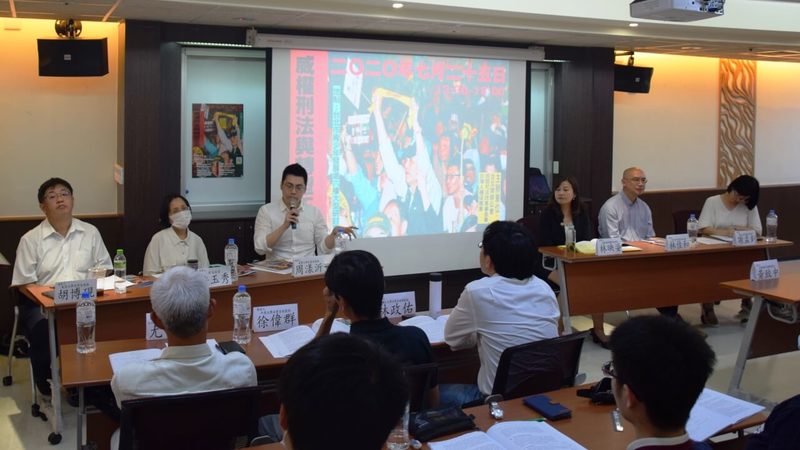
‱ Click the "" icon in the upper right corner of the video above to view the complete seminar video playlist.
The March 23 Executive Yuan occupation incident was decided in the second instance on April 28 this year, and protesters were sentenced to 2 to 4 months in prison for violating Article 153 of the Criminal Code, the "Offense of Instigation". More than 30 years have passed since Taiwan transitioned from authoritarianism to democracy. In our highly democratized contemporary era, we are still witnessing the police and prosecutor systems mobilizing state power to prosecute citizens for peacefully exercising their freedom of speech and assembly, arousing extensive discussion among legislators and academics. The definition and scope of the offense of instigation are overly broad and abstract, which may already impede people's freedom of expression in the democratic era. Legislators have even directly called on the Ministry of Justice to comprehensively review the "Authoritarian Criminal Law".
The so-called "Authoritarian Criminal Law" includes not only the "offense of instigation" in the current Criminal Code, but also Article 140 on the offense of insulting a public office and Article 160 on insulting the national flag, among others. In recent years, there has been no shortage of protesters being prosecuted under these criminal provisions when expressing symbolic speech.
The Taipei Bar Association, the Judicial Reform Foundation, and the Taiwan Association for Human Rights have long focused on the protection of rights such as assembly, procession, and freedom of speech in Taiwan. The abolition and amendment of "Authoritarian Criminal Law" concerns how state power suppresses people's freedom of speech and is closely connected to transitional justice. Therefore, it is necessary to invite criminal and public law scholars, official representatives from the Ministry of Justice, and practicing attorneys to jointly discuss and deliberate.

Opening Remarks
Guest Attny. Yu Po-hsiang / Convener of the 318 Anti-Black Box CSSTA Pro Bono Legal Team
Attny. Yu Po-hsiang delivered the opening remarks on behalf of the Taipei Bar Association. As the conceptual originator of this seminar's theme and the convener of the 318 Pro Bono Legal Platform, he shared his feelings on the streets during the 318 Movement and expressed his belief that it is time to seriously consider whether the offense of instigation—acting as a tool for rule or suppression to protect those in power—still needs to remain in our Criminal Code. Attny. Yu also emphasized that not only the offense of instigation, but many provisions enacted during the authoritarian period within the Criminal Code, should be comprehensively reviewed and discussed in the contemporary promotion of transitional justice, with the hope that this seminar will spark numerous ideas and carry over into subsequent legislative amendments.
Session I Starting from the Offense of Instigation
Moderator Hsu Yu-hsiu / Former Grand Justice
Grand Justice Hsu Yu-hsiu responded to Attny. Yu Po-hsiang's opening remarks, suggesting that the amendment of the current Criminal Code should not just be done piecemeal, but rather examined from an overall perspective, while paying attention to who participates in such amendments. Professor Hsu looked forward to the presenters and discussants explaining aspects such as the definition of authoritarian criminal law, legal interest theory, and constitutional review one by one.
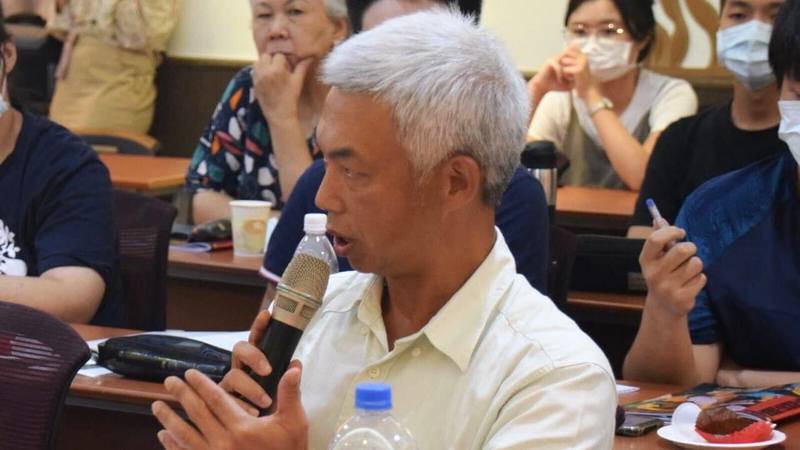
Presenter Hu Po-yen / Professor, Department of Law, Soochow University
Professor Hu Po-yen's presentation first traced the origins of the offense of instigation from the Tai-Qing Criminal Code, emphasizing that public order lies in ensuring the continued existence of the authoritarian regime. He further detailed the unconstitutionality of this provision. Regarding the principle of proportionality, he argued that the normative purpose of this provision is overly abstract and risks excessive infringement upon freedom of speech, and the types of conduct regulated by this provision also lack clarity, potentially failing to be foreseen by ordinary citizens. Therefore, this provision should at least be subject to a constitutionally restrictive interpretation.
Presenter Chou Yang-yi / Professor, Department of Law, National Taiwan University
Professor Chou Yang-yi's presentation first examined the justification of the offense of instigation. He argued that it is difficult to justify the offense of instigation based on the legal interests protected by the instigated crime itself; hence, this provision can only be justified by the independent infringement of the legal interest of public order. Among them, the so-called public order is a social consensus of a sense of security and stability of cognition. Under this spirit, the offense of instigation should be examined for constitutional interpretation by determining whether the conduct "releases criminal appeals," "triggers genuine criminal associations," "shakes cognitive stability," and "affects the willingness to participate in social interaction."
Discussant Lin Ying-tzu / Chief Prosecutor (Official Representative)
Prosecutor Lin Ying-tzu agreed with Professor Chou Yang-yi's constitutional interpretation framework regarding the protection of public order legal interests, and further illustrated potential occasions for applying the offense of instigation using practical examples such as the prevention of fake news or encirclement events initiated by netizens. On the other hand, Prosecutor Lin also emphasized that constitutional interpretation and legislative power are different issues, and the prosecution agency will endeavor to provide practical opinions for legislators' reference during the legislative amendment process.
Discussant Lin Chia-ho / Associate Professor, Department of Law, National Chengchi University (Academic Circle)
Professor Lin Chia-ho first summarized the arguments of the previous presenters and used the histories of countries like Poland and the Czech Republic to remind the audience that if the offense of instigation uses public order as its protected legal interest, this concept very easily falls into abuse. Professor Lin mentioned that given specific historical contexts and trajectories, the legal system cannot be entirely value-neutral. In judging violence and order in social movements, Europe has shifted its focus away from absolute formulas and toward more relative formulas and police order prevention. Taiwan should likewise rethink and rewrite the concept of public order in a context consistent with social perception.
Discussant Hsieh Meng-chao / Attorney, Yuan-Chu Law Firm (Practicing Attorney)
Attorney Hsieh Meng-chao contrasted the first and second instance judgments of the March 23 Executive Yuan occupation movement with the four criteria for teleological interpretation cited by presenter Professor Chou, questioning whether judicial practice in handling the offense of instigation follows formal textual interpretation and overly preempts criminal law. Attorney Hsieh cited other practical cases of the offense of instigation to illustrate that formal textual review is not an isolated incident. Under such extremely formal operation, anything from impossible crimes to other non-personal legal interest crimes has resulted in, or could result in, individuals being criminalized under the offense of instigation. Attorney Hsieh used this point to highlight that there are indeed many problems in the application of the offense of instigation.
FAQ Starting from the Offense of Instigation
#Scope of political speech
#Does the theory of tyrannicide count as political speech?
#Feasibility of operating the four criteria of constitutional interpretation
#Will abolishing the offense of instigation impact our sense of security?
Session II Starting from the Offense of Insulting a Public Office
Presenter Hsu Wei-chun / Associate Professor, Department of Law, Chung Yuan Christian University
Professor Hsu Wei-chun's presentation was divided into German law and Taiwan's judicial practice. Professor Hsu argued that insulting speech cannot cause damage to state power. Furthermore, through the evolution of the concept of insulting a public office in German law, he suggested that Taiwan does not need to emulate the offense of defamation of state organs under Germany's offenses against democratic rule of law, but should directly discard such criminal penalties. Regarding Taiwan's judicial practice, Professor Hsu observed that since 2014, Taiwan's courts have included more discourses on freedom of speech in judgments related to the offense of insulting a public office, indicating that democratic reflection is currently underway and should continue.
Presenter Lin Cheng-yu / Assistant Professor, Department of Law, Fu Jen Catholic University
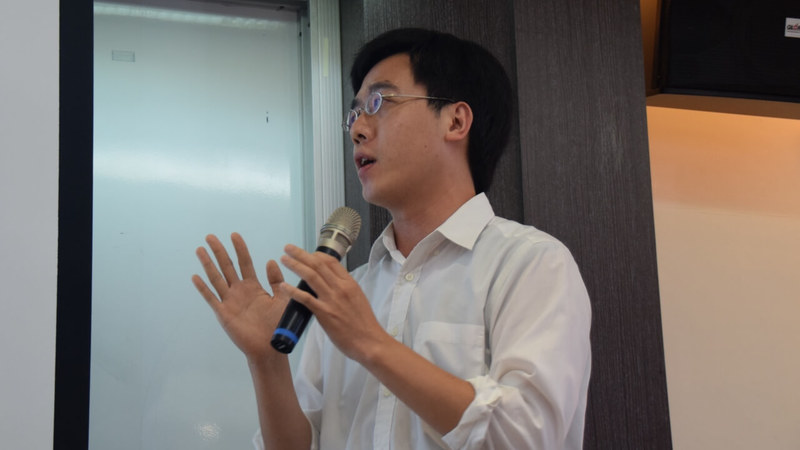
Professor Lin Cheng-yu examined the protected legal interests of the offense of insulting a public office and conducted an investigation into legislative history, discovering that the offense of insulting a public office in the Tai-Qing Criminal Code imitated the old French-style criminal code of Japan, with the second paragraph regarding insulting a public office being added at the beginning of the Qing Dynasty. However, whether the need to establish state prestige during the early rule of modern states persists to the contemporary era is questionable. Furthermore, Professor Lin analyzed the conflict between this offense and freedom of speech, and supported by comparative law from South Korea, argued that criminalizing this offense harms democracy and freedom. The legislature's intent to protect the prestige of public offices is insufficient for justification; conversely, if law enforcement officers embody procedural justice and distributive justice during enforcement, citizens will be more willing to cooperate.
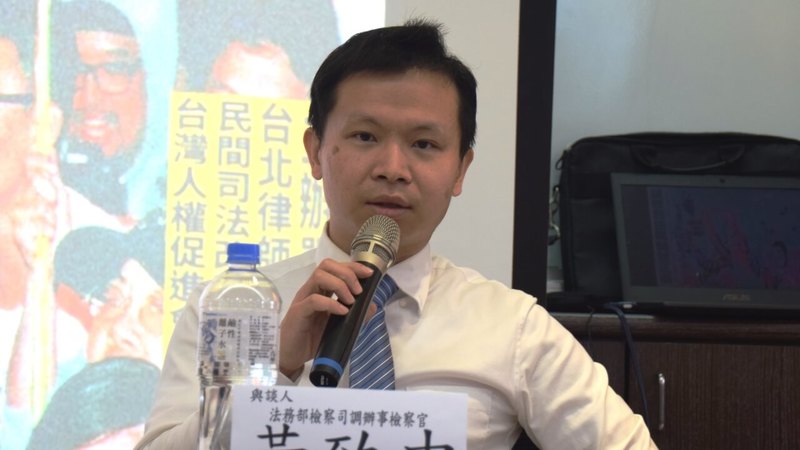
Discussant Huang Chih-chung / Prosecutor (Official Representative)
Prosecutor Huang Chih-chung attended to provide opinions today, not representing a specific position of the Ministry of Justice. He provided comments on the revisions of the two presenters' articles and concluded that he considers the abolition or retention of the offense of insulting a public office to be a political issue rather than a legal one, driven by different ideologies. Ideologies have no right or wrong dichotomy, and the law is merely an analytical tool; one must timely recognize individual limitations.
Discussant Su Hui-chieh / Assistant Professor, Department of Law, National Taiwan University (Academic Circle)
Professor Su Hui-chieh discussed the offense of insulting a public office from a constitutional perspective. Professor Su noted that the biggest problem with this provision lies in its legislative purpose. In this regard, Professor Su's view aligns with presenter Professor Hsu, similarly arguing that state organs do not enjoy the right to reputation protected by the Constitution, and for this provision to comply with the principle of the rule of law, it can only be restricted to the protection of the lawful and effective exercise of state power. Finally, Professor Su reminded the audience that "fake news" may be an unavoidable issue in the contemporary era when discussing how "speech undermines public trust in state organs."
Discussant Huang Yu-chung / Attorney, Yi-Yi Law Firm (Practicing Attorney)
Attorney Huang Yu-chung first explored the definition of authoritarian criminal law. Comparing the explanation of authoritarianism provided by the Transitional Justice Commission with the legislative history of the offense of insulting a public office, he pointed out the possibility that this offense is considered to possess authoritarian elements in the contemporary era. Returning to practical cases in Taiwan, Attorney Huang cited empirical research indicating that the application of this offense post-martial law has predominantly involved police law enforcement disputes, and it carries the potential to improperly restrict people's freedom of expression. Overall, he agreed with the presenters' conclusions that the offense of insulting a public office should be abolished.
FAQ Starting from the Offense of Insulting a Public Office
#Is the ideology behind the offense of insulting a public office a continuation of the authoritarian system?
#Does this count as authoritarian criminal law?
#Would changing it to the offense of defaming a public office be better?
#When invoking criminal law, one must pay attention to compliance with the principle of proportionality.