
JRF Newsletter
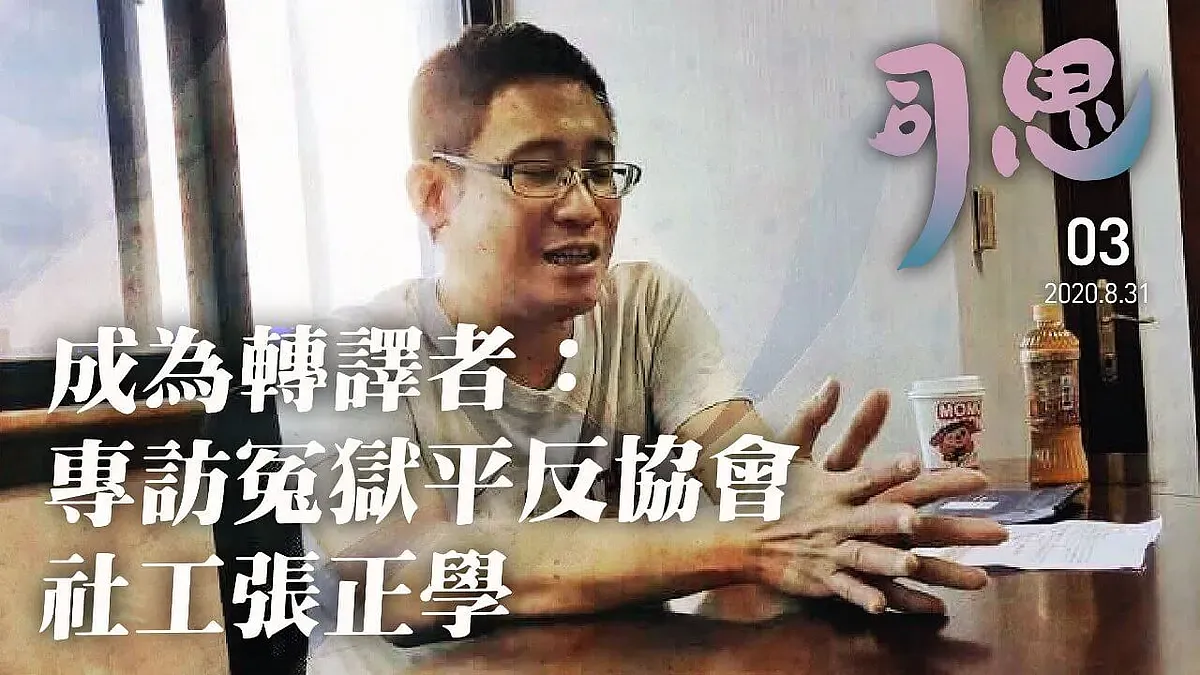
Becoming a Translator: An Exclusive Interview with Chang Cheng-hsüeh, Social Worker at the Taiwan Association for Innocence
Last edited: 2026-07-27
Chang Cheng-hsüeh, widely known as Ah-hsüeh, is a part-time social worker at the Taiwan Association for Innocence (TAI). Appearing youthful and energetic, he is actually a veteran social worker with nearly eleven years of experience advocating for the rights of HIV-positive individuals before joining TAI. Laughing, he remarked, "I'm quite old! But I've only changed careers twice in my entire life."
While the presence of social workers in social welfare organizations is far from rare, having a part-time social worker within a legal advocacy organization is uniquely characteristic of TAI. This naturally sparked our curiosity: Why did he become a social worker, and what led him to practice social work at TAI? What is his role in the wrongful conviction exoneration movement, and how does he manage to converse and collaborate with so many legal professionals in this field?
Becoming a Social Worker, Becoming Oneself
Recalling how he became a social worker, Ah-hsüeh shared that back in his high school days in Kaohsiung, opportunities to encounter social movements were scarce. The most crucial source of information was underground radio stations, which served as his "extracurricular independent study" and quietly laid the foundation for his future advocacy work.
"I was born in the Year of Wu-Wu (1979), so I'm in my 40s. When underground radio stations were flourishing and before they started peddling medicinal products, I was around junior or high school age. I began learning about social issues through those underground radio stations and even attended camps held by the Taiwan Association for Human Rights (TAHR)."
"My parents are teachers, and they were distressed and heartbroken that I wasn't good at studying. I looked obedient, but I simply couldn't get the hang of schoolwork. At that time, I started listening to the radio, and I would even write letters to the hosts. Eventually, a host asked if I wanted to host a segment for young people, which led to me becoming a show host. Later on, the people at the underground radio station would take me along to pre-record shows, and I would lie to my mother by telling her I was going to bookstore. As a high school student attending various gatherings, I began to understand what social movements were. I even met some of the 'grown-ups' from the founding era of the Taiwan Independence Party back then. I used to cry when hearing Chiang Kai-shek's birthday commemoration songs, but after listening to all sorts of alternative programs, I realized that the world was entirely different from what I had originally imagined."
Immersed in this novel understanding of the world, he gradually found a sense of identity and belonging. It was also through this process that Ah-hsüeh figured out he wanted to become a social worker and dedicate his life to these issues.
"I have many issues of interest, but I simply chose one closely connected to myself. To me, it felt quite natural. I came to understand social issues through my identity as a gay man, and in that process, I met other HIV-positive individuals. I believe I've been able to sustain HIV advocacy work for so long because I met these friends and entered this community. These people have all looked after me, and the real lives of HIV-positive individuals I witnessed were completely different from the depictions in newspapers. Therefore, those media portrayals couldn't influence me. These organizations and people have become tightly bound together with me in this way."
Calling a Time-Out: Anxiety and Frustration of a Veteran Social Worker
Throughout this brief interview, as he reflected on his past encounters with social movements, social work, and the HIV sector, Ah-hsüeh's sense of identity and emotional attachment were palpable. This, however, made us all the more curious: what caused him to interrupt his work in the HIV field and become who he is today?
When faced with our question, he shared with us with utmost sincerity. Rather than a meticulously planned career move, his transition was more akin to facing a severe life challenge.
At the time, he had already served as a frontline social worker for over a decade. While he had accumulated a certain level of professional expertise in casework, he was entirely unfamiliar with managerial roles. Because he naturally held himself to high standards and was thus prone to anxiety and nervousness, being tasked with organizational leadership and management triggered a massive physical and mental crisis. The accumulated panic, resembling an overwhelming storm, enveloped him. Burdened by internal and external trust and expectations, a strong sense of mission regarding his service work, and high self-expectations, his failure to complete critical tasks left him feeling utterly frustrated and panicked.
"I used to take that stack of documents home with me every single day, only to bring it back to the office the next day completely untouched. Until one time, when a report was due the following day, I realized at three o'clock in the morning that I had been so anxious I hadn't moved a single character. In a panic, I called all my colleagues—of course, no one answered my phone at three in the morning—until six o'clock, when someone finally answered, and I told them, 'I can't finish this.' I was at the office by five or six in the morning, sitting in a small room, shivering continuously," Ah-hsüeh blurted out, finishing the story in one breath.
"I've always been prone to nervousness, but it was then that I truly realized I might actually be experiencing a real condition." As helpers, social workers are always assisting others in perceiving and confronting the issues in their own lives and accompanying them through life's storms. Yet, social workers are human too, and they have their own issues to face. Procrastination or the inability to finish tasks were merely the outward manifestations of his emotional distress, forcing the Ah-hsüeh of that time to turn inward and confront his own stress and helplessness.
While describing this incident, we could sense that he was exceedingly hard on himself. This harsh self-criticism turned his misstep into trauma, plunging him into a low valley where he found it difficult to work with ease and comfort.
"I felt ashamed. Even to this day, I still feel that way. I've been with the organization for so long and have deep emotional attachments to it; that was all I could think about back then. This matter has stayed lodged in my heart, and to this day, I still harbor this sense of guilt toward the organization."
No matter how veteran a social worker may be, there comes a time when they need to hit the pause button. Thus, after eleven years in the HIV sector, he called a time-out.
Changing Tracks and Entering TAI
"I've been in the HIV field for so long; where on earth can I go now?" This was the immediate question Ah-hsüeh faced after leaving the HIV sector.
Although wrongful conviction exoneration work might seem to have no intersection with HIV advocacy at first glance, Ah-hsüeh had actually accumulated considerable experience working with inmates while handling correctional facility cases.
"My interest in correctional facilities stemmed from when I first started doing HIV work. I thought I would be serving a community of gay men, but because it coincided with the peak period of HIV infections caused by shared needles in correctional facilities, I unexpectedly often had to conduct health education inside prisons, targeting heterosexual men much older than myself. Having just completed my military service and being only in my early twenties, that was the first time I realized how tiny prison cells were and how many people were crammed into them. That was how I began to understand what correctional facilities were like."
For a young Ah-hsüeh whose social circle of HIV-positive friends consisted mostly of gay men, entering correctional facilities to serve older heterosexual men with HIV was a formidable challenge.
"I felt that the distrust behind their attitude towards me was actually because they didn't believe anyone would genuinely treat them well."
Ah-hsüeh shared that he built relationships with these older inmates by walking from cell door to cell door, chatting and "bonding" with them, and conducting long-term visits to understand the stories buried behind each individual case. Only after establishing this relationship could he actually roll out health education and provide information. Spending time with these incarcerated inmates built up Ah-hsüeh's understanding and perspective on correctional facility issues, which serendipitously provided nourishment when he transitioned to a new professional field.
After resigning, he happened to catch an open recruitment for a part-time social worker at TAI. Taking stock of his past experiences—visiting correctional facility cases, accompanying infected individuals in filing grievances, and fighting for their right to work—and feeling that collaborating with legal professionals would not be entirely unfamiliar, coupled with a certain degree of understanding and trust in TAI's executive director, he decided to join TAI as a part-time social worker.
The Importance of Social Workers in Wrongful Conviction Rescue Organizations
While TAI's secretariat comprises professionals from various disciplines, lawyers still make up the majority of participants in case rescues. Ah-hsüeh's mission at TAI focuses on providing care services to innocent individuals.
"When I came here, I knew I would be working with a group of legal professionals. I feel that people inadvertently draw a line between legal and non-legal, splitting things into a litigation department and a public relations department. When I arrived, I wondered which department I belonged to. At the Taiwan AIDS Foundation, I also did a lot of legal-related work, but we didn't divide ourselves into departments; after all, we were simply a group of social workers. Although we might have different titles, our essence is that of social workers. Some might think, 'Oh, you do care work for the innocent, so that has nothing to do with the law,' but in reality, it is very difficult to separate the two."
Such divisions between legal and non-legal spheres are quite common in legal advocacy organizations. Aside from internal boundaries drawn by division of labor, clients naturally harbor different expectations as well. Ah-hsüeh shared that, compared to discussing their daily lives, innocent individuals often care far more about the progress of their legal cases. As a newcomer to the organization, Ah-hsüeh felt that his legal expertise fell short of a lawyer's and his knowledge of the case details was limited, which initially left him struggling to find an entry point to build a care relationship with clients, causing him a degree of frustration.
"Probably because I'm a part-time worker, I wasn't initially required to attend every case review meeting. I was also somewhat afraid that the discussions in those meetings would be overly professional and sound like 'a duck listening to thunder' [incomprehensible]. But later on, I felt something was amiss because I didn't quite know what I could actually do, and for a while, I found it quite painful and difficult to intervene. However, through organizing certain activities, I gradually got to know these individuals. Nowadays, I also participate in the legal team meetings for the cases I handle. After attending them, I realized it makes a difference, because I can find out where the current legal progress stands. This enables me to provide progress updates regarding what the clients care about the most, and even explain the judicial progress to them in terms they can understand, which then allows me to follow up with the services I can provide."
Wrongful conviction exoneration is an arduous journey filled with uncertainty and no visible end in sight. The expectations, struggles, pain, or disillusionment experienced by innocent individuals during the exoneration process may not even be consciously recognized by themselves, or they might brush them off as unimportant. Yet Ah-hsüeh believes that innocent individuals also yearn to have their voices heard or to vent the frustrations ("a-za") accumulated throughout their litigation journey; emotions that they have no outlet for—or feel embarrassed to burden their lawyers with—need someone willing to receive and hold them.
"Our care and services help provide an outlet for these individuals. This also assists legal professionals in communicating more effectively when working alongside innocent individuals, allowing them to walk this path together with strength. Good collaboration between social workers and legal professionals helps facilitate this process."
Beyond the dimension of "assisting" legal rescue work, for Ah-hsüeh, caring for the immediate suffering of innocent individuals holds intrinsic value in its own right.
"TAI engages in wrongful conviction exoneration, but the exoneration process is simply too long, and we never know when exoneration will actually happen. Even for those whose retrials have been granted and who have been released, their lives aren't necessarily going well. In fact, many people might still feel unable to be happy even after exoneration because those years have already passed. Regardless of the stage they are at, what social workers hope to see is that, at the very least, their lives in the present moment can be a bit more stable, a bit better, or a bit smoother. Even though their cases are constantly waiting for exoneration, if their present suffering can be seen and addressed, we still want to ask: can we ensure that what these years leave behind isn't just pain?"
We then asked Ah-hsüeh whether he found anything particularly fulfilling during his interactions with so many legal professionals, or conversely, what difficulties he encountered.
"After joining the legal team meetings, I later found out that it wasn't as difficult as I had imagined. I could understand what the lawyers intended to do next, unlike the painful experience I had anticipated. What I found particularly heartwarming was that legal team meetings still allowed room to voice doubts and put forward ideas." The law can actually be comprehensible; within the organization, non-legal personnel, including social workers, strive to keep up with these dialogues. Looking at it from the reverse perspective, however, helping legal professionals understand the content and importance of social work once caused Ah-hsüeh considerable distress.
"I feel what needs to be communicated to legal professionals is that care and concern involve steps and methods grounded in social work training, even if they cannot be articulated as clearly as laws or statutory clauses. For instance, we really dislike it when people say social workers are simply full of love and compassion, because slapping that label of 'love' on us implies that as long as you have love, anyone can do this job, thereby ignoring our professionalism. Sometimes, social work conversations resemble casual chatting, but they actually serve a purpose. If legal professionals feel we are merely dropping by to 'show a bit of care,' it leaves us feeling deeply frustrated. I am also practicing how to let people trained differently from me know what I do, and what social work is all about."
Ah-hsüeh shared several approaches he has tried.
For example, regarding letter statistics, TAI previously divided letters into litigation-related ones, while non-litigation letters were classified simply as care letters. He advocated for presenting the fruits of this labor in work reports as well, especially since many volunteers are invested in it. Ah-hsüeh noted, "Writing it down specifically shows that we are doing this work and that we care about it."
Another example is how Ah-hsüeh organized volunteer gatherings, making the previously informal innocent care services more structured. Through the sharing of veteran volunteers, he consolidated the momentum of the volunteer group, sustaining the knowledge and skills developed at the grassroots level of innocent care services. All of these contribute to helping the organization directly understand the functions of social work.
"Although we already had visitation record sheets, I found that before I came, people would simply fill them out and upload them to the community platform. Now, I lay out clearer items to tell volunteers what needs to be done, and I insist that volunteers must hold meetings. I'm still somewhat old-fashioned; I believe getting together in person is important. In the past, people would finish a visit, toss it into an online chat group, and that was the end of it. There was zero room for discussion, but discussion is crucial. After a visit, people invariably have doubts, but without discussion and the atmosphere it brings, experiences cannot be sustained, nor can strengths and weaknesses be corrected."
"Currently, we hold group supervision sessions about once every three months. There are very few volunteers in central and southern Taiwan, but they have been persisting for a long time. We never had an opportunity to let them speak; they stay on out of genuine dedication, yet they feel very isolated. I believe this sense of isolation needs to be tended to, otherwise that lifeline will snap, and the precious experience they've accumulated over the years cannot be passed down. Some people may have sat with unresolved issues for years, yet they dared not speak up or lacked the opportunity to do so. Providing these volunteers with a shoulder to lean on is quite important, I feel. We held two sharing sessions this year where even I am more junior than them, yet they have developed many impressive skills. It would be a great pity if these experiences were never voiced."
In the future, he also hopes to further promote physical and mental care programs and attempt to invite innocent individuals to participate, enabling them to receive more comprehensive care services.
Balancing and Adapting to "Part-Time" Life: To Be Continued
Finally, Ah-hsüeh shared his thoughts on adjustment and transformation in his work. Early in his career serving HIV-positive individuals, because of his rich service experience in the HIV field and his deep empathy for their plight, Ah-hsüeh had attempted a so-called separation of public and private life, but this only caused him greater distress. Ultimately, he realized that a complete separation between work and life does not exist; only by knowing one's boundaries and providing services based on available energy could one gradually find joy and a sense of accomplishment in the work.
"Actually, the concept of a part-time social worker is very interesting. Service and a client's condition are continuous; a client's needs do not pause, so a social worker being part-time merely serves as a contrast to full-time status. In reality, however, each organization operates under different considerations."
Following court hearings or activities, having meals together with innocent individuals, their families, or lawyers was something Ah-hsüeh was not initially used to. "Dining together" was not a standard interaction he used to have with clients, yet at TAI, it is an important part of daily life. Deliberately avoiding such contexts would mean losing the opportunity for true understanding. In this new environment, Ah-hsüeh continues to practice helping others understand social work, while also learning to translate language across different contexts, striving to find his own balance and strategies.
Ah-hsüeh's journey of self-growth continues.
This article is an AI-generated translation of the original Chinese text. In the event of any discrepancy, the Chinese version shall prevail.
