
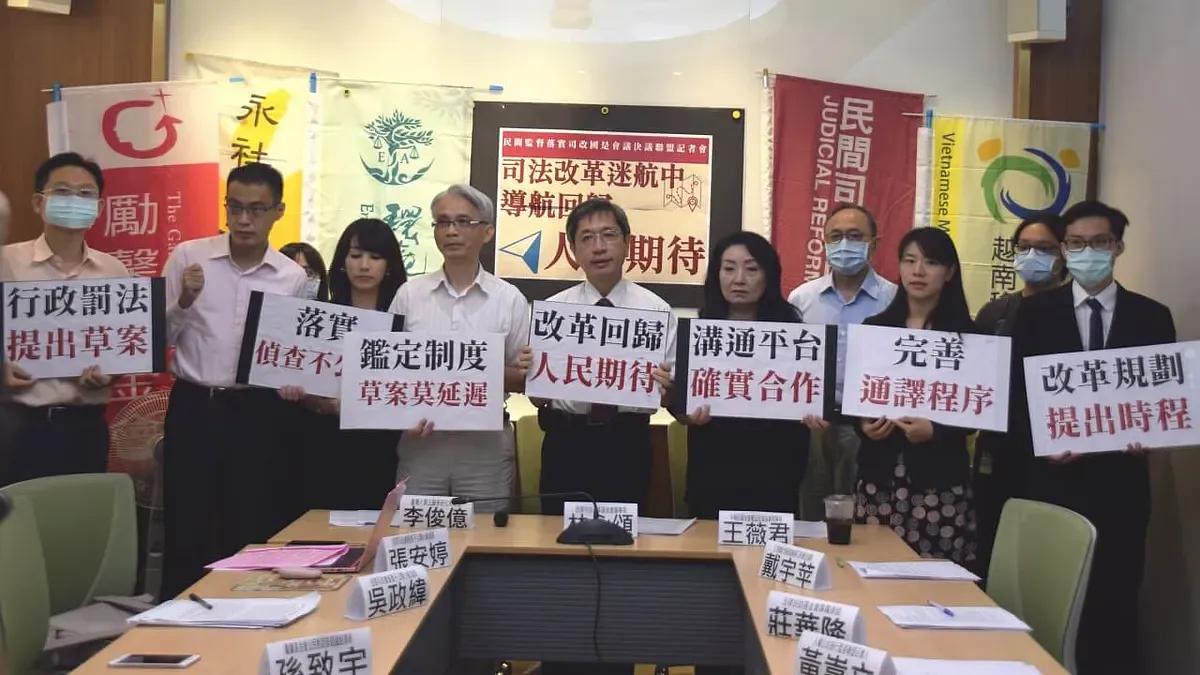
Judicial Reform Adrift, Navigating Back to the Public's Expectations: Press Conference Marking the Third Anniversary of the National Cornell on Judicial Reform
Last edited: 2026-11-03
Three years have passed since the conclusion of the National Conference on Judicial Reform in August 2017, yet public satisfaction with the judiciary remains sluggishly low. This is because the government has focused solely on advancing a handful of indicator bills, such as the Citizen Judges Act, while stalling on numerous other judicial reform issues vital to public welfare. Even the semi-annual judicial reform progress reports originally scheduled to be jointly issued by the Judicial Yuan and the Executive Yuan have failed to materialize. Judicial reform is akin to a fleet lost at sea, urgently in need of navigation back to the right course.
I. A Government Team Lacking a Direction for Governance
During President Tsai Ing-wen's first term, five semi-annual judicial reform progress reports were convened. While they grandly listed the implementation status of the 87 major resolutions and 303 sub-resolutions of the National Conference on Judicial Reform, they completely lost sight of governance priorities amidst minutiae, resulting in the sixth semi-annual report failing to be produced indefinitely.
From an implementation perspective, the Alliance has categorized judicial reform issues concerning public welfare into the following three groups, inviting alliance members to present reports on their respective fields: (See Attachments 1–9)
(1) Major Issues with No Drafts Proposed Yet
- Vulnerable Groups Issues: Including (1) Crime victim protection and restorative justice. (2) Interpretation and translation of the intent of judicial documents. (3) Judicial issues concerning Indigenous Peoples. Aside from the Crime Victim Protection Act, for which the Ministry of Justice is currently drafting a bill, no action has been seen on other issues.
- Forensic Science and Wrongful Conviction Relief: (1) National-level forensic science committee. (2) Common rules of evidence shared across criminal, civil, and administrative litigation. (3) The CCRC wrongful conviction special relief system. There is currently no progress; among these, a draft for the CCRC has already been formulated by civil society to lobby for advancement.
- Judicial Efficiency: (1) Prevention of frivolous litigation. (2) Strengthening of Alternative Dispute Resolution (ADR) mechanisms. There has been no progress on these.
- Judicial Transparency and Accessibility: (1) Open information in the attorney market. (2) Proposals for judicial sunshine and transparency. (3) Live-streaming of court trials. (4) Reform of judicial documents and legal language. (5) Reforms enabling parties and their attorneys to be informed of investigation progress and obtain information during investigations. There is currently no progress.
- Public Participation in the Judiciary: Supervision mechanisms for indictment, non-prosecution, and suspension of prosecution—the Prosecutors Review Board. Stalled at the Ministry of Justice.
- Judicial Specialization: (1) Transforming adjudicatory organs into judicial administrative bodies. (2) Mandatory legal representation by attorneys. (3) The system of non-concomitant transmission of case files and evidence (the "no-file-transfer" system). Still under study within the Judicial Yuan.
- Rule of Law Education: Strengthening civic legal education. No progress.
(2) Drafts Proposed, but Legislation Not Yet Enacted
- Judicial Specialization: Reviewing the appraisal system and perfecting the expert witness system. Under review by the Executive Yuan.
- Judicial Efficiency: The pyramidal structure for civil, criminal, and administrative litigation. Under review by the Judicial Yuan.
(3) Legislation and Amendments Already Enacted, Requiring Implementation
- Judicial Specialization: (1) Labor Incident Act. (2) Constitutional Court Procedure Act. (3) Commercial Incident Adjudication Act. (4) Attorney Regulation Act (professionalism, ethics, public interest). Implementation must be monitored.
- Public Participation in the Judiciary: Citizen Judges Act. Implementation issues need to be evaluated.
- Judicial Human Rights: (1) Prison Act and Custody Act. (2) Amendments to the Operational Regulations on Non-Disclosure of Investigation. (3) Public supervision of the judiciary. (4) Evaluation of judges and prosecutors (Judges Act). Implementation status needs to be monitored.
The Judicial Reform Foundation stated that issues of utmost concern to the public—such as enhancing judicial efficiency, rescuing wrongful convictions, and eliminating unfit judges and prosecutors—are receiving no advocacy or oversight. (See Attachment 1) Over the past year since its implementation, the Regulations on Non-Disclosure of Investigation have remained a dead letter, utterly failing to function. (See Attachment 2) To this end, the JRF has proposed a draft amendment to the criminal special relief system to respond to public expectations. (See Attachment 3)
The Garden of Hope Foundation stated that the progress tracking website for judicial reform is experiencing glitches, with the page reviewing child- and gender-friendly judicial systems displaying a "server error." Not only have semi-annual reports failed to appear, but conducting independent online inquiries is also impossible. As early as January 31, 2018, the Ministry of Health and Welfare petitioned the Executive Yuan to amend laws so that adult sexual assault reporting generally reverts to victim self-reporting, yet this has still not completed review. (See Attachment 4)
The Environmental Jurists Association stated that resolutions from the National Conference on Judicial Reform—such as the amendment to the Administrative Penalty Act to mandate government estimation of illicit gains, and the Civil Code explicitly stipulating the reversal of the burden of proof for torts arising from public nuisance disputes—have yet to see proposed draft amendments, with progress falling severely behind. (See Attachment 5)
Professor Li Chun-yi stated that the forensic computed tomography (CT) system should be established within medical centers, combining various medical professionals to assist forensic appraisals, in order to guide the reform of the domestic forensic system. The draft amendment to the criminal procedure appraisal system urgently awaits accelerated review by the Executive Yuan. As for establishing a national-level forensic science organization to integrate resources and promote forensic science policies, along with other evidence custody, appraisal norms, institutional accreditation, and personnel licensing, there is absolute zero progress. (See Attachment 6)
Associationanya stated that major policies for sexual assault prevention, such as self-reporting by adult sexual assault victims and the reduction of repetitive statements, are seeing sluggish legislative progress. Furthermore, recent high-profile incidents—such as the shooting case involving internet celebrity "Guan-chang" and the legislators' corruption scandal—highlight problems with the ineffective enforcement of the Regulations on Non-Disclosure of Investigation, all of which urgently require improvement. (See Attachment 7)
The migrant NGO, the Catholic Diocese of Hsinchu Vietnam Migrant and Immigrant Office, stated that judges and lawyers fail to allocate time for interpreters to translate for parties, and sometimes even arbitrarily decide that interpretation personnel are unnecessary without consulting the parties' opinions. Even when it is known that a party does not understand Chinese, important information regarding court dates, how to file interlocutory appeals, and judgment results is presented exclusively in Chinese. These issues concerning the major rights and interests of the people have not been resolved. (See Attachment 8)
The aforementioned issues demonstrate that the government team's policy direction is vague and ambiguous, and resources are not being invested where they are most needed, causing judicial reform to achieve half the results with twice the effort and spin in place.
II. A Communication Platform Lacking Efficiency and Transparency
On March 27 of this year, this Alliance paid a visit to President Tsai Ing-wen. President Tsai stated that the government would strengthen communication platforms with civil society, implementing communication and dialogue mechanisms at the ministerial and cabinet levels respectively, to ensure the model and spirit of the National Conference on Judicial Reform are continuously upheld. However, following President Tsai's policy declaration, official quarters gave no response whatsoever.
It was not until August 12 and 19 that civil society received an official document from the Executive Yuan explaining the cooperation model for the communication platform and contact windows for various issues. The problem is that the document failed to propose major policies the government wishes to advance or priority bills it wishes to communicate with civil society about. As for the Judicial Yuan, it has yet to reply, passively boycotting President Tsai's policy declaration.
If government governance can combine both efficiency and transparency, it will win public affirmation; the epidemic prevention efforts against "COVID-19" this time around are the best demonstration of this. Yet on the issue of judicial reform, the procrastination and black-box operations of the Executive Yuan and the Judicial Yuan leave civil society at a loss as to what to do. The absence of a sound communication platform between officials and the public is the crux of why judicial reform cannot win public trust.
III. Returning Judicial Reform Policies to Public Expectations
The bureaucratic tactic to obstruct reform is to fragment issues, using cumbersome technical details to mask their intention to oppose reform. The five semi-annual judicial reform reports previously published by the Judicial Yuan and the Executive Yuan are the most typical illustrations of this.
We call upon President Tsai Ing-wen to thoroughly review this bureaucratic work style and avoid repeating such mistakes in her second term. President Tsai should reference civil society's constructive advice, take stock of judicial issues of public concern from an execution standpoint, grasp the overarching policy guidelines for promoting reform, and demand that her government team earnestly execute them. Only thus can the progress of judicial reform be advanced and genuinely respond to the earnest expectations of the people.
Attendees
Covenant Watch / Convenor Huang Sung-li
Associationanya / Secretary Peng Chih-ch'eng
Member of the 1st Division of the National Conference on Judicial Reform / Professor Li Chun-yi
ROC Association for the Promotion of Children's Rights / Chairperson Wang Wei-chün
Catholic Diocese of Hsinchu Vietnam Migrant and Immigrant Office / Specialist Tai Yü-p'ing
Chairman of the Judicial Reform Foundation / Attorney Lin Yung-sung
Non-Disclosure of Investigation Group, Judicial Reform Foundation / Attorney Chang An-t'ing
Non-Disclosure of Investigation Group, Judicial Reform Foundation / Attorney Wu Cheng-wei
Environmental Jurists Association / Chairperson Chang Yü-yin
The Garden of Hope Foundation / Specialist Sun Chih-yü, Advocacy Division, Citizen Dialogue Department, General Headquarters
Attachments
- Judicial Reform Foundation - Review of Issues from the National Conference on Judicial Reform
- Judicial Reform Foundation - Review of the Operational Regulations on Non-Disclosure of Investigation
- Judicial Reform Foundation - Draft Amendment to the Criminal Special Relief System
- Garden of Hope Foundation - Tracking Judicial Reform Progress
- Environmental Jurists - Recommendations on the Implementation of Judicial Reform in Environmental Legal Systems
- Professor Li Chun-yi - Tracking Status of Resolution Matters on Perfecting Forensic Science Issues
- Associationanya - Opinions on Sexual Assault Prevention and Non-Disclosure of Investigation
- Catholic Diocese of Hsinchu Vietnam Migrant and Immigrant Office - Opinions Regarding Interpreters
- Legal Aid Foundation - Protecting the Plight of Vulnerable Groups in the Judiciary
Press Contacts
Judicial Reform Foundation / Director of the Office, Hsiao I-min
This article is an AI-generated translation of the original Chinese text. In the event of any discrepancy, the Chinese version shall prevail.